AEO vs GEO: What’s the Difference and Why It Matters
Search is no longer just about rankings.
In 2025, discovery itself changed.
Shoppers are increasingly finding answers, product recommendations, and comparisons through answer engines and generative AI tools, not just traditional search results. Whether it’s a quick “best sunscreen for sensitive skin” query or a detailed “which diaper brand is safest for newborns” prompt, the path to visibility has shifted.
This is where two concepts are now reshaping digital marketing strategy:
- Answer Engine Optimization (AEO)
- Generative Engine Optimization (GEO)
While both aim to improve visibility beyond classic SEO, they solve very different discovery problems. AEO focuses on owning direct answers across platforms like Google’s AI Overviews, voice assistants, and featured snippets. GEO, on the other hand, is about training generative AI systems to recognize, understand, and cite your brand when users explore options through tools like ChatGPT, Gemini, or AI-powered shopping assistants.
For brands, especially in eCommerce, retail media, and quick commerce, this difference is no longer academic. It directly impacts:
- how products are discovered,
- which brands get mentioned in AI-generated responses,
- and who influences the shopper before the click even happens.
This blog breaks down what AEO and GEO mean in digital marketing, how they differ, and when brands should use each. More importantly, it explains why treating them as separate strategies can cost visibility in 2026, and how aligning both can create a durable discovery advantage.
What Is AEO in Digital Marketing?
Answer Engine Optimization (AEO) is the practice of optimizing content so that it appears as direct answers across search and voice-driven platforms. Unlike traditional SEO, which focuses on ranking pages, AEO focuses on being the answer.
In digital marketing, AEO helps brands surface in:
- Google featured snippets and AI Overviews
- Voice search responses (Google Assistant, Alexa, Siri)
- “People Also Ask” results
- Zero-click search experiences
When users ask clear, intent-driven questions, answer engines prioritize structured, concise, and authoritative responses. AEO ensures your content is written and formatted in a way these systems can easily extract and trust.
How AEO Works in Practice
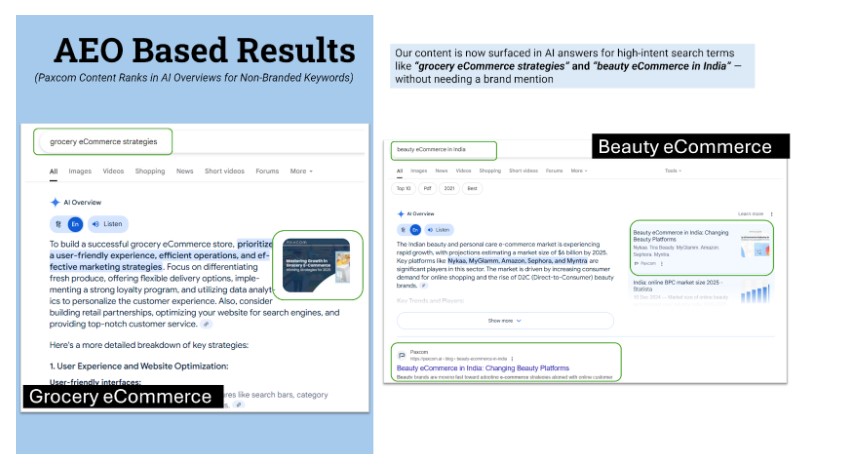
AEO relies on clarity and structure over depth alone. Brands that win at AEO typically:
- Answer specific questions directly
- Use simple, unambiguous language
- Structure content with clear headings, FAQs, and schema
- Align closely with conversational search queries
For example, a query like “what is AEO in digital marketing?” doesn’t need a 2,000-word article. It needs a precise definition, supported by context and credibility.
This is why FAQ sections, glossary-style explanations, and how-to content perform strongly in AEO-driven discovery.
AEO Use Case Example
A brand publishes a page answering:
- What is AEO in digital marketing?
- How is AEO different from SEO?
- Why does AEO matter for eCommerce brands?
If structured well, this content can appear directly in:
- Google’s AI-powered summaries
- Featured snippet boxes
- Voice responses without requiring a click
The benefit is immediate visibility at the top of the discovery funnel, even when users don’t scroll or click further.
Where AEO Fits Best
AEO is most effective when the user intent is:
- Informational
- Comparison-based
- Problem-solving
It works particularly well for:
- Definitions and explanations
- Buying guides and FAQs
- Category education pages
- Early-stage research queries
However, while AEO helps brands answer questions, it doesn’t fully address how AI systems form opinions, compare brands, or recommend products across longer conversations. That’s where GEO comes into play.
What Is Generative Engine Optimization in Digital Marketing?
Generative Engine Optimization (GEO) is the practice of optimizing brand content so it is understood, referenced, and recommended by generative AI systems such as ChatGPT, Gemini, Perplexity, and other large language model–powered answer engines.
While AEO focuses on answering a single query, GEO focuses on shaping how AI models talk about your brand, category, and products across multi-step conversations.
In digital marketing, GEO determines:
- Whether your brand is mentioned in AI-generated responses
- How accurately your products are described
- If your brand appears as a recommended option during comparison queries
- How consistently your messaging shows up across AI platforms
This makes GEO critical as users increasingly rely on AI assistants for research, evaluation, and decision-making, not just search
How GEO Works in Practice
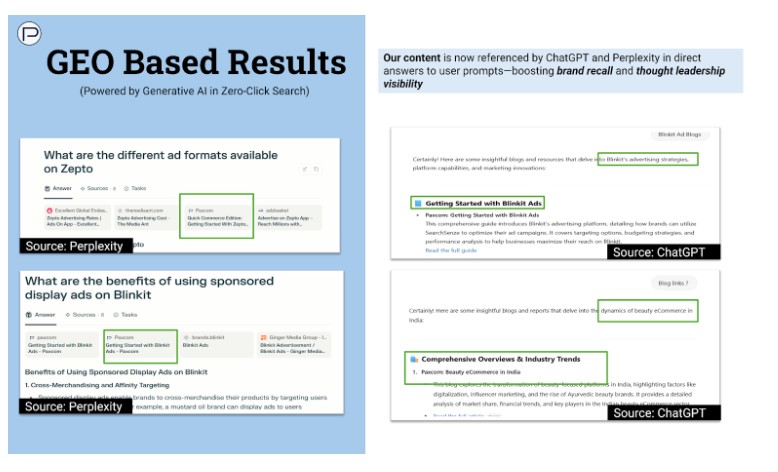
Generative AI engines do not simply pull one answer from a page. They:
- Synthesize information from multiple trusted sources
- Look for consistent signals across content, citations, and mentions
- Evaluate context, sentiment, and expertise
- GEO ensures your brand feeds these systems the right signals at scale.
Effective GEO strategies focus on:
- Clear brand narratives across owned and earned content
- Consistent product positioning and use-case clarity
- Structured, machine-readable information combined with expert depth
- Presence across authoritative third-party sources
Instead of optimizing for one keyword, GEO optimizes for topic authority and contextual relevance.
GEO Use Case Example
A user asks an AI assistant:
“What are the best eCommerce analytics platforms for enterprise brands?”
A GEO-optimized brand:
- Appears in the AI’s shortlist of recommended platforms
- Is described accurately in terms of capabilities and differentiation
- Is positioned for the correct audience and use cases
This happens not because of one optimized page, but because the AI has seen consistent, high-quality signals about the brand across multiple sources.
Where GEO Fits Best
GEO becomes essential when the user intent is:
- Exploratory
- Comparative
- Decision-oriented
It is especially powerful for:
- B2B and enterprise brands
- Complex products with longer buying cycles
- Categories where trust, credibility, and differentiation matter
- eCommerce platforms, SaaS tools, and data-driven solutions
In short, AEO helps you answer questions. GEO helps AI systems understand and recommend your brand.
AEO vs GEO: Key Differences Explained
As AI-powered discovery replaces traditional search journeys, brands are encountering two emerging optimization frameworks: AEO (Answer Engine Optimization) and GEO (Generative Engine Optimization).
While they are often grouped together, AEO and GEO serve fundamentally different purposes. Understanding where they differ and how they complement each other, is essential for modern digital marketing strategy.
AEO vs GEO: Side-by-Side Comparison
| Dimension | AEO (Answer Engine Optimization) | GEO (Generative Engine Optimization) |
| Primary Objective | Deliver precise, direct answers | Shape how AI models describe and recommend brands |
| Optimized For | Answer engines, featured snippets, voice assistants | Generative AI systems (ChatGPT, Gemini, Perplexity, Copilot) |
| User Intent Type | Single-question, immediate intent | Exploratory, multi-step, conversational intent |
| Content Format | FAQs, definitions, step-by-step answers | Structured narratives, entity-rich content, contextual explanations |
| Output Visibility | One-line answers or short summaries | Brand mentions, comparisons, recommendations, long-form responses |
| Role in Funnel | Top-of-funnel discovery | Mid-to-lower funnel influence and trust-building |
| Success Metric | Answer selection accuracy | Brand inclusion and narrative control |
AEO is designed to help AI systems answer specific questions clearly and quickly.
For example:
- “What is AEO in digital marketing?”
- “What is the difference between AEO and SEO?”
In these cases, AI systems look for highly structured, factual, and concise content. If your content is optimized for AEO, it gets selected as the answer.
GEO, on the other hand, operates at a broader and more strategic level.
It influences responses to queries such as:
- “Which platforms are leading AI-led commerce optimization?”
- “How should brands prepare for AI-driven discovery?”
Here, AI models are not just retrieving answers — they are generating perspectives, synthesizing multiple sources, and forming recommendations. GEO ensures your brand is part of that generated narrative.
AEO vs GEO: Content Structure Differences
From a content standpoint, the distinction is critical:
AEO content is:
- Question-first
- Modular and scannable
- Optimized for one clear intent
GEO content is:
- Topic-first
- Entity-driven and context-rich
- Designed to connect ideas across multiple queries
AEO helps AI systems answer correctly. GEO helps AI systems answer credibly and contextually.
AEO vs GEO Example in Digital Marketing
Consider the query:
“What is AEO and GEO in digital marketing?”
AEO-optimized content is likely to be used to define both terms clearly. Whereas, GEO-optimized brands are the ones AI systems may cite as examples, tools, or pioneers shaping these practices. This is where the strategic gap appears.
Many brands stop at being informative. Very few ensure they are referenced.
Why Brands Can’t Choose One Over the Other
AEO and GEO are not competing strategies, they are sequential layers of AI visibility.
AEO earns the answer, GEO earns the influence
In AI-driven ecosystems, winning visibility is no longer about ranking first, it’s about being understood, trusted, and consistently represented across AI-generated outputs.
AEO vs GEO Use Cases in Digital Marketing
What Is AEO Used For?
Answer Engine Optimization (AEO) helps brands win direct answers in AI assistants, search snippets, and voice responses.
Primary AEO use cases
- Explaining what something is (definitions, concepts)
- Clarifying how something works (features, processes)
- Answering specific, intent-led questions
Examples
- What is AEO in digital marketing
- What is digital shelf analytics
- How does retail media optimization work
Where AEO performs best
- FAQs
- Definition-led blog sections
- How-to and explainer content
- Voice and conversational search queries
Core AEO outcome: Your content becomes the selected answer, not just a search result.
What Is GEO Used For?
Generative Engine Optimization (GEO) helps brands appear inside AI-generated recommendations, comparisons, and narratives.
Primary GEO use cases
- Brand discovery inside AI responses
- Category and market exploration
- Tool, platform, and solution comparisons
- Strategic and trend-based queries
Examples
- Best digital shelf analytics platforms
- AEO vs GEO comparison
- How brands are preparing for AI-led commerce
Where GEO performs best
- Thought leadership blogs
- Trend reports and market analysis
- Comparison and positioning content
- Brand narrative and authority content
Core GEO outcome: Your brand is included, cited, and contextualized in AI-generated answers.
AEO vs GEO: Quick Use-Case Comparison
Aspect | AEO | GEO |
Optimizes for | Direct answers | AI-generated recommendations |
Query type | Specific, factual | Exploratory, comparative |
Content style | Structured, concise | Narrative, contextual |
AI behavior | Retrieval | Generation |
Visibility outcome | Chosen as the answer | Included in the response |
When and Why AEO vs GEO Matters for Brands
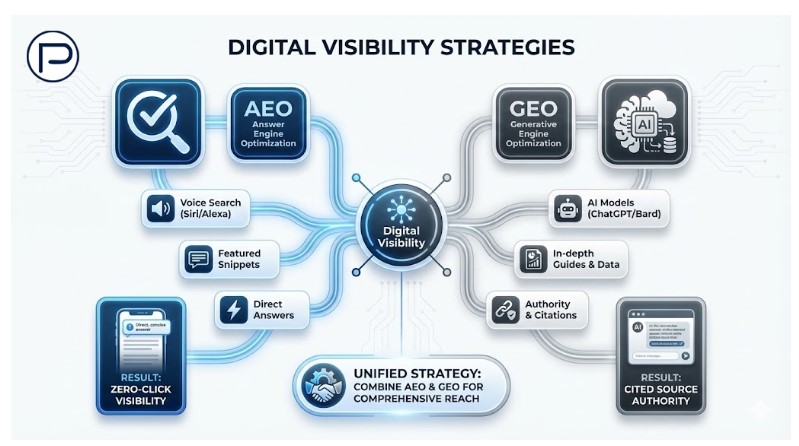
Answer Engine Optimization (AEO) matters when intent is clear and decisions are imminent. When users ask direct questions—what is AEO in digital marketing, what is quick commerce, how digital shelf analytics works—AI systems look for structured, authoritative answers they can trust. AEO ensures your brand is surfaced as that answer. Its value is efficiency: faster discovery, higher trust, and visibility at the exact moment intent peaks.
Generative Engine Optimization (GEO) becomes critical when intent is exploratory. For queries like AEO vs GEO, best eCommerce analytics platforms, or AI trends shaping commerce, AI doesn’t fetch one answer, it generates one by synthesizing multiple sources. GEO ensures your brand is part of that synthesized response. The value here is influence: shaping how AI frames the market, competitors, and strategic options.
For leadership teams, the distinction is simple. AEO captures demand. GEO shapes demand. AEO wins high-intent moments. GEO secures presence earlier in the decision journey, where preferences are formed and shortlists are built.
In 2026, brands that treat AEO and GEO as separate tactics will underperform. The winners will be those that deploy both deliberately, using AEO for precision and conversion, and GEO to influence AI-led discovery before the decision is ever made.
How Brands Should Operationalize AEO and GEO Together in 2026
Winning brands in 2026 will not choose between AEO or GEO. They will design for both, intentionally.
Operationally, this starts with clarity of role. AEO should be embedded wherever intent is explicit; FAQs, PDPs, category explainers, buying guides, and brand thought leadership that answers direct questions. This is where structured data, clear entity definitions, and authoritative answers matter most. The objective is precision: being the answer when the question is asked.
GEO, on the other hand, must be layered across strategic content and narratives—market outlooks, comparisons, trend analysis, platform explainers, and long-form insights. This content feeds generative models with context, relationships, and brand positioning. The objective here is influence: shaping how AI systems describe your category, your strengths, and your relevance before demand crystallizes.
The operational shift brands must make is moving from search-first optimization to answer-and-context optimization. Content, digital shelf data, competitive signals, and regional performance can no longer live in silos. AI-led discovery rewards brands that connect these dots consistently. This is where execution becomes the real differentiator.
How Paxcom Helps Brands Win Across AEO + GEO
Paxcom helps brands operationalize AEO and GEO as one connected system, not fragmented initiatives.
Through Kinator, brands gain always-on digital shelf intelligence—tracking visibility, availability, pricing, content quality, and competitive share across marketplaces and quick commerce platforms. These shelf signals inform what answers matter, where discovery is breaking, and which narratives AI systems are most likely to surface.
With GEO as a service, Paxcom structures brand and product narratives so they are discoverable, understandable, and usable by generative engines. This includes aligning content for AI answers, not just rankings, and ensuring brands show up in synthesized responses across AI-led discovery experiences.
On the activation side, Paxcom’s performance marketing and content teams ensure that AEO-optimized answers and GEO-led narratives translate into action across retail media, quick commerce, and marketplaces closing the loop from visibility to conversion. The result is not just better reach, but better decisions:
- Brands know where they are visible
- Why they are winning or losing discovery
- And what to fix before performance drops
The 2026 Readiness Test
If AI systems were explaining your category today:
- Would your brand be cited as the answer?
- Would it shape the narrative?
- Or would it be invisible?
In 2026, discovery will not wait for brands to catch up.
Those who prepare now by aligning AEO, GEO, digital shelf intelligence, and execution, will define the conversation. The rest will be summarized without them.
If you’re ready to operationalize AI-led discovery, Paxcom is already building where the shelf, search, and generative engines meet.Contact us at info@paxcom.net for more information.