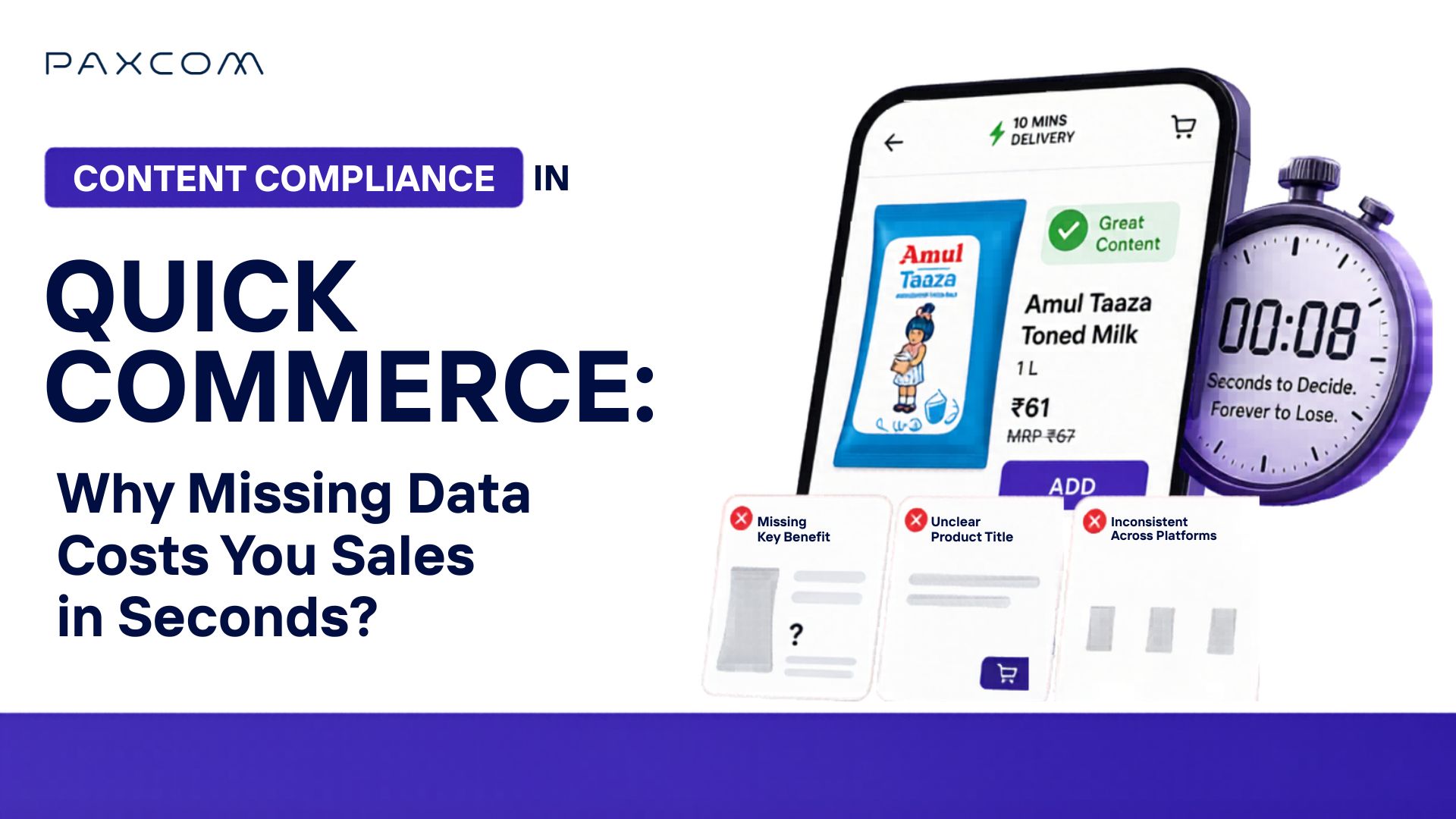
Struggling with content compliance in quick commerce? Learn how missing claims, specs, and product data gaps impact visibility and conversions across platforms like Blinkit, Zepto, and Instamart.
The 10-Second Decision
A user opens a quick commerce app to buy something simple. Maybe oats, a protein bar, or a face wash they’ve purchased before. They scroll through a handful of options and within seconds, the decision is made. There is no deep comparison, no reading through detailed descriptions, no switching between tabs to evaluate alternatives. Just a quick scan, a moment of recognition, and a choice.
Now here’s the part most brands don’t see. Your product was probably there. It showed up in the same list. It may have had the right price, even better reviews. But it wasn’t chosen.
This is the reality of quick commerce today. The India quick commerce market is estimated to reach USD 3.65 billion in 2026 and is projected to grow to USD 6.64 billion by 2031, according to Mordor Intelligence. This growth is being driven not just by expansion, but by a fundamental shift in how users behave, with faster adoption and increasing frequency of everyday purchases happening through these platforms.
But unlike traditional marketplaces, these decisions are not researched. They are made instantly. The sector continues to grow at a rapid pace, with estimates suggesting sustained double-digit growth and increasing user adoption across metros and emerging markets. And that changes everything.
In traditional eCommerce, product content supports decision-making. Users explore, compare, and evaluate before they choose. In quick commerce, product content becomes the decision itself. If a user cannot immediately understand what your product is, why it matters, and whether it fits their need, the opportunity is lost before it even begins.
This is where most brands run into a silent problem. They assume that accurate and complete product information is enough. But in an environment where decisions happen in seconds, completeness alone does not guarantee visibility, and visibility alone does not guarantee selection.
Because in quick commerce, it is not the most detailed product that wins. It is the one that is understood the fastest. And that is where content compliance begins to take on a very different meaning.
What Changes When Commerce Becomes Instant?
For years, brands have built their product content around how users behave on traditional marketplaces. The assumption has always been the same: give users enough information and they will make the right choice. Titles, bullet points, detailed descriptions, specifications, reviews, everything is designed to support a considered decision.
That approach works when users are willing to spend time.
But quick commerce operates on a completely different rhythm. Here, users are not exploring. They are not comparing multiple options or reading through product details. More often than not, they already know what they want, or at least the category they want to buy from. The role of content is no longer to educate or persuade over time. It is to confirm relevance instantly.
The shift toward quick commerce is not just being driven by consumers. It is being reinforced by the platforms themselves.
What began as a category led by a few specialized players has quickly expanded into a broader ecosystem.
Platforms like Blinkit, Zepto, Swiggy Instamart, and BigBasket have built their models around speed. Their entire experience is designed for immediacy, from limited assortment visibility to fast delivery and simplified decision-making.
But what is more telling is what traditional marketplaces are doing.
Players that were once built for deep browsing and long consideration cycles are now moving in the opposite direction.
Nykaa Now, Flipkart Minutes, Amazon Now, and Myntra Now are all early indicators of this transition.
These are not just new features. They represent a structural shift in how commerce is being delivered.
Redefining Content Compliance for Quick Commerce
Traditionally, content compliance has been defined by accuracy and completeness. As long as product specifications, claims, and attributes were correctly filled, a listing was considered compliant.
But in quick commerce, this definition starts to fall short.
A product can have complete backend data, accurate specifications, and well-structured attributes, yet still fail to perform. Not because the information is missing, but because it is not immediately visible or understandable.
This is where content compliance evolves from being a data accuracy problem to a visibility and decision-readiness problem.
If a user cannot make sense of your product within seconds, the system has technically done its job, but the content has failed.
This creates what can be called the 5-second compliance gap.
A product is compliant on paper, but non-compliant in practice.
The 5-Second Compliance Gap
In quick commerce, every product gets a few seconds of attention. That makes it critical to evaluate whether your content can pass a simple test.
The 5-Second Test
If a user sees your product for a few seconds, can they instantly understand:
- What the product is
- What makes it different
- Whether it is relevant to their need
If the answer to any of these is unclear, the product is effectively non-compliant in a quick commerce environment.
This is where most brands fall short. They optimize for completeness, but not for clarity. Key claims sit in descriptions, specifications are buried in attributes, and differentiation is not immediately visible.
In quick commerce, compliance is not about having the information. It is about making the right information impossible to miss.
The New Types of Content Compliance Gaps
As brands begin to audit their quick commerce presence, a different set of gaps starts to emerge.
- Invisible Claims: The first is invisible claims. These are not missing, but they are not visible upfront. A product might have strong selling points, but if they are not reflected in the title or primary image, they do not influence the decision.
- Delayed Specifications: The second is delayed specifications. Important details such as size, quantity, or variant are present but not immediately accessible. This creates hesitation and slows down the decision.
- Ambiguous Title: The third is ambiguous titles. Titles that are technically correct but not clear enough at first glance often fail to communicate what the product actually is or why it stands out.
- Inconsistency Across Platforms: Another common issue is inconsistency across platforms. The same product may appear with different titles, claims, or attributes across Blinkit, Zepto, or Instamart. This not only affects discoverability but also weakens brand recall.
- Finally, there is the issue of visual-content mismatch. Images do not always reflect the key claim or the most important product attribute. In a visual-first environment, this disconnect directly impacts click and conversion behavior.
Why Traditional Compliance Frameworks Fall Short?
Most existing content compliance frameworks were built for traditional eCommerce environments. They assume that users will spend time engaging with product pages, reading through descriptions, and evaluating specifications.
Quick commerce removes that layer of interaction.
There is limited time, limited screen space, and limited attention. Content does not get the opportunity to perform over time. It either works immediately or it doesn’t work at all.
This compression of the decision journey exposes gaps that were previously hidden. What could earlier be compensated by detailed descriptions or strong reviews now needs to be addressed upfront.
Also Read: Content Compliance Across eCommerce Marketplaces
Quick Commerce Content Audit Framework
Improving content compliance in quick commerce requires a different approach to auditing. Instead of focusing only on backend completeness, brands need to evaluate how content performs in real decision moments.
A simple way to approach this is through four focused checks.
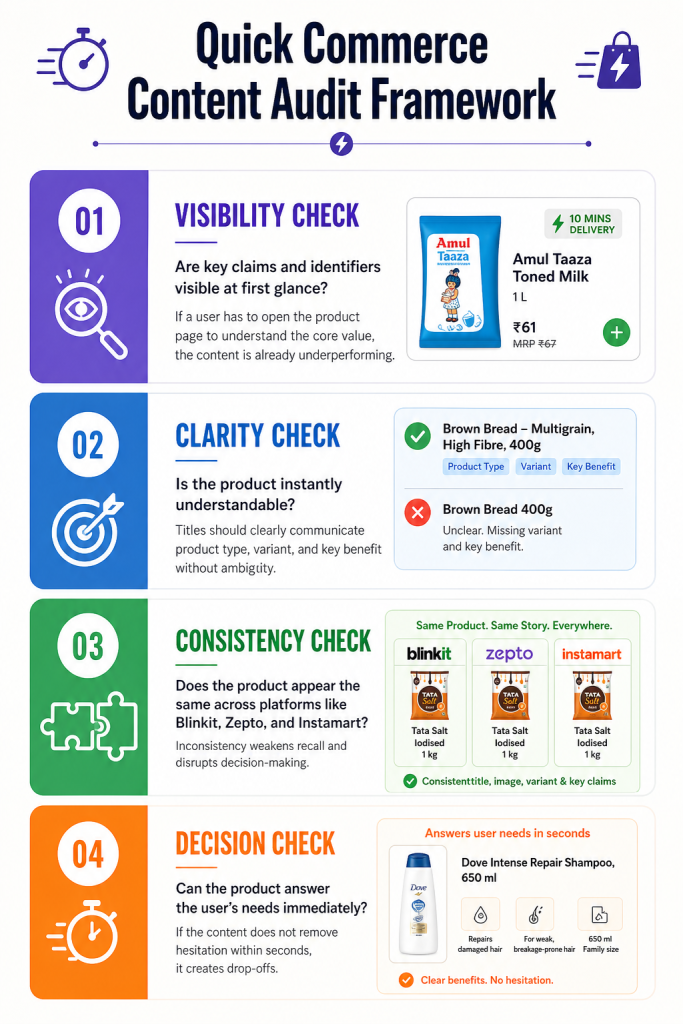
1. Visibility Check
Are key claims and identifiers visible at first glance? If a user has to open the product page to understand the core value, the content is already underperforming.
2. Clarity Check
Is the product instantly understandable? Titles should clearly communicate product type, variant, and key benefit without ambiguity.
3. Consistency Check
Does the product appear the same across platforms like Blinkit, Zepto, and Instamart? Inconsistency weakens recall and disrupts decision-making.
4. Decision Check
Can the product answer the user’s needs immediately? If the content does not remove hesitation within seconds, it creates drop-offs.
This framework shifts the focus from data validation to decision readiness, which is far more relevant in quick commerce environments.
Decision-Layer Thinking
Most content strategies are built around information layers. Titles, images, descriptions, and specifications are treated as separate elements.
Quick commerce requires a different lens.
Instead of asking “Is the information complete?”, the better question is “Does this content help the user decide instantly?”
This shift from information-layer thinking to decision-layer thinking is what separates high-performing products from those that remain unnoticed.
Signals That Your Product Is Being Ignored
Content compliance issues in quick commerce often surface through performance signals rather than operational checks.
Products that receive impressions but fail to generate clicks often indicate weak visibility or unclear positioning. Similarly, strong clicks with poor conversions may point toward missing or unclear specifications.
Inconsistent product performance across platforms can signal underlying content inconsistencies. Frequent manual corrections and listing updates often indicate deeper structural gaps in content management.
Recognizing these signals early helps brands address issues before they scale across the catalog.
Executive Perspective: What Our Quick Commerce Experts Are Seeing
To better understand what separates high-performing brands from the rest, we asked our quick commerce and performance marketing experts a few important question:
- What changes the most when content moves from traditional eCommerce to quick commerce?
- Which content gaps have the most direct impact on performance?
- Which metrics best reflect content effectiveness in quick commerce?
- Have you seen measurable lifts from improving product content?
Their responses pointed to one clear reality. Quick commerce has fundamentally changed the role of product content.
Unlike traditional marketplaces, where shoppers compare, research, and deliberate, quick commerce is built around urgency and habit. Decisions are made in seconds, often directly from search results, category pages, or repeat purchase journeys. In many cases, the product image, title, and price do nearly all the selling.
This shift places enormous strategic importance on content quality. Thumbnail visibility becomes a growth driver. Pack size, variant clarity, and primary claims must be instantly recognizable. If shoppers need to click to understand the product, conversion friction has already been introduced.
Our experts consistently identified three metrics as the strongest indicators of content effectiveness: Click-Through Rate, Add-to-Cart Rate from Search, and Search Visibility. Together, these metrics reveal whether content is discoverable, persuasive, and conversion-ready.
The performance upside is significant. Across categories, seemingly small optimizations such as restructuring titles, improving hero image clarity, or surfacing key product benefits, have delivered double-digit lifts in engagement and conversion.
The larger takeaway is impossible to ignore. In quick commerce, content is no longer a support function. It is a commercial lever. Brands that elevate content from an operational checklist to a strategic growth priority will be best positioned to win in the next phase of digital retail.
| A Simple Playbook to Get Started: Improving quick commerce content does not always require large-scale changes. In many cases, small but focused improvements can make a measurable difference.Start by ensuring that key claims are visible in the title or image. Simplify titles to make them easier to scan and understand. Align visuals with the most important product attributes. Maintain consistency across platforms, and continuously monitor performance to identify gaps early. |
How Paxcom Helps Brands Bridge the Gap?
As brands transition from traditional marketplaces to quick commerce, the challenge is no longer just managing product data. It is ensuring that product content is decision-ready at scale.
Paxcom helps brands identify and fix visibility gaps across platforms through structured digital shelf monitoring and content intelligence systems. By connecting product data with performance signals, brands can move beyond compliance and build content that drives measurable outcomes.
Paxcom’s 360° Campaign Management Approach
Quick commerce doesn’t operate in silos. Product content, visibility, and campaign performance are tightly interconnected. Yet most brands continue to manage them separately.
That’s where gaps begin to appear.
At Paxcom, we take a 360° approach to campaign management, where content compliance is not treated as a checklist, but as a performance driver.
We help brands move beyond fragmented execution by connecting:
- Content intelligence: Identifying missing claims, unclear titles, and visibility gaps across platforms
- Digital shelf monitoring: Tracking how products appear and perform across Blinkit, Zepto, Instamart, and more
- Campaign optimisation: Aligning product content with ad performance to improve CTR, conversions, and ROI
- Cross-platform consistency: Ensuring products maintain clarity and positioning across all quick commerce touchpoints
This integrated approach ensures that your campaigns are not just well-funded, but also decision-ready.
Because in quick commerce, even the best campaigns cannot compensate for unclear content.
Final Words
Quick commerce is not just changing how products are delivered. It is changing how products are chosen. In this environment, content does not have the luxury of time. It needs to be clear, immediate, and effective. Because in the end, the fastest product does not win. The clearest one does.
If your products are getting visibility but not conversions, or if performance varies across platforms, it may not be a demand problem. It may be a content compliance gap.
Paxcom helps you identify, fix, and scale what truly drives performance.
📩 Request a quick commerce content audit: info@paxcom.net
Frequently Asked Questions