
Over the last decade, online retail has evolved from being an “additional channel” to becoming the primary growth engine for most brands.
Marketplaces, direct-to-consumer platforms, and social commerce have significantly lowered the barrier to entry. Today, almost any brand can launch online, reach customers across geographies, and scale faster than traditional retail models ever allowed.
However, this accessibility has also made the ecosystem more complex.
Brands are no longer competing only on product or price. They are competing on:
- Visibility across platforms
- Consistency of product information
- Speed of execution
- Customer experience across multiple touchpoints
This is where online retail strategies become critical.
In 2026, success in eCommerce is no longer driven by isolated efforts. It depends on how well a brand aligns its sales strategy, omnichannel marketing efforts, and execution capabilities.
Table of Contents
What are Online Retail Strategies?
Online retail strategies refer to the structured approaches businesses use to drive product visibility, customer engagement, and sales growth across digital channels.
A strong strategy is built on three interconnected pillars:
- Sales Strategy – How a brand drives revenue through pricing, assortment, and positioning
- Omnichannel Marketing – How a brand ensures consistent presence across marketplaces, social platforms, and owned channels
- Strategy and Execution Alignment – How effectively plans are implemented across systems, teams, and platforms
While many businesses focus heavily on strategy, it is the alignment between strategy and execution that ultimately determines performance.
The Changing Nature of Online Retail in 2026
The way consumers discover and purchase products has changed significantly.
Earlier, the path to purchase was relatively linear, customers searched for products, compared options, and made a decision. Today, that journey is far more dynamic.
Customers:
- Discover products through social content and recommendations
- Validate choices across marketplaces
- Compare pricing instantly
- Expect accurate and consistent information across platforms
At the same time, marketplaces and platforms have evolved into closed ecosystems, where algorithms determine visibility based on factors such as:
- Product content quality
- Pricing competitiveness
- Availability
- Customer feedback
This shift has made it clear that execution quality directly impacts growth.
Why Strategy Alone Is No Longer Enough?
Many eCommerce businesses already have well-defined strategies.
They invest in:
- Advertising campaigns
- Product content optimization
- Pricing strategies
- Analytics tools
Yet, growth often remains inconsistent.
This happens because these efforts are typically executed in silos.
For example:
- Marketing teams focus on traffic generation
- Content teams optimize product listings
- Operations manage inventory and pricing
While each function performs well individually, the lack of coordination leads to gaps such as:
- Traffic being directed to poorly optimized product pages
- Pricing inconsistencies across platforms
- Stock availability issues affecting conversions
In such cases, the issue is not the absence of a sales strategy, but the disconnect between strategy and execution.
7 Key Online Retail Strategies for Sustainable Growth
To scale effectively in 2026, businesses must adopt a more integrated approach.
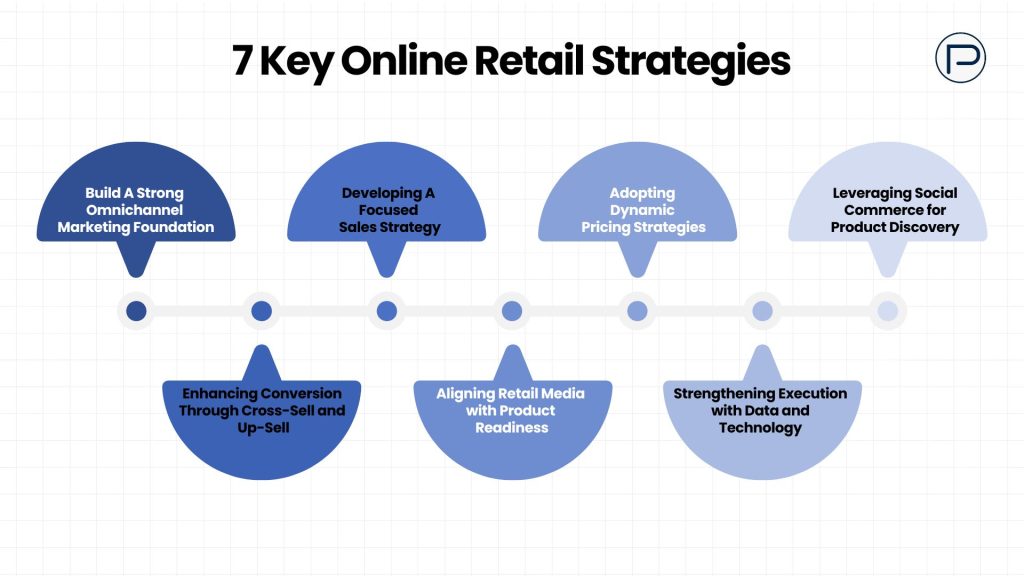
1. Building a Strong Omnichannel Marketing Foundation
| A customer discovers a product on Instagram at a discounted price. They click through to a marketplace listing, but the price is different, the images don’t match, and key product details are missing.The result?Confusion. Drop-off. Lost sale. |
An effective omnichannel marketing strategy ensures that customers experience a seamless journey across all touchpoints.
This includes:
- Maintaining consistent product data across marketplaces
- Aligning messaging across social, search, and retail platforms
- Enabling flexible purchase options (e.g., buy online, pick up in-store)
The goal is not just presence across channels, but consistency and continuity in the customer experience.
2. Developing a Focused Sales Strategy
| A brand expands aggressively across multiple categories on a marketplace, assuming more assortment will drive more sales.Instead, they notice:Low visibility across most SKUsWeak conversion ratesHigh dependency on adsMeanwhile, a smaller subset of products consistently performs well, but receives the same level of attention as the rest. |
A well-defined sales strategy is essential for prioritizing efforts and maximizing returns.Rather than trying to cater to all segments, businesses should:
- Focus on high-performing categories
- Align product offerings with marketplace strengths
- Understand customer demand patterns
This approach helps improve conversion rates while reducing unnecessary operational complexity.
3. Adopting Dynamic Pricing Strategies
| Two sellers offer the same product. One updates pricing dynamically based on competitor movements. The other sticks to static pricing. Over time: The dynamic seller wins better visibility gains higher conversions. Moves inventory faster |
Pricing plays a crucial role in both visibility and conversion.
Modern pricing strategies must consider:
- Competitor pricing
- Demand fluctuations
- Product lifecycle stages
Techniques such as competitive benchmarking, promotional pricing, and psychological pricing can significantly influence purchasing decisions.
4. Leveraging Social Commerce for Product Discovery
| A product may gain traction through influencer-led content or short-form videos, generating high engagement and curiosity. But if the transition from that content to a purchase environment is not seamless, whether due to inconsistent product information, lack of availability, or poor listing quality, the opportunity is lost. |
Social platforms have become key drivers of product discovery.
Features such as:
- In-app shopping
- Influencer collaborations
- Live commerce
enable brands to engage customers earlier in the buying journey.
Integrating social commerce into the broader omnichannel marketing strategy helps expand reach and build brand affinity.
5. Enhancing Conversion Through Cross-Sell and Up-Sell
| When a customer adds a product to their cart, it signals intent. However, generic or poorly matched recommendations can disrupt the purchase journey rather than enhance it.Suggesting unrelated or low-value add-ons may lead to confusion or friction, whereas recommending complementary products, such as accessories or bundled items, can simplify decision-making and improve overall order value. |
Increasing average order value is an effective way to improve revenue without acquiring new customers.
This can be achieved by:
- Recommending complementary products
- Offering upgraded versions of selected items
- Personalizing suggestions based on customer behavior
When done correctly, these techniques enhance both customer experience and profitability.
6. Aligning Retail Media with Product Readiness
| A common scenario involves brands increasing ad spend to drive traffic during key sales periods. While this may result in higher impressions and clicks, underlying issues such as stock limitations, inconsistent product content, or negative reviews can prevent this traffic from converting effectively. |
Retail media networks offer significant opportunities for visibility and revenue growth. However, their effectiveness depends on product readiness.
Before scaling advertising efforts, brands must ensure:
- Accurate product information
- Competitive pricing
- Adequate stock levels
Without this alignment, advertising investments may not deliver optimal results.
7. Strengthening Execution with Data and Technology
| A pricing discrepancy identified today may take several days to resolve due to internal workflows, by which time competitors may have already captured the opportunity. |
Technology plays a crucial role in bridging the gap between strategy and execution.
Businesses should focus on:
- Using analytics tools to generate actionable insights
- Automating repetitive tasks to reduce errors
- Monitoring key performance indicators aligned with business goals
The objective is to create a system where decisions are data-driven and execution is efficient.
Common Challenges in Online Retail Execution
Despite having well-defined strategies, many businesses face challenges such as:
- Inconsistent Product Data Across Platforms
One of the most common challenges in online retail is maintaining consistency in product information. A single product may have variations in titles, descriptions, images, or attributes across different marketplaces.
While these differences may seem minor individually, they collectively impact discoverability and customer trust. For example, incomplete or inconsistent product data can reduce search visibility on one platform while creating confusion for customers comparing listings across multiple channels.
- Delayed Response to Market Changes
Online retail operates in a highly dynamic environment where pricing, demand, and competition can shift rapidly. Brands that rely on slow or manual processes often struggle to keep up.A typical scenario involves a competitor adjusting prices or launching a promotion, while internal processes delay the response by several days. During this time, visibility and sales are often redirected elsewhere.
- Siloed Execution Across Teams
Different functions within an organization often operate independently, leading to misalignment. For instance, marketing teams may increase advertising spend to drive traffic, while operations teams are managing inventory constraints separately. Without coordination, this can result in increased demand for products that are not adequately stocked, leading to missed opportunities and inefficient spend.
- Underutilization of Tools and Capabilities
Many brands invest in multiple tools to manage analytics, content, and performance. However, these tools are often underutilized. Features remain unused, insights are not fully acted upon, and teams continue to rely on manual processes.
This creates a situation where complexity increases without a corresponding improvement in outcomes, reinforcing the gap between strategy and execution.
Addressing these challenges requires a shift from isolated actions to integrated execution.
The Role of Integrated Systems in eCommerce Growth
As eCommerce ecosystems become more complex, managing individual functions separately is no longer sustainable.
High-performing brands are moving towards integrated systems that:
- Connect data across platforms
- Align content, pricing, and availability
- Enable faster and more informed decision-making
This shift helps improve efficiency, reduce errors, and create a more consistent customer experience.
How Paxcom Supports Online Retail Growth?
At Paxcom, we help brands bridge the gap between strategy and execution by building connected commerce systems.
Our approach includes:
- Digital shelf intelligence for visibility and performance tracking
- Retail media management aligned with product readiness
- Content and search optimization for improved discoverability
- AI-driven solutions to automate and scale operations
By integrating these capabilities, we enable brands to execute their strategies more effectively and achieve sustainable growth.
Conclusion
Online retail continues to evolve rapidly, creating both opportunities and challenges for businesses. While strategies remain important, their success increasingly depends on how well they are executed across channels and systems.
Brands that focus on aligning their sales strategy, omnichannel marketing efforts, and execution processes will be better positioned to scale in 2026 and beyond.