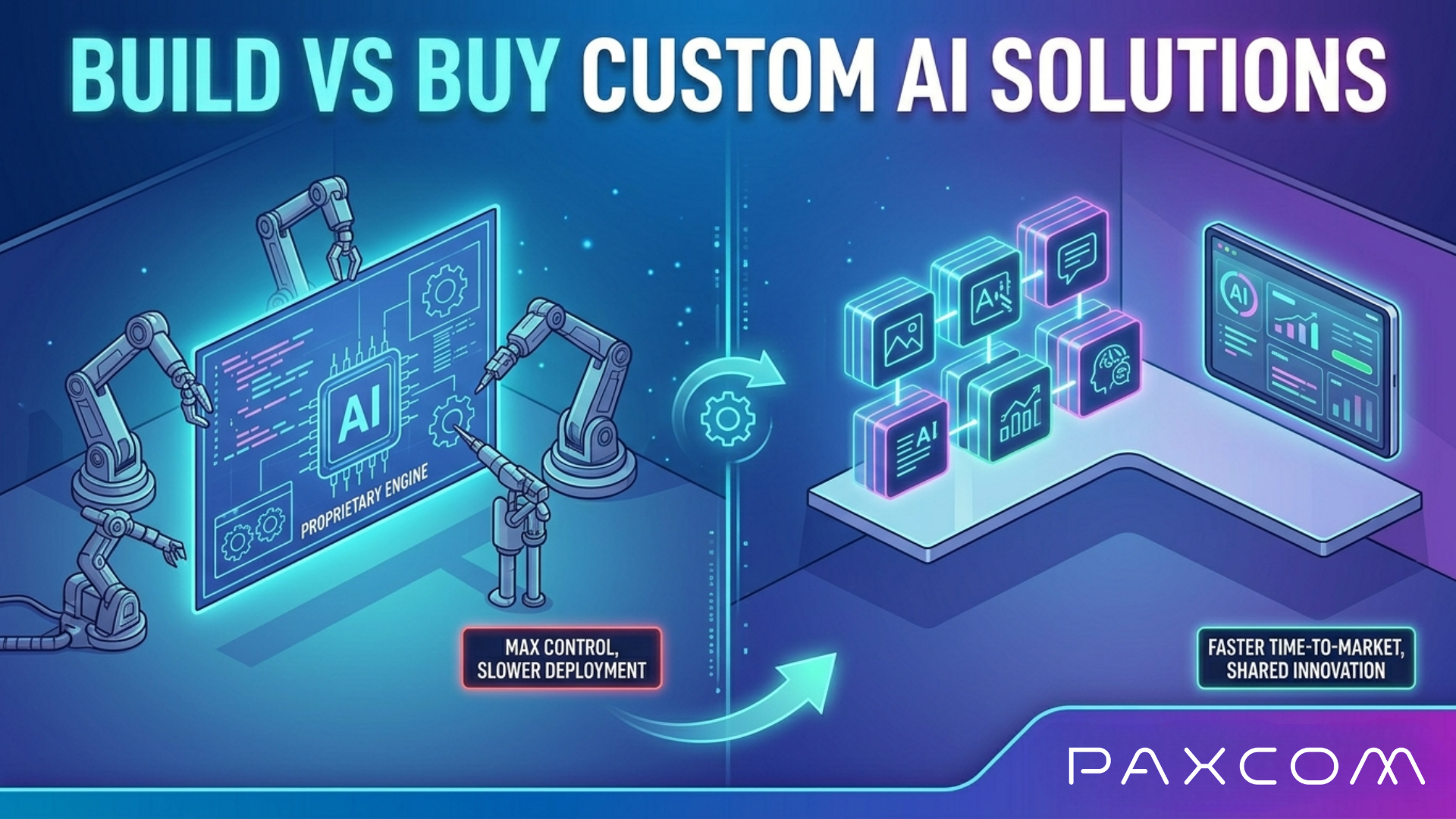
Build vs Buy Custom AI Solutions
There is a question keeping enterprise executives up at night in 2026: when it comes to AI, should we build our own custom solution or buy something that is already available off the shelf?
It is not a new dilemma. Businesses have wrestled with this choice for decades, from large business software in the 1990s to cloud platforms in the 2010s. But AI raises the stakes considerably. Get it right and you unlock a real edge over your competitors. Get it wrong and you are looking at millions of dollars wasted, a frustrated engineering team, and a vendor contract that is nearly impossible to exit.
This guide cuts through the noise. We will walk you through the real tradeoffs, share a practical decision framework, look at the hidden costs on both sides, and explain why the smartest enterprises in 2026 are increasingly choosing a third path: the hybrid model. We will also look at how Paxcom helps brands navigate this decision and deploy AI that actually delivers results.
Why This Decision Matters More Than Ever ?
AI has moved from a nice-to-have experiment to a core business requirement. Recent industry research shows that over 72% of large companies now have active AI projects, but fewer than 30% are satisfied with the results. The gap comes down to one thing: poor decision making at the start.
Some companies over-built. They spent years and millions creating bespoke AI systems for problems that an off-the-shelf tool could have solved in weeks. Others are under-built. They bolted on generic AI tools that could not handle the specifics of their industry, their data, or the rules they have to follow.
The good news is that building custom AI is far more accessible than it was even two years ago. Powerful foundation models from companies like Anthropic, OpenAI, and Google have dramatically lowered the cost and time of building something custom. At the same time, the market for ready-made AI tools has grown rapidly, with vendors offering increasingly capable products for specific industries.
This means the decision has never been more consequential, and the options have never been more varied. Let us break them down.
What Does Building Custom AI Actually Mean in 2026?
When we talk about building, we do not mean training a large AI model from the ground up. Almost no company should be doing that. In 2026, building custom AI typically means one or more of the following:
- Fine-tuning an existing AI model on your own data so it understands your industry, your products, and how your business works
- Building a system that pulls relevant information from your internal documents and data, and feeds it to an AI model so it gives accurate, specific answers rather than general ones
- Creating AI-powered tools that can carry out multi-step tasks within your existing business systems
- Building a custom layer that connects commercial AI models to your internal tools, with controls and checks tailored to your needs
The key point is that you own it. You control the data, you shape how the AI behaves, and you are not dependent on a vendor deciding to change their product or pricing.
What Does Buying AI Look Like Today?
The range of off-the-shelf AI products has grown enormously. Options today span from broad platforms used across entire organisations to tightly focused tools built for one specific job:
- Big platform AI tools: Products like Microsoft Copilot or Salesforce Einstein that embed AI into software your teams already use every day
- Industry-specific AI products: Tools built for healthcare, legal, finance, logistics, and other sectors with the compliance and terminology already built in
- AI available through programming interfaces: Services from companies like Anthropic, OpenAI, and Cohere that let you add powerful AI to your own applications with relatively little engineering work
- No-code AI builders: Platforms that let business teams create AI workflows without needing technical skills
Buying is fast. You can typically be up and running in days or weeks rather than months. The vendor looks after updates, security, and compliance. For many tasks, especially common ones that do not require anything unique to your business, buying is entirely the right call.
Build vs Buy Custom AI : The Complete Comparison
Here is a clear comparison of the key factors enterprise decision makers should weigh up:
| Factor | Build (Custom AI) | Buy (SaaS or Vendor AI) |
|---|---|---|
| Upfront Cost | High ($500K to $5M+) | Low (subscription-based) |
| Time to Deploy | 6 to 18 months | Days to weeks |
| Customisation | Unlimited | Limited by vendor |
| Data Control | Full ownership | Shared or vendor risk |
| Scalability | Built to spec | Vendor-dependent |
| Ongoing Maintenance | Internal team required | Vendor-managed |
| Competitive Advantage | High — proprietary capability | Low — same as rivals |
| Vendor Lock-in | None | High risk |
| AI Talent Needed | Significant | Minimal |
The Hidden Costs Nobody Talks About
The True Cost of Building
The upfront investment in custom AI development often gets the most attention. A solid custom AI solution for a large organisation typically involves:
- AI engineering talent costing $200,000 to $500,000 or more per year for senior specialists
- Data infrastructure work that can run to $300,000 to $1 million in the first year
- Ongoing computing costs that vary widely depending on how the system is used
- Continuous work to monitor, maintain, and update the system over time
But the less visible costs can be just as large. These include the time your best engineers spend on AI infrastructure instead of your core product, the risk of messy technical problems if the system is not designed well from the start, and the cost of ensuring the system meets security and regulatory requirements.
The True Cost of Buying
Off-the-shelf AI looks affordable at first glance. But enterprise AI vendor contracts come with costs that rarely make it into the initial sales conversation:
- Fees that grow quickly as your usage scales up
- Limits on customisation that force expensive workarounds or extra spending on professional services
- The cost of switching: once your teams and processes are built around a vendor’s tool, moving to a different one becomes very expensive
- Data and compliance risks, especially if your business operates in regulated sectors or across multiple countries
- Products that claim to use AI but deliver little real value at a premium price
| When you look at total cost over three to five years rather than just the upfront price, custom AI solutions often become cost-competitive with enterprise software licensing. The break-even point typically sits around 18 to 24 months for mid-size enterprise deployments. |
The Build vs Buy AI Decision Framework
Rather than applying a one-size-fits-all answer, smart enterprise leaders use a structured set of questions. Here are the five you need to answer honestly:
1. Does this capability set you apart from competitors?
If the AI you are building is at the heart of what makes your product or service better than the alternatives, you should almost certainly build it yourself. Buying means your competitors can access the exact same capability. If the task is something everyone needs to do and no one wins by doing it differently, such as writing meeting notes or answering basic support questions, buying makes far more sense.
2. How sensitive is your data?
Organisations handling private customer information, confidential business data, financial records, or regulated health information face real risks when that data is sent to third-party AI vendors. Even with strong contracts in place, the risk changes when your sensitive data is being processed on someone else’s systems. A custom AI solution running inside your own environment removes this risk entirely.
3. How long can you wait?
If you need AI working in production within 60 to 90 days, building is almost certainly off the table. Custom AI development takes time, usually 6 to 18 months for a properly built solution. But if you are thinking over a two to five year period and want to build something that genuinely differentiates your business, the picture changes.
4. Do you have the right people?
Building custom AI requires people who understand not just software development but AI system design, data management, and responsible AI practices. If you do not have this expertise in-house and cannot realistically hire or train for it, buying is the practical choice. Alternatively, working with a specialist partner like Paxcom gives you access to that expertise without needing to build it yourself from scratch.
5. How much does vendor dependency worry you?
The more you embed a vendor’s AI tools into your workflows, the harder it becomes to move away from them. If being able to switch providers, control your own technology roadmap, and avoid being at the mercy of a vendor’s pricing decisions matters to your organisation, that should weigh heavily in your decision.
Quick Reference: Build, Buy, or Hybrid?
Use this table to map your situation to a recommended starting point:
| Scenario | Recommendation |
|---|---|
| You need a capability that sets you apart from competitors | Build |
| You need AI working within 60 to 90 days | Buy |
| Your data is sensitive or must stay within your systems | Build or Hybrid |
| The task is generic (email, search, basic support) | Buy |
| Long-term cost efficiency is the priority | Build |
| You have limited in-house AI expertise | Buy or Hybrid |
| You need deep integration with your existing systems | Build |
| You operate in a regulated industry (finance, healthcare) | Hybrid or Build |
The Third Option: A Hybrid AI Strategy
Here is the insight reshaping enterprise AI strategy in 2026: build versus buy is often a false choice. The most thoughtful enterprises are adopting a hybrid approach. They buy for speed and for tasks that do not require anything unique, while they build for the things that genuinely differentiate their business.
In practice, this looks like:
- Using a commercial AI model as the underlying engine while building the specific application logic, data connections, and user experience on top
- Buying a ready-made AI tool for generic tasks while building custom AI for the workflows that are unique to how your business operates
- Starting with a bought solution to test whether the idea works, then moving to a custom build once you know it delivers business value
The hybrid model gives you speed without giving up long-term control. You are not locked into a single vendor’s capabilities, but you are also not spending engineering time reinventing tools that already exist and work perfectly well.
| Think of it like the way businesses use cloud computing today. Most organisations use a mix of managed services they buy from providers and custom applications they build on top of those platforms. AI strategy in 2026 follows the same logic. |
How Paxcom helps businesses build the right custom AI solutions
Knowing whether to build or buy AI is one thing.
Actually making that decision work inside a business is something else.
This is where many teams get stuck.
They know there is inefficiency somewhere. They know teams are spending too much time on repetitive analysis, fragmented reporting, manual checks, disconnected insights, content corrections, or workflow slowdowns. They know there is potential for AI to improve something meaningful.
But they are often unclear on what should be automated, what should remain human-led, what can be solved with an existing tool, and where a tailored AI capability would create stronger long-term value.
That is where Paxcom comes in.
At Paxcom, the approach is not to push AI for the sake of it. The approach is to identify where AI can solve a real business problem in a way that fits existing workflows, data environments, and execution realities.
That means helping businesses answer practical questions such as:
- What business problem are we actually solving?
- Is this use case better suited to a bought tool, a custom build, or a hybrid model?
- What data sources should power the solution?
- How should the output connect to day-to-day execution?
- What level of customisation is necessary for the solution to be useful, not just impressive?
- How do we make sure adoption happens once the solution is live?
This matters because most businesses do not need a giant AI platform with dozens of disconnected features. They need one or two high-value things to work really well inside their environment.
That could mean building AI-led workflows for digital shelf analytics, content compliance, catalog quality monitoring, marketplace intelligence, quick commerce visibility, campaign analysis, competitive benchmarking, decision support, internal knowledge retrieval, or operational summarisation.
It could mean creating custom intelligence layers over business data so teams can move from information overload to clear action faster.
It could mean grounding AI outputs in real business signals instead of generic public knowledge.
It could mean integrating AI into existing operational systems so the output does not sit in a side tool, but becomes part of how teams work.
That is the core distinction.
The real value of custom AI is not in the model alone. It is in how well the solution reflects the business context around it.
That is the lens Paxcom brings.
Instead of starting with a generic AI stack and trying to force use cases into it, Paxcom starts with the business need, the operational bottleneck, and the decision-making gap. From there, the solution can be shaped in the right way, whether that means:
- building feature-specific AI workflows
- creating custom intelligence layers over internal and marketplace data
- grounding AI outputs in trusted business inputs
- integrating AI into dashboards, workflows, and reporting systems
- enabling faster decisions through smarter analysis, prediction, recommendations, and tagging
- combining existing AI capabilities with tailored logic, rules, and execution layers
This is a more practical way to think about custom AI.
What does this look like from a Paxcom mindset?
A Paxcom India lens on AI is not about asking, “Where can we add AI?”
It is about asking, “Where is friction slowing the business down, and how can AI help remove it in a way that actually improves execution?”
That is a very different mindset.
At Paxcom, this means approaching AI with a commercial and operational lens first. The question is not where AI looks impressive. The question is where AI can improve visibility, remove repetitive effort, speed up decisions, reduce manual dependency, or strengthen execution in a way that matters to the business.
That is what makes custom AI valuable. This is especially important in complex business environments where teams are already overloaded with tools, dashboards, and data sources. The answer is rarely another disconnected platform. More often, the answer is a smarter capability built around the workflow itself.
That is why Paxcom’s view of custom AI is rooted in business fit. AI built around workflows, not just models. Decision intelligence over dashboard overload. Execution support, not just visibility. Feature-specific solutions instead of full-suite complexity.
That is where the difference starts to show.
Because businesses do not create ROI from “having AI.”
They create ROI when AI reduces friction, increases clarity, improves speed, and helps teams take better action at scale.
Industry-Specific Things to Consider
Financial Services
Rules and regulations are often the deciding factor in financial services. Requirements around how AI decisions are explained, where data is stored, and how transactions are recorded push most banks and insurers toward custom AI or very tightly controlled vendor relationships with strong legal protections built in.
Healthcare and Life Sciences
Privacy laws around patient data create significant complexity when using third-party AI vendors. Many healthcare organisations are running AI within their own systems, or using private setups in cloud environments, to stay compliant while still getting the benefits of modern AI.
Retail and Consumer Goods
This is where Paxcom’s work is most relevant. Retail businesses have enormous amounts of proprietary data around customer behaviour, purchasing patterns, and pricing that gives them a genuine advantage when that data is used well. Generic tools cannot access this data in a meaningful way. Custom or hybrid AI, built around your own data, is what actually moves the needle here.
Manufacturing and Logistics
Predicting when equipment will fail, improving quality control, and optimising delivery routes are all highly specific to each organisation’s setup. These use cases almost always need a custom approach because the relevant data, the equipment involved, and the operational processes are unique to each business.
The Five Most Expensive Build vs Buy Mistakes
1. Building when buying would have done the job: Spending a year and significant budget building a custom AI tool for a task that a commercial product handles perfectly well. Always check what is available off the shelf before committing to a build.
2. Signing contracts without reading the small print: Enterprise AI contracts can include clauses around how your data is used, limits on what you can do with the output, and significant price increases over time. Have your legal and procurement teams review everything before signing.
3. Starting to build before your data is ready: Custom AI is only as good as the data it works with. Organisations that start building before their data is properly organised and accessible consistently overspend and underdeliver. Sort your data before you sort your AI.
4. Forgetting about the people side: Whether you build or buy, the biggest barrier to success is often getting teams to actually use the new tools and change how they work. Investing in change management and proper training consistently produces much better results.
5. Treating it as a one-time decision: The AI landscape changes fast. A tool you buy today may be overtaken in 18 months. A system you build today may eventually be replaceable by something better off the shelf. Review your AI portfolio at least once a year.
A Practical Starting Point
Whatever path you choose, here is how to begin with confidence:
- Map what you already have: List every AI tool, project, and vendor relationship across your organisation. You likely have more overlap and fragmentation than you realise.
- Categorise your priorities: For each AI use case, ask whether it is genuinely unique to your business, how sensitive the data is, how quickly you need it, and how important independence from vendors is.
- Do a proper cost comparison: Look at total cost over three years, not just upfront pricing. Include maintenance, talent, and switching costs.
- Be honest about your in-house capability: If you do not have the right people to build, consider whether partnering with a specialist like Paxcom is a faster, lower-risk route than hiring from scratch.
- Set up governance before you scale: Decide who owns AI decisions in your organisation, how risks are assessed, and how vendor relationships are managed before you commit to either path at scale.
The Bottom Line
The build vs buy AI decision is not a single choice. It is a set of choices that should be made carefully, one use case at a time, using a clear framework and an honest look at what your organisation is actually capable of.
In 2026, the enterprises doing well with AI are not necessarily the ones spending the most or building the most. They are the ones making smart, deliberate choices about where to build, where to buy, and how to combine both in a way that fits their business.
For brands in the ecommerce and retail space, partners like Paxcom offer a way to get the best of both worlds: AI that is purpose-built for online retail, tailored to your specific products and markets, and backed by a team that helps you use it well. That is not a generic buy. That is a smarter kind of build.
The real question is not build or buy. It is: what combination of building and buying gives your business the best chance of real, lasting advantage without creating problems that will be much harder to fix three years from now?
Answer that well, and you are already ahead of most of the market. Contact us or reach out to us at info@paxcom.net for more infomation