Search used to be the front door. You typed “best anti-dandruff shampoo” or “vitamin C gummies,” scanned a grid, and clicked a few listings.
Now a growing share of shoppers ask an AI assistant the same question and get a short list. That list is the new shelf. You can’t buy that placement with a banner. You earn it through what the model can read, trust, and repeat.
For CPG teams, this shift changes three things:
- Visibility is moving from ten blue links to five brand picks.
- Copy, feeds, and reviews matter as much as bids.
- Your brand story needs to be easy for machines to quote without twisting your claims.
Table of Contents
Why the shelf went invisible
AI systems pull from many signals: brand sites, marketplace listings, retailer content, reviews, forums, and well-structured explainer pages. When a shopper asks for a recommendation, the model stitches a short answer from what it can best interpret.
That means your share of shelf now depends on:
- How clean and complete your product facts are.
- How consistent your claims are across channels.
- How much real-world proof shows up in reviews and third-party mentions.
- Whether your content is easy to read in plain text.
Tools and research firms are already tracking how often brands get mentioned or cited in AI answers across ChatGPT, Copilot, Perplexity, and Google’s AI features.
The shift: from blue links to best answer
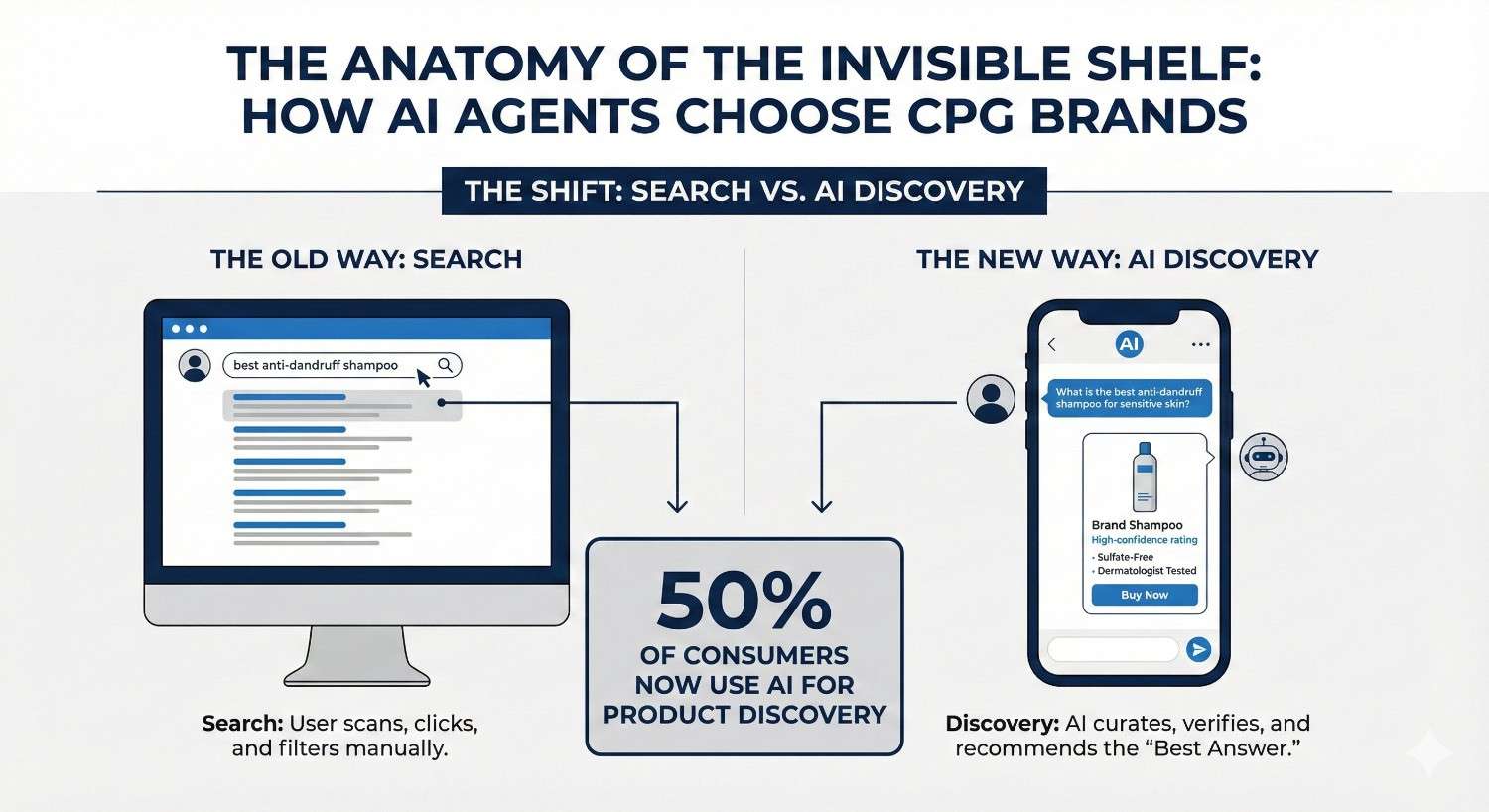
For twenty years, the digital shelf was a list of blue links or a grid of product thumbnails. You won by ranking #1. Today, that shelf is collapsing into a single, high-confidence answer generated by an AI.
This isn’t a future bet. This is the current reality of Generative Engine Optimization (GEO).
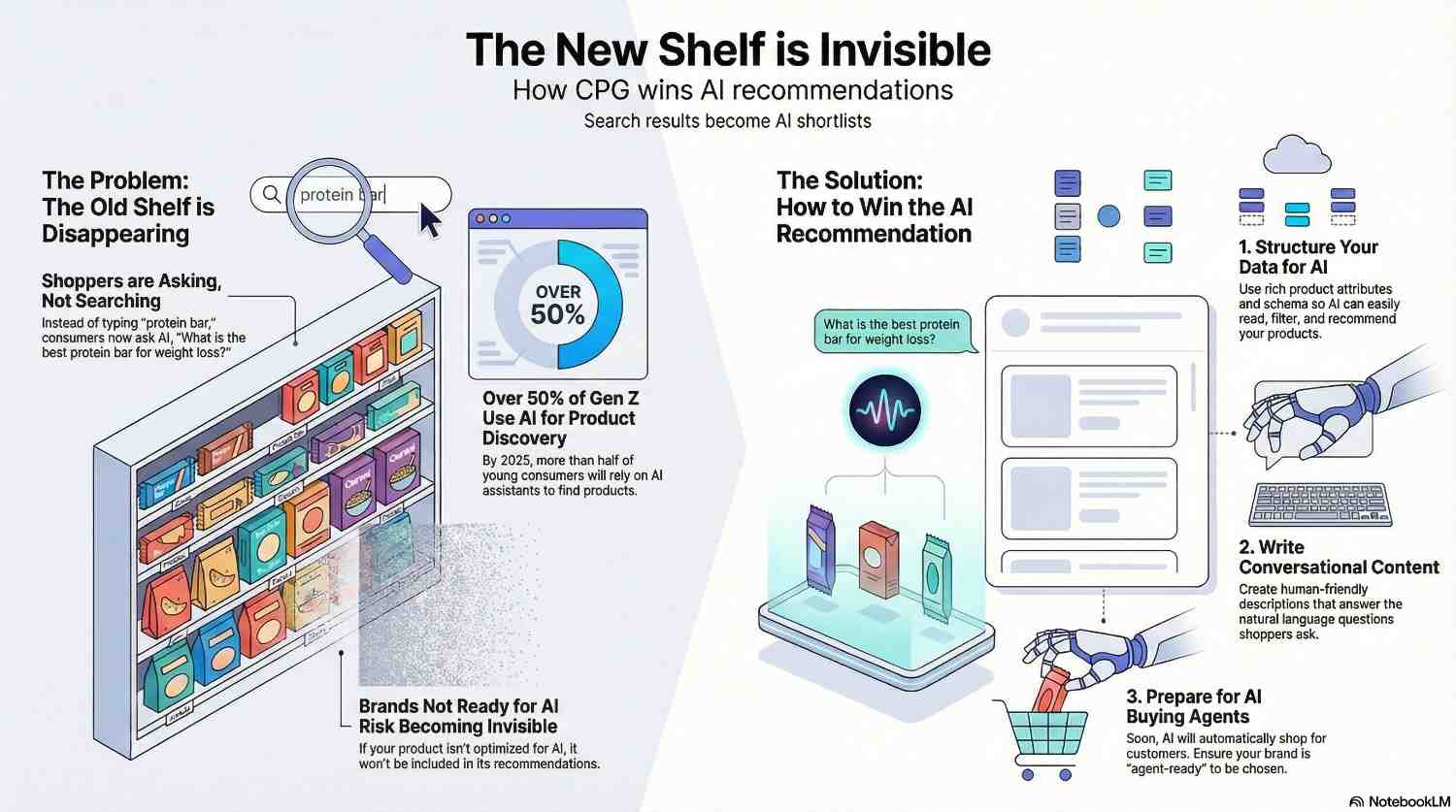
Consumer behavior has changed. Shoppers no longer type “protein bar” and open 15 tabs. They ask an agent: “What is the best chocolate-flavored protein bar for weight loss that uses sustainable packaging?”
The AI looks at reviews, ingredients, brand values, and availability, then recommends one product. If you aren’t that recommendation, you are invisible.
The math behind the shift
The business impact of this change is big.
- $660 billion opportunity: McKinsey estimates that generative AI could add between $400 billion and $660 billion in annual value for retail and CPG.
- 50% consumer adoption: According to McKinsey’s AI Discovery Survey (August 2025), nearly 50% of consumers now use AI-based search. For Gen Z, that number climbs to 55%.
- 1000% traffic growth: Adobe Analytics reports that referrals from AI agents to retailer sites have grown over 1000% (10x) in the last year.
This is a winner-take-all economy. The traffic volume is lower, but the intent is higher. Visitors from AI referrals spend 41% longer on-site and have lower bounce rates because the AI has already pre-qualified them.
How LLMs read your product
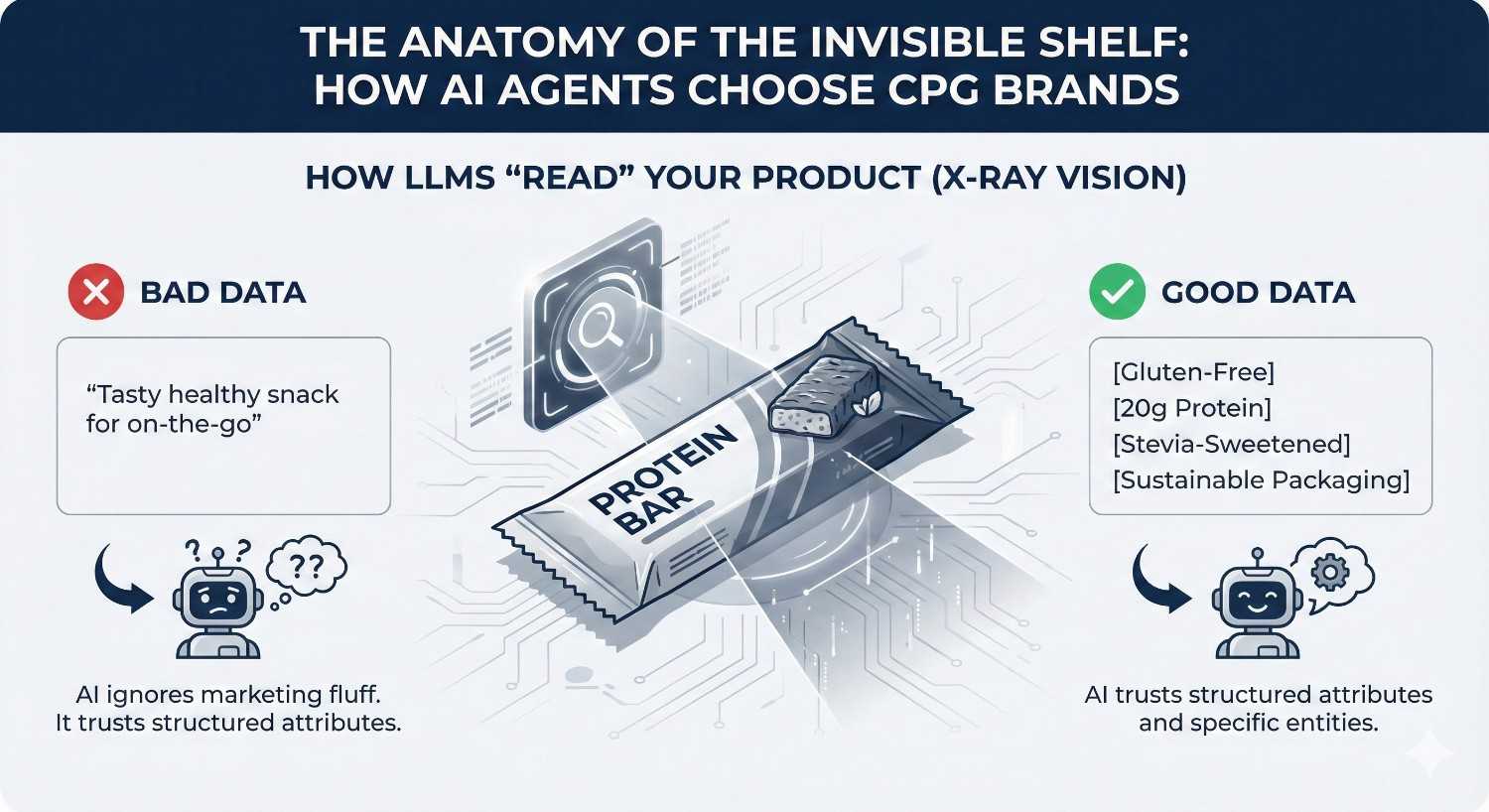
Traditional SEO was about keywords. GEO is about entities and relationships. Large Language Models (LLMs) work like probability engines. To win the recommendation, your product data must be structured so the model trusts it as the best answer.
1. Structured data is the new SEO
An LLM does not read a product description like a human. It ingests it as data. You must define your product’s attributes with explicit schema markup.
- Attribute density: A generic description like “healthy snack” is invisible to an AI. You need specific, machine-readable tags: Gluten-Free, Non-GMO Project Verified, 20g Protein, Stevia-Sweetened.
- The knowledge graph: You must structure your data to connect entities. “Contains Peanuts” is not just text; it is an allergen entity that connects to “Safety Warning.”
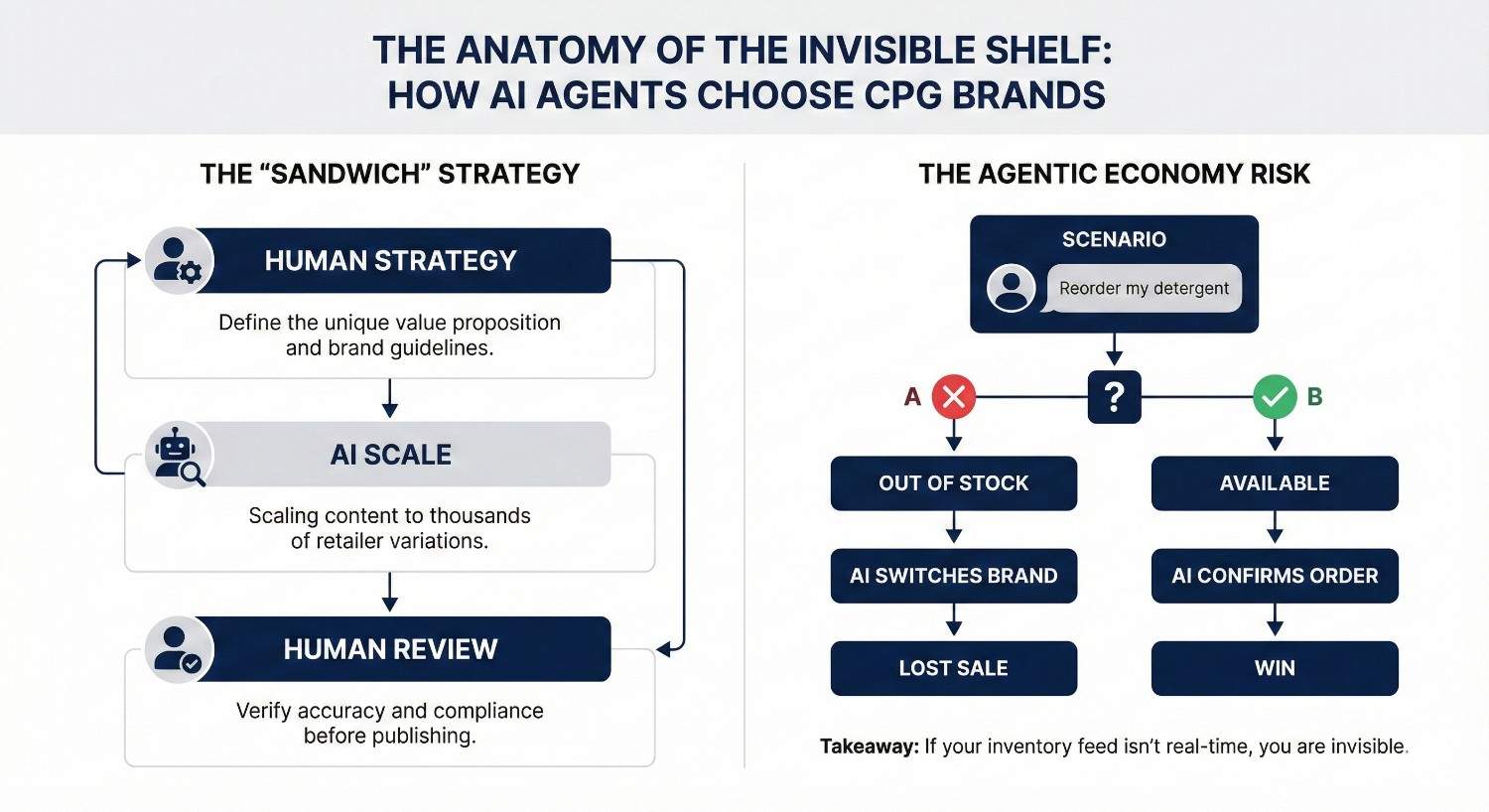
2. The “Human–AI sandwich” strategy
To create content at the speed of AI without losing brand voice, successful teams use a three-step process:
- Human strategy: Define the unique value proposition and brand guidelines.
- AI scale: Use tools to generate many variations for Amazon, Instacart, and quick commerce.
- Human review: Verify accuracy and compliance before publishing.
What AI tends to reward in CPG
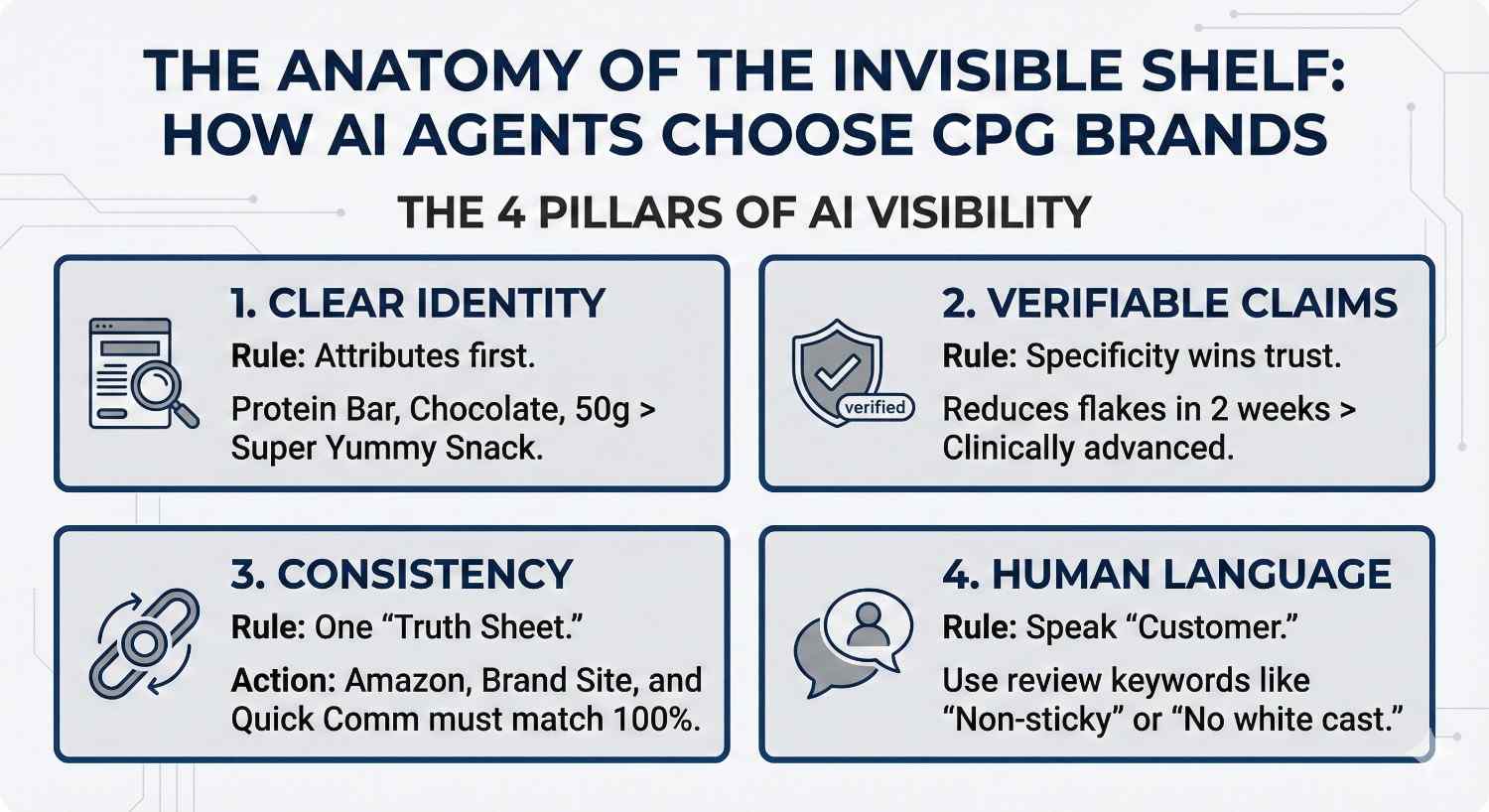
Across categories, four drivers keep showing up in AI shortlists.
1. Clear product identity
If your title and bullets read like a messy warehouse label, the model struggles to know what you really are.
Do this:
- Use one simple product name across your brand site and marketplaces.
- Put the top 3–5 attributes early: form, key benefit, pack size, age/skin/hair type, and any safety or diet markers your category expects.
2. Specific, verifiable claims
AI assistants are more likely to repeat claims that are concrete and supported.
Do this:
- Prefer “reduces dandruff flakes in 2 weeks*” over “clinically advanced care.”
- Add a short proof line and a footnote or link to the study page when you can.
3. Consistency across the web
If your brand site says one thing, Amazon says another, and quick commerce listings say a third, the model may choose a competitor with less noise.
Do this:
- Create a single truth sheet for each SKU: title, bullets, ingredients, warnings, usage, and hero images.
- Push that sheet into every channel on a set cadence.
4. Real customer language
AI systems learn the words people use, not just the words brands prefer.
Do this:
- Mine reviews for phrases customers repeat (“non-sticky,” “no white cast,” “baby-safe,” “works for humid weather”).
- Mirror that language in your bullets and FAQ.
Technical basics that still affect AI answers
Some advice is boring. It’s still worth doing.
Checklist:
- Make sure your main product facts are not hidden behind heavy scripts.
- Add schema where it fits: Product, FAQ, HowTo.
- Check robots.txt and CDN rules to avoid accidental blocks.
Keep older evergreen pages updated so they stay credible.
The agentic economy: protecting the zero click
We are moving toward an agentic economy, where software agents buy products for humans.
The risk is simple: if an AI agent recommends your product, but your feed says it is out of stock, the agent will instantly switch to a competitor.
The fix: you need real-time inventory visibility. Your digital shelf analytics must be live. Static daily feeds won’t hold up when an AI is making the purchase decision in seconds.
Conclusion: audit your visibility
The metrics have changed. You are no longer competing for “Page 1.” You are competing for “The Answer.”
Where Paxcom fits
Paxcom’s work in digital shelf and AI-led discovery gives CPG teams a way to see the new shelf before it costs you share.
We focus on:
- Tracking category prompts and brand mentions across AI assistants.
- Improving SKU fact quality across marketplaces and quick commerce.
- Building content blocks that answer the questions models keep seeing.