You’ve optimized your headlines, tested your CTAs, and refined your product copy. But visitors still leave without converting, often because they had a question you never answered.
FAQ sections have quietly become one of the highest-converting elements on modern landing pages. They address objections before they become barriers, capture question-based search traffic, and build trust through transparency. Below, you’ll learn how to structure, write, and optimize FAQ sections that drive measurable results.
Table of Contents
Why AI Reads Your Answers Before Customers Read Your Brand
Before a consumer lands on your website, scrolls your product page, or clicks an ad, something else has already made a decision.
Search engines, large language models, and answer engines now scan, interpret, and prioritise content long before it reaches a shopper. And in this AI-first ecosystem, the content layer being read most closely isn’t your homepage or hero banner.
It’s your FAQ section.
Welcome to the era where FAQs are the new landing pages.
FAQs answer common visitor questions to guide purchase decisions, build trust, and drive conversions, functioning as a mini-landing page rather than a traditional support resource. Unlike help-center FAQs buried in site navigation, FAQ landing pages are placed strategically to address objections, capture question-based search intent, and reduce support tickets before visitors bounce.
Think of it this way: a traditional FAQ sits in your footer, waiting for confused customers to find it. Dynamic FAQ placements, on the other hand, meets visitors proactively answering the questions that stop them from clicking “Buy” or “Request Demo.”
The distinction matters more than you might expect. One is reactive support. The other is active conversion.
The Internet Has Shifted From Browsing to Questioning
The modern buying journey rarely starts on your website. It starts with:
-
- a Google AI Overview
-
- a conversational search result
-
- a recommendation surfaced by an LLM
-
- a comparison summary generated automatically
Before a shopper ever clicks your page, AI has already scanned your content to decide whether you deserve visibility.
And in that evaluation, AI doesn’t prioritise brand storytelling. It prioritises clarity.
That’s why FAQ sections matter more than ever.
They are:
-
- structured
-
- direct
-
- question-led
-
- context-rich
Exactly how answer engines interpret information.
In an AI-first world, your FAQ section often becomes the primary source AI uses to understand your product, your policies, and your credibility. And as AI platforms increasingly summarise, compare, and recommend products, the content that survives is the content that answers clearly, directly, and contextually.
This is where GEO (Generative Engine Optimization) truly begins.
Consumer behaviour has changed fundamentally.
People no longer explore websites the way they used to. Instead, they ask:
-
- “Is this safe for sensitive skin?”
-
- “Which brand lasts longer?”
-
- “Is this better than the alternative?”
Search today is question-led, not keyword-led.
This is why FAQ sections now sit at the centre of discoverability.
Why FAQ sections outperform traditional landing pages
Your visitors arrive with questions. Pricing, shipping, compatibility, returns, these concerns sit between them and conversion. Traditional landing pages often talk to visitors with features and benefits. FAQ sections talk with them by addressing what they actually want to know.
-
- They address objections before they become barriers
Every unanswered question is a potential exit. FAQs preemptively tackle concerns about pricing, shipping timelines, return policies, or product fit that would otherwise cause visitors to leave and research elsewhere.
You’ve probably done this yourself, landed on a product page, had a question, couldn’t find the answer, and left to check a competitor.
-
- They reduce cognitive load for visitors
Scannable Q&A format lets visitors find exactly what they’re looking for without reading paragraphs of marketing copy. This reduces friction and keeps attention focused on the path to conversion.
-
- They build trust through transparency
Answering tough questions openly, even uncomfortable ones about limitations or pricing signals confidence. Visitors notice when brands don’t hide from hard questions.
-
- They capture question-based search intent
Google rewards content matching “how,” “what,” and “why” queries. FAQs naturally align with how people search, which means they can pull organic traffic directly to your conversion pages.
When to use FAQ sections on landing pages
Not every page benefits equally from FAQ sections. Here’s where they deliver the most impact:
-
- High-consideration purchases: Products or services requiring research before buying
-
- Complex offerings: Solutions with multiple features, pricing tiers, or technical requirements
-
- New market entries: When your brand or product category is unfamiliar to visitors
-
- Lead generation pages: Where visitors want reassurance before submitting contact information
If your product is simple and low-risk, a brief FAQ might suffice. If you’re selling enterprise software or high-ticket items, comprehensive FAQs become essential.
How to write FAQs that both AI and humans trust
FAQ content follows a very different logic than traditional marketing copy. Instead of persuading or promoting, effective FAQs focus on precision, clarity, and intent-matching. Each answer should begin with a direct response, avoid unnecessary explanations, use simple and neutral language, and establish context immediately so both AI systems and human readers understand it without friction. Strong FAQ writing prioritises accuracy over persuasion, clarity over creativity, and intent over branding because AI engines reward structured, unambiguous information and buyers instinctively trust it.
In high-intent moments such as pricing queries, comparisons, or implementation questions, FAQs should gently guide users toward the next step with a soft, contextual call to action. The goal isn’t aggressive selling, but directional clarity that helps both machines and decision-makers move forward confidently.
How to identify the right questions for your FAQ section?
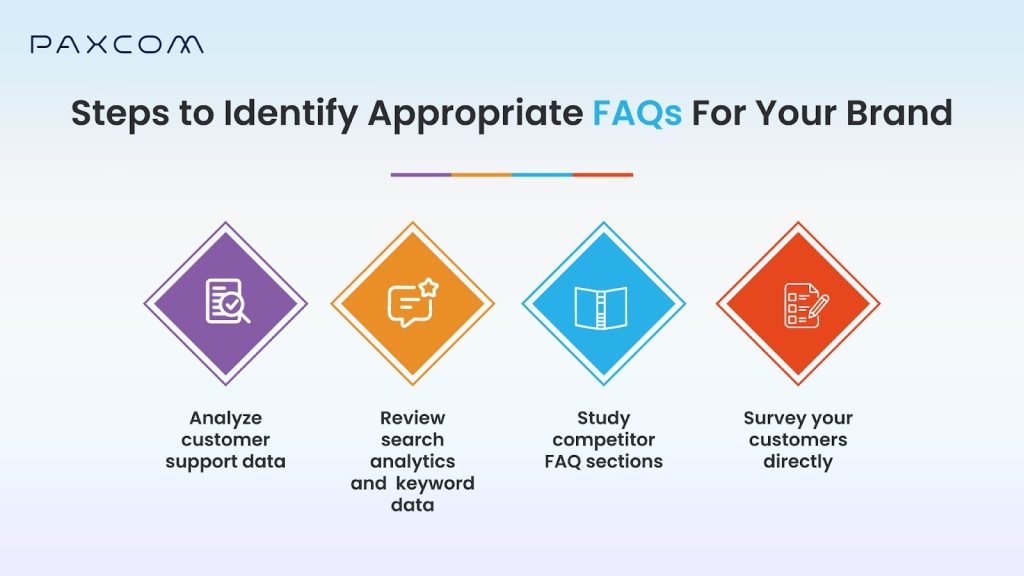
The best FAQ sections answer real questions, not the ones you wish people asked. Here’s how to find them.
-
- Analyze customer support data
Your support tickets, chat logs, and email inquiries contain gold. Pull the questions that appear repeatedly. These are the objections blocking conversions right now.
-
- Review search analytics and keyword data
Google Search Console shows what question-based queries bring visitors to your site. Site search data reveals what people look for after they arrive. Both point to gaps your FAQ can fill.
-
- Study competitor FAQ sections
Audit competitor landing pages and FAQ pages to identify questions you may have overlooked. You’ll often find patterns across your industry that reveal what buyers expect to see answered.
-
- Survey your customers directly
Ask recent buyers what questions they had before purchasing. Post-purchase surveys work well here, and the answers often surprise you.
How to write FAQs that drives conversions
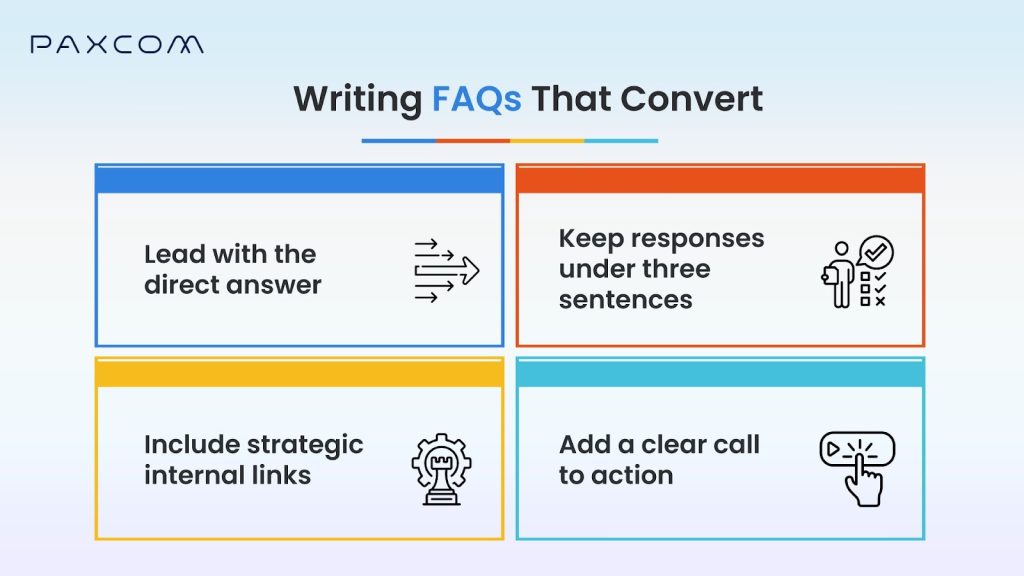
Writing effective FAQ content follows different rules than typical marketing copy.
1. Lead with the direct answer
Start each answer with the key point, don’t bury it. Visitors scan, so front-load value in the first sentence.
2. Keep responses under three sentences
Brevity builds trust. If an answer requires more detail, link to a dedicated resource page rather than overwhelming the FAQ format.
3. Include strategic internal links
Guide visitors to product pages, pricing pages, or demo requests within answers where relevant. Each link is a conversion opportunity.
4. Add a clear call to action
End high-intent questions (pricing, comparisons, implementation) with a CTA like “Request a demo” or “Start free trial.”
Tip: Questions about pricing, competitors, or “how it works” signal high purchase intent. These deserve your strongest CTAs.
Where to place FAQ sections for maximum impact
Placement determines whether your FAQ gets seen or ignored.
-
- Above the fold: For high-objection products where questions block immediate action
-
- Below product details: After visitors understand the offer but before they commit
-
- Near the CTA: Address last-minute hesitations right before the conversion point
-
- As a standalone page: When FAQs are comprehensive enough to warrant dedicated navigation
Testing different placements often reveals surprising results. What works for one product category may not work for another.
How to optimize FAQ sections for SEO
FAQs can drive significant organic traffic when optimized correctly.
-
- Implement FAQ schema markup
FAQ schema markup is structured data that helps Google display your questions and answers directly in search results as rich snippets. This increases visibility and click-through rates without additional ad spend.
-
- Target long-tail question keywords
Each FAQ question can target a specific phrase that real searchers use. Tools like Paxcom’s Channel Intelligence platform can help identify which question-based queries drive traffic in your category.
-
- Optimize for featured snippets and People Also Ask
Structure answers to match Google’s preferred snippet format direct answer in the first sentence, supporting detail after. This positions your content for AI Overviews and featured snippets.
How to measure and improve FAQ section performance?
What gets measured gets improved.
-
- Track click-through and expansion rates
Monitor which questions get clicked most high engagement signals relevant content. Low engagement might mean the question isn’t resonating or the answer is visible without clicking.
-
- Monitor time on page and bounce rate
Improved FAQ sections typically increase time on page and reduce bounces as visitors find answers and continue exploring.
-
- A/B test question order and wording
Test which questions perform best when placed first, and experiment with phrasing to improve clarity. Small changes in wording can significantly impact engagement.
Request a Demo to see how Paxcom’s analytics tools can help you track and optimize content performance across your digital shelf.
With proper structure, FAQ sections support:
-
- long-tail question keyword visibility
-
- featured snippets
-
- People Also Ask placements
-
- AI-generated answers
-
- conversational search results
Schema markup strengthens this further by helping search engines and answer engines interpret context precisely.
In GEO frameworks, FAQs often become the most indexable, reusable, and extractable part of a page.
Which means they punch far above their visual size.
Measuring FAQ performance is no longer optional
FAQs should be treated like performance content.
Brands should track:
-
- which questions are expanded most
-
- where users drop off
-
- how FAQs affect bounce rate
-
- whether CTAs near FAQs improve conversion
-
- how question wording impacts engagement
Small wording changes can significantly shift outcomes especially when those answers are reused by AI systems externally. This is where digital shelf intelligence becomes essential.
Understanding how content performs not just on-site, but across search and AI ecosystems, defines modern optimization.
The real shift brands must understand
FAQ sections are no longer at the end of the page. They are often the reason the page works at all. In an AI-first world, brands that win are those that:
-
- anticipate questions
-
- structure answers cleanly
-
- update FAQs continuously
-
- treat them as living assets
-
- optimise them for humans and machines simultaneously
FAQs are no longer support tools.
They are visibility engines, trust builders, and conversion drivers, all at once.
Brands leveraging data-led platforms like Paxcom gain a critical advantage by identifying which questions influence discoverability, ranking, and revenue across the digital shelf.
Common FAQ section mistakes to avoid
Even well-intentioned FAQ sections can backfire. Watch for these pitfalls:
-
- Asking questions no one actually asks: Base FAQs on real data, not assumptions
-
- Writing answers that are too long: Walls of text defeat the purpose of quick-reference Q&A
-
- Hiding FAQs in hard-to-find locations: If visitors can’t find them, they can’t help
-
- Neglecting to update content: Outdated answers erode trust and hurt SEO
-
- Ignoring mobile formatting: Accordions that don’t work on phones frustrate users
-
- Missing CTAs: Every FAQ section is a conversion opportunity
FAQ landing page examples that convert
Different industries use FAQ landing pages in distinct ways.
-
- SaaS product pages: FAQs addressing pricing tiers, integrations, and onboarding timelines
-
- E-commerce checkout pages: FAQs covering shipping, returns, and payment security
-
- Lead generation landing pages: FAQs answering “what happens after I submit my info”
-
- Event registration pages: FAQs about schedules, refunds, and access details
The common thread? Each example places FAQs where objections naturally arise in the buyer journey.
Turn your FAQ sections into conversion engines
FAQ sections have evolved from support afterthoughts into strategic conversion tools. They address objections, build trust, capture search traffic, and guide visitors toward action, all while reducing support load.
The brands seeing the best results treat FAQs as living content, continuously updated based on customer questions, search data, and performance metrics. Teams using data-driven content approaches, like those supported by Paxcom’s analytics and content services can identify which questions matter most and optimize FAQ performance over time.
Ready to transform your FAQ sections into conversion drivers? Reach out to us at info@paxcom.net to start optimizing your digital shelf today.
People Also Ask