TL;DR
By 2026, AI in eCommerce will move from enablement to execution, becoming the core layer driving personalization, retail media optimization, predictive analytics, and digital shelf intelligence. In 2025 alone, over 77% of commerce professionals used AI daily, accelerating adoption across pricing, inventory planning, content optimization, and campaign management. AI-powered personalization now influences nearly half of shopper discovery journeys, while predictive analytics in eCommerce enables brands to forecast demand and conversion instead of reacting to past performance. As retail media networks mature, AI-led bidding, placement, and creative optimization are reshaping ROI-focused growth. At the same time, Generative Engine Optimization (GEO) is emerging as a critical capability, ensuring product and brand content is structured for AI-led discovery, LLM answers, and conversational commerce. Brands that combine digital shelf analytics, quick commerce intelligence, and AI-driven decision systems will be best positioned to win in 2026, where speed, relevance, and visibility, not scale alone, define success.
Why 2026 Will Redefine AI in eCommerce
By the end of 2025, AI was no longer an advantage in eCommerce, it became the baseline.
Over 75% of commerce teams globally were already using AI across media planning, demand forecasting, and content workflows, while leading retailers embedded AI directly into search ranking, recommendations, and retail media auctions. The result? Visibility and performance began shifting before campaigns even went live.
Shoppers changed too. Product discovery increasingly started with AI-led recommendations, not category browsing. Promotions were influenced by predictive demand signals, not historical performance alone. And brands that relied purely on past-period reporting found themselves reacting late to shifts already priced into the system.
As we move into 2026, the competitive gap will widen, not between brands using AI and those who aren’t, but between those who operate AI as a decision layer and those still treating it as a support tool.
This blog outlines the non-negotiable eCommerce and AI trends for 2026, grounded in what materially changed in 2025 and what brand leaders, performance marketers, and commerce heads must operationalize next. These are not forecasts. They are readiness signals.
1. AI Has Moved From Experimentation to Execution
In 2025, AI stopped being an innovation layer and became an operating layer for commerce teams.
Across global eCommerce organisations, AI adoption shifted from isolated pilots to embedded workflows, spanning media buying, demand forecasting, pricing intelligence, inventory planning, and content optimization. What changed was not just usage, but ownership. AI moved out of innovation labs and into core revenue teams.
Industry reports from BCG and Gartner consistently highlighted this shift: brands that operationalised AI across daily decision-making saw measurable improvements in speed-to-market, cost efficiency, and forecast accuracy, while late adopters struggled with fragmented tools and delayed reactions.
From an execution standpoint, AI now directly influences:
- Retail media bidding and budget pacing
- Product discoverability across marketplaces
- Quick commerce demand sensing
- Real-time inventory and availability decisions
This is where eCommerce AI trends for 2026 begin to diverge. The advantage no longer comes from having AI tools, but from how tightly they are integrated into decision loops.
Brands still using AI only for reporting or post-campaign analysis are already behind. In contrast, leaders are using AI-driven decision intelligence to act before performance shifts appear in dashboards.
What this means for 2026
AI will no longer be evaluated as a “tool.” It will be judged as a decision engine.
Brands that win in 2026 will:
- Use AI in eCommerce to guide spend allocation, not just measure it
- Rely on predictive analytics instead of backward-looking performance reports
- Treat AI as part of core commerce strategy, not marketing experimentation
Those who delay operational adoption will still see data, just too late to act on it.
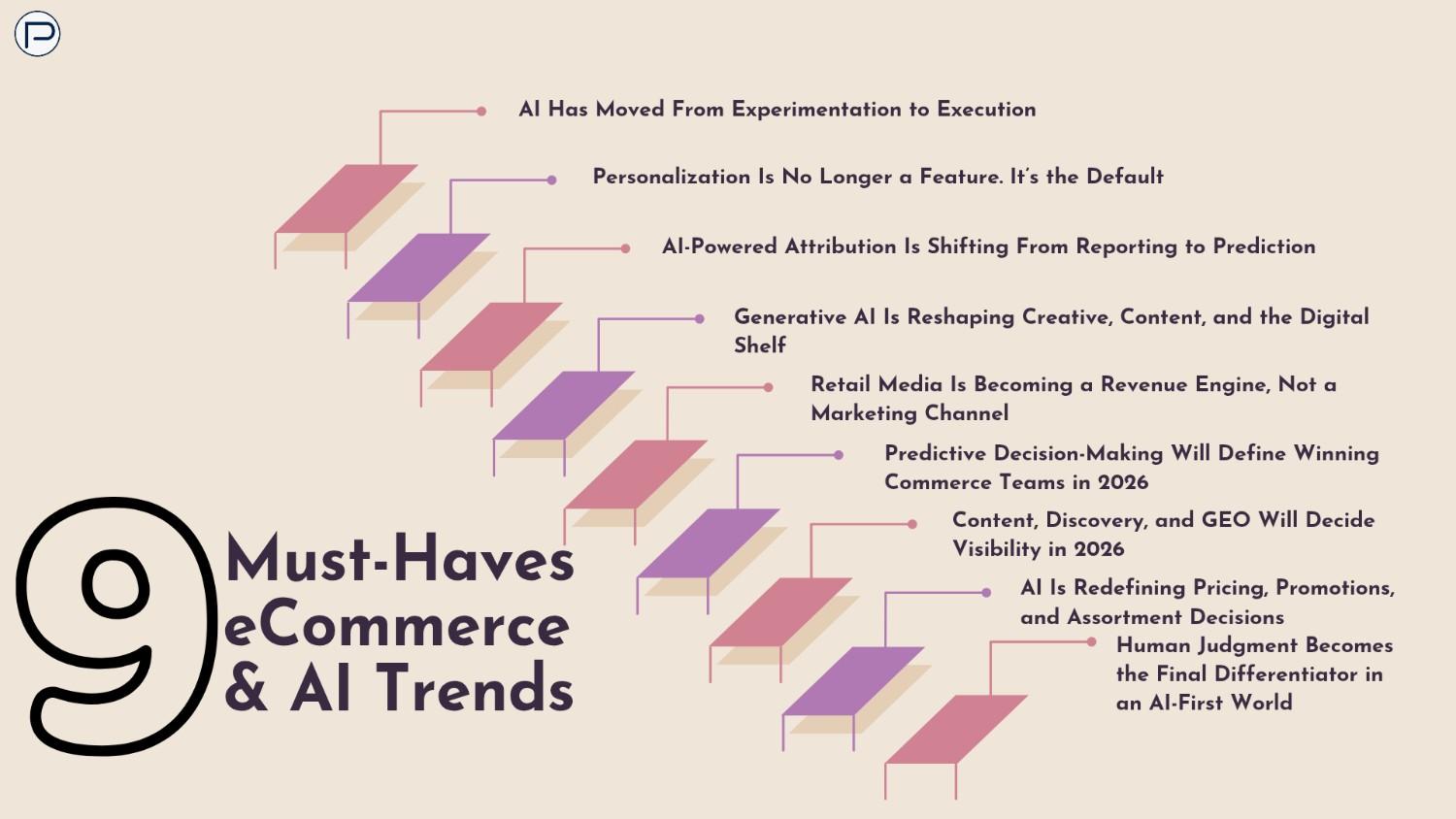
2. Personalization Is No Longer a Feature. It’s the Default
By 2025, personalization crossed a critical threshold, it stopped being a differentiator and became a baseline expectation.
Shoppers no longer discover products through linear search alone. Instead, AI-powered personalization now shapes what they see before intent is fully formed, across retail media networks, marketplaces, and quick commerce platforms.
In practice, this showed up as:
- Dynamic creatives adapting to shopper cohorts
- Recommendation engines influencing basket composition
- Context-aware placements driven by time, location, and prior behavior
- Quick commerce discovery driven by urgency, proximity, and availability
Personalization has been flagged as one of the fastest-scaling AI applications in commerce, particularly when combined with first-party retail data. The biggest shift wasn’t creativity, it was precision. Brands moved from broad targeting to moment-based relevance.
This mattered most during high-traffic periods. In 2025, nearly half of shoppers globally interacted with AI-influenced discovery surfaces such as recommendations, sponsored listings, and curated brand shelves before making a purchase decision.
For performance teams, this changed how success was defined. Reach alone stopped correlating with outcomes. Instead, conversion velocity, basket expansion, and repeat intent became the real indicators of effective personalization.
Where brands struggled
Many brands still applied personalization after campaigns were live, adjusting creatives or bids reactively. This limited impact.
High-performing teams, however, built personalization directly into:
- Retail media strategy
- Quick commerce campaign structures
- Product detail page (PDP) content
- Digital shelf layouts
They treated personalization as a system, not a tactic.
What this means for 2026
In 2026, generic targeting will underperform by design.
Winning brands will:
- Use AI-powered personalization to shape discovery, not just conversion
- Align content, creatives, and media to the same shopper signals
- Design campaigns for micro-moments, not mass audiences
- Relevance will consistently outperform reach — and personalization will be how relevance is delivered at scale.
3. AI-Powered Attribution Is Shifting From Reporting to Prediction
In 2025, attribution quietly became one of the most transformed layers in eCommerce.
Traditional reporting models focused on what already happened. AI-powered attribution, however, began answering a more valuable question: what is likely to convert next? Brands increasingly moved beyond last-click and static dashboards toward predictive analytics in eCommerce, where AI models evaluated:
- Demand signals
- Price elasticity
- Competitive movement
- Inventory availability
- Creative fatigue
- Regional and temporal buying patterns
According to BCG and Gartner’s 2025–26 outlooks, retailers using AI-driven decision intelligence saw measurable gains, not by increasing spend, but by allocating it earlier and more precisely.
This shift mattered most in environments like:
- Retail media networks, where bids fluctuate by the hour
- Quick commerce, where demand spikes are city- and time-specific
- Marketplaces, where shelf dynamics change faster than campaign cycles
- Instead of reacting to underperformance, AI-enabled teams began anticipating demand inflection points.
From Performance Reporting to Predictive Decision-Making
What changed in 2025 wasn’t visibility, it was timing.
High-performing brands used AI-powered analytics to:
- Forecast conversion windows before peak demand
- Identify SKUs likely to win share of search
- Detect when competitor pricing would trigger volume shifts
- Adjust bids, budgets, and creatives before performance dropped
A move from “descriptive analytics” to decision intelligence, where AI supports action, not just insight. As a result, campaign planning cycles shortened. Weekly reviews gave way to near-real-time optimization, especially across fast-moving categories like FMCG, electronics, and beauty.
Why This Matters for eCommerce and Retail Media in 2026
By 2026, attribution will no longer be a reporting function. It will be a planning engine.
Winning organizations will:
- Use AI-powered attribution models to plan campaigns ahead of demand
- Integrate digital shelf signals into media decisions
- Link availability, pricing, and content directly to performance forecasting
- Treat attribution as a growth lever, not a post-mortem exercise
- Brands that still rely on backward-looking metrics will continue optimizing too late.
4. Generative AI Is Reshaping Creative, Content, and the Digital Shelf
By 2025, generative AI in eCommerce moved well beyond copy assistance or image generation. Its real impact showed up on the digital shelf.
Brands began using AI not to replace creativity, but to scale relevance across platforms, regions, and moments of intent. This was especially visible across marketplaces and quick commerce, where content freshness and contextual relevance directly influenced conversion.
Creative Is Becoming Data-Informed, Not Data-Replaced. In 2025, the strongest campaigns followed a clear pattern:
- AI accelerated creative testing and iteration
- Humans defined narrative, trust signals, and tone
Using AI-powered content optimization, brands were able to:
- Generate multiple creative variants quickly
- Localize messaging by region and platform
- Adapt creatives to different placements (search, banners, quick commerce tiles)
- Refresh assets in response to performance fatigue
However, the best-performing creatives still relied on human judgment for:
- Brand voice consistency
- Emotional resonance
- Cultural and seasonal nuance
- AI scaled execution. Humans defined impact.
- Product Detail Pages (PDPs) Became Strategic Assets
Another major shift in 2025 was how brands treated PDPs.
With AI-driven discovery influencing how shoppers compare products, content quality on PDPs became a conversion driver, not a hygiene factor.
High-performing brands focused on:
- Benefit-first messaging instead of feature overload
- Use-case visuals and infographics
- Structured content that AI models and recommendation engines could interpret
- Platform-specific content formats for Amazon, Flipkart, Blinkit, Zepto, and other quick commerce platforms
This alignment between ads and PDP content reduced drop-offs and improved downstream metrics like CVR and ROAS.
Why This Matters for 2026
In 2026, content will no longer be created just for shoppers.
It will be created for shoppers and machines.
Brands that win will:
- Treat digital shelf content as a performance lever
- Use generative AI to maintain freshness at scale
- Align creatives with real-time shelf and demand signals
- Ensure content is structured for both human discovery and AI-led discovery
Those who rely on static creatives and generic PDPs will struggle to stay visible as platforms become more algorithm-driven.
5. Retail Media Is Becoming a Revenue Engine, Not a Marketing Channel
By 2025, retail media networks stopped behaving like optional ad placements and started functioning like full-fledged revenue levers. According to BCG and Gartner analyses, retail media is now one of the fastest-growing profit centers for marketplaces, driven by AI-led bidding, targeting, and placement optimization rather than higher budgets alone.
This shift changed how brands approached performance marketing. Spend decisions moved closer to revenue planning and further away from pure media execution.
AI Is Optimizing Retail Media in Real Time
In 2025, AI became deeply embedded in how retail media advertising operated across platforms like Amazon, Flipkart, and quick commerce apps.
AI-driven systems began optimizing:
- Keyword bidding based on intent signals
- Placement selection across search, banners, and in-app discovery
- Budget pacing aligned to demand spikes
- Creative selection based on historical conversion patterns
Gartner highlighted that brands using AI-driven retail media optimization saw measurable gains in efficiency, as algorithms adjusted campaigns faster than manual interventions ever could.
The result was not more ads, but smarter exposure at the right moment.
Retail Media and the Digital Shelf Are Now Interlinked
One of the most important changes in 2025 was the collapse of silos between ads and shelf performance.
Retail media outcomes increasingly depended on:
- Product availability
- Pricing competitiveness
- Content quality
- Share of search and visibility
Brands that paired retail media strategy with digital shelf analytics consistently outperformed those treating ads in isolation.
This created a new operating model:
- Shelf signals informed media decisions
- Media performance revealed shelf gaps
- Actions became clearer, faster, and less debated
Quick Commerce Accelerated This Shift Further
In quick commerce advertising, retail media evolved even faster.
Because of shorter purchase windows and hyper-local demand, AI-led retail media helped brands:
- Activate pincode-level campaigns
- Adjust spend based on local availability
- Respond instantly to demand surges
- Align promotions with fulfillment speed
Here, retail media was no longer about awareness.
It became about capturing intent within minutes.
Why This Matters for 2026
By 2026, retail media will sit closer to:
- Revenue forecasting
- Demand planning
- Margin management
- Not just campaign dashboards.
Brands that succeed will:
- Treat retail media networks as strategic growth infrastructure
- Integrate AI-driven media optimization with shelf intelligence
- Shift from reactive spending to signal-led activation
Those still viewing retail media as “just ads” will struggle to scale efficiently.
6. Predictive Decision-Making Will Define Winning Commerce Teams in 2026
One of the most meaningful shifts in 2025 was not how much data brands collected, but how early they began acting on it. AI pushed commerce teams beyond backward-looking reports into a world of predictive analytics, where decisions were made before demand peaked, not after performance dipped.
According to Gartner, organizations that adopted AI-powered predictive decision-making in commerce and marketing functions moved faster, allocated budgets more accurately, and reduced waste across campaigns.
From Reporting to Readiness
For years, analytics answered one question: What happened? In 2025, AI expanded that question to:
- What is likely to happen next?
- Where will demand rise first?
- Which categories or SKUs need attention before performance drops?
By combining historical sales data, real-time shopper behavior, pricing movement, and sentiment signals, AI systems began forecasting outcomes with increasing precision.
This marked a clear move from reporting dashboards to decision intelligence systems.
Predictive Analytics in Retail Media and Quick Commerce
Predictive analytics proved especially powerful in environments where timing mattered most. In retail media advertising, AI-driven forecasts helped brands:
- Anticipate keyword competition before bids spiked
- Shift budgets ahead of high-conversion windows
- Identify under-invested categories with rising intent
In quick commerce platforms, predictive models enabled:
- Inventory repositioning before stockouts occurred
- Localized promotions based on hyper-regional demand
- Smarter campaign activation aligned with delivery capacity
Here, predictive decision-making became a growth multiplier rather than an efficiency tool.
Why Forecasting Beats Faster Reactions
BCG noted that brands using predictive intelligence in 2025 were not necessarily reacting faster, but acting earlier. This distinction mattered.
Early signals allowed teams to:
- Lock in efficient CPCs before competition intensified
- Prepare creatives and content ahead of seasonal spikes
- Align supply chain decisions with media planning
As a result, AI-powered forecasting improved both performance outcomes and organizational confidence in decisions.
The Human Layer Still Matters
Despite these advances, predictive systems did not replace human judgment. The strongest teams used AI to:
- Surface patterns
- Quantify risk
- Model scenarios
But relied on human expertise to:
- Set priorities
- Validate assumptions
- Balance short-term performance with long-term brand goals
In 2026, success will depend on how well teams blend machine-led prediction with human-led interpretation.
Why This Matters for 2026
As commerce environments become more competitive and compressed, decision timing will matter as much as decision quality.
Brands that invest in:
- Predictive analytics
- AI-powered forecasting
- Decision intelligence across retail and quick commerce
will move from reactive optimization to proactive growth. Those that don’t will continue to chase performance after the opportunity has passed.
7. Content, Discovery, and GEO Will Decide Visibility in 2026
In 2025, brands realized a hard truth: being present on platforms no longer guaranteed being discoverable. AI-driven discovery changed how shoppers found products across search engines, retail media networks, and quick commerce platforms. Visibility was no longer controlled only by keywords or bids, but by how well content was structured for AI systems to interpret and surface.
This shift made Generative Engine Optimization (GEO) a core requirement, not a future experiment.
From Search Optimization to Discovery Optimization
Traditional SEO focused on ranking in search results. GEO focuses on being selected by AI systems.
In 2025, AI assistants and recommendation engines increasingly answered questions like:
- “Which sunscreen is best for sensitive skin?”
- “What are the top diaper brands for newborns?”
- “Which vitamins are trending right now?”
Brands with structured, machine-readable content appeared more frequently in these AI-driven answers, while others remained invisible despite strong media spends.
Why Content Structure Matters More Than Volume
BCG highlighted that AI-led discovery favors clarity over creativity and structure over scale.
High-performing brands invested in:
- Clear product narratives
- Benefit-first descriptions
- Consistent attribute tagging
- Use-case driven content formats
This applied across:
- Marketplace product detail pages
- Retail media creatives
- Quick commerce listings
- Brand store content
AI systems rewarded content that was easy to understand, compare, and recommend.
GEO in Retail Media and Quick Commerce
In retail media advertising, GEO ensured that:
- Sponsored placements reinforced organic discovery
- Ads aligned with how AI categorized products
- Messaging matched high-intent query patterns
In quick commerce platforms, GEO became critical because:
- Discovery happens in seconds
- Recommendations drive impulse purchases
- Localized demand influences what gets surfaced first
Here, visibility was determined by how well content matched contextual intent, not just keyword presence.
The Digital Shelf Is Now an AI Surface
By 2026, the digital shelf will function as an AI decision layer, not just a catalog.
Every element matters:
- Titles and descriptions
- Images and infographics
- Attribute completeness
- Consistency across platforms
Brands that treat content as a strategic asset, rather than a static requirement, will dominate AI-led discovery.
8. AI Is Redefining Pricing, Promotions, and Assortment Decisions
By 2025, pricing and promotions stopped being static levers. AI-driven commerce teams now adjust pricing, discount depth, and SKU visibility based on:
- real-time demand signals
- competitor price movements
- inventory pressure
- regional performance patterns
This shift is especially visible across marketplaces and quick commerce platforms, where even small pricing mismatches can impact conversion within minutes.
In 2026, winning brands will not ask “What should we discount?”
They will ask “Where, when, and for whom should this SKU be promoted?”
What this means for 2026:
Pricing intelligence will move from monthly planning to continuous optimization, turning promotions into precision tools rather than margin leaks.
9. Human Judgment Becomes the Final Differentiator in an AI-First World
AI will continue to get faster, sharper, and more autonomous.
But in 2025, one truth became clear.
AI explains what is happening. Humans decide what to do about it.
The strongest commerce teams used AI to:
- surface anomalies
- flag opportunities
- prioritize actions
And relied on human expertise to:
- interpret market context
- protect brand equity
- balance short-term gains with long-term growth
In 2026, competitive advantage will not come from more AI tools.
It will come from better human–AI collaboration.
What this means for 2026:
The brands that win will pair machine speed with strategic judgment, using AI as a decision engine, not a decision maker.
The 2026 Readiness Test: Where Brands Truly Compete
AI will not be the differentiator in 2026. Intent will be.
The question is no longer who is using AI, but:
- Who is using it to decide faster?
- Who is using it to see clearer?
- Who is using it to act smarter?
The next phase of commerce growth will belong to brands that connect
data → insight → action, without delay.
The brands that will pull ahead are those that can translate signals into action quickly. They will not rely on fragmented dashboards or backward-looking reports. Instead, they will connect digital shelf signals, retail media performance, content readiness, and regional demand into a single decision-making loop. In this environment, speed matters, but direction matters more. AI will decide faster, but human judgment will decide better.
This is where readiness for 2026 is truly tested. Are your products discoverable where AI-driven search and recommendations now influence choice? Are your campaigns reacting to demand, or anticipating it? Are pricing, promotions, and assortment decisions being optimized continuously, or still planned in static cycles? The answers to these questions will define not just performance, but resilience in an increasingly AI-shaped commerce landscape.
At Paxcom, we work with brands across this entire spectrum. Our approach is holistic by design, bringing together digital shelf intelligence, retail media execution, quick commerce performance, and AI-led discovery optimization into one integrated framework. Through platforms like digital shelf analytics, Kinator and services such as 360-campaign management, Generative Engine Optimization, we help brands see what is happening on the shelf, understand why it is happening, and act before opportunities are lost. The goal is not more data, but clearer decisions and faster outcomes.
Commerce in 2026 will reward brands that move with precision, not volume. Those that treat AI as a strategic partner rather than a standalone tool will find themselves better prepared for what comes next. The future belongs to teams that combine machine intelligence with human context, and insight with execution. The readiness test has already begun.
Reach out to us at info@paxcom.net for more information.