
Table of Contents
From Aesthetics to Digital Shelf Performance
eCommerce and qCommerce design has quietly crossed a threshold. It is no longer about how your brand looks, it’s about how your brand gets found, understood, trusted, and chosen across marketplaces, quick commerce apps, and AI-led discovery surfaces.
How eCommerce & qCommerce Design Directly Impacts Conversion, Trust, and Digital Shelf Performance?
In today’s environment, shoppers don’t patiently browse. They skim. They compare. They rely on platform cues, visuals, badges, and AI-generated summaries. Whether it’s Amazon, Flipkart, Blinkit, Zepto, or Instamart, design now operates as a performance layer of the digital shelf directly influencing ranking, click-through rate, and conversion.
This shift is why design has moved decisively from an awareness lever to a consideration-stage growth driver.
Design vs Advertising Design: A Distinction That Matters More Than Ever
Advertising design is built for moments.Marketing and commerce design is built for systems.
- Advertising design focuses on short-term campaigns, banners, ads, promotions.
- Commerce design establishes consistency across PDPs, brand stores, mobile screens, and AI-readable surfaces.
In eCommerce and qCommerce, both must work together. A high-performing ad is meaningless if it lands users on a poorly structured product page. Design today must bridge acquisition and conversion, not sit in silos.
Why Design Directly Impacts Conversion (Especially on Marketplaces)?
First impressions still matter but now they happen in milliseconds, often on mobile, and frequently inside a crowded marketplace interface.
Strong design influences conversion by:
- Making product information instantly scannable
- Reducing cognitive load during decision-making
- Guiding users toward the next action without friction
High-quality visuals, structured layouts, readable typography, and consistent branding act as a silent salesperson especially in environments where human persuasion is absent.
On qCommerce platforms, this effect is amplified. With shorter attention spans and urgency-led shopping, design clarity often decides whether a product is added to cart or ignored.
Design Is No Longer Just Visual, It’s Algorithmic
One of the biggest shifts brands underestimate: Your design is being “read” by machines before humans.
AI-led search engines, marketplace algorithms, and recommendation systems evaluate:
- Image quality and consistency
- Information hierarchy
- Content clarity
- Mobile responsiveness
Design now plays a role in:
- Product discoverability
- AI summarisation accuracy
- Ranking stability across categories
This is where brands move from “designing pages” to engineering digital shelf experiences, a space where Paxcom actively operates.
From Trends to Truth: What Actually Works in Modern Commerce AND Qcommerce Design
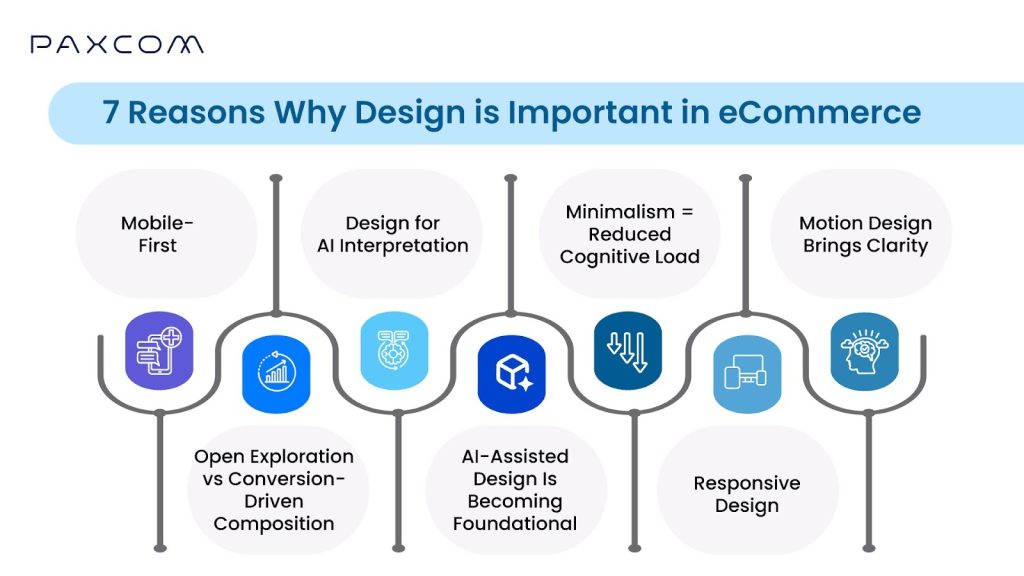
Design in modern commerce is no longer about visual appeal alone. It has become a performance layer, one that directly influences discoverability, trust, and conversion across eCommerce and qCommerce platforms. While new design trends emerge every year, only a few consistently translate into measurable business impact. The difference lies in understanding which design decisions reduce friction, guide intent, and align with how both consumers and AI systems evaluate digital experiences today.
- Mobile-First Is Now About Priority, Not Responsiveness
Most commerce journeys now begin and end on mobile, particularly in qCommerce environments where speed and simplicity define success. Effective mobile-first design goes beyond responsive layouts and focuses on prioritisation—what the user sees first, how quickly value is communicated, and how effortlessly actions can be completed. Clean interfaces, reduced visual clutter, and immediate clarity around pricing, availability, and benefits significantly improve decision velocity and reduce drop-offs.
- Design for AI Interpretation Before Human Interaction
Before a shopper scrolls, an AI system has already scanned your page. Marketplaces, search engines, and answer engines analyse structure, hierarchy, and consistency to determine relevance and visibility. Design that is overly complex or visually inconsistent may look impressive but often underperforms algorithmically. Clear layouts, predictable visual logic, and structured content blocks help AI systems interpret product pages accurately improving ranking, recommendations, and long-term digital shelf performance.
- Minimalism Works When It Reduces Cognitive Load
Minimalist design continues to dominate not because it looks modern, but because it simplifies decision-making. In high-intent moments, fewer distractions lead to faster comprehension. Clean layouts, intentional white space, and focused CTAs help users process information without fatigue. However, minimalism must be functional not empty. The goal is to remove friction, not information, ensuring shoppers have exactly what they need to move forward confidently.
- Motion Design Should Clarify, Not Entertain
Motion graphics have shifted from decorative elements to functional tools. Subtle animations that demonstrate product usage, highlight benefits, or guide attention can significantly enhance engagement when used with restraint. In commerce contexts, motion works best when it answers a question quickly or reduces effort especially in explaining complex features or differentiating products in crowded categories.
- Open Exploration vs Conversion-Driven Composition
Not every page in the commerce journey serves the same purpose. Discovery-focused pages benefit from open compositions that encourage exploration and curiosity. In contrast, product detail pages and checkout flows require closed, conversion-driven compositions that focus attention and eliminate ambiguity. High-performing brands design with intent, adapting visual structure based on where the shopper is in their decision journey.
- AI-Assisted Design Is Becoming Foundational
AI-powered design tools are no longer experimental they are becoming operational essentials. From generating creative variations to maintaining brand consistency across thousands of SKUs, AI enables faster iteration and smarter optimisation. When paired with human judgment, AI-assisted design improves speed-to-market while ensuring creatives remain aligned with performance goals and platform-specific requirements.
- Responsive Design Has Evolved Into Conversion Design
Responsiveness today is less about fitting screens and more about adapting intent. A well-designed experience anticipates how users behave differently on mobile apps, mobile web, and desktop environments. Faster load times, simplified navigation, and app-specific design logic directly influence conversion rates and repeat engagement, especially in high-frequency shopping environments like qCommerce.
What This Means for ECommerce and qCommerce Brands?
Modern commerce design works best when it is intentional, structured, and performance-led. Brands that treat design as a strategic layer, one that supports AI discoverability, reduces decision friction, and aligns with platform behavior consistently outperform those chasing trends in isolation. As eCommerce and qCommerce ecosystems grow more competitive, design is no longer just how a brand looks, but how effectively it converts attention into action.
Why Design Now Decides Digital Shelf Performance (Not Just First Impressions)?
Design has officially moved beyond the awareness stage of the funnel. In modern eCommerce and qCommerce environments, it plays a decisive role in how products are discovered, evaluated, and chosen not just how they are perceived.
On marketplaces and quick commerce platforms, consumers rarely arrive with brand loyalty alone. They arrive with intent, limited attention, and multiple comparable options. What determines which product wins is not only price or ratings, but how clearly and consistently information is presented across the digital shelf.
This is where design becomes inseparable from content optimisation.
Every visual element on a product listing; images, infographics, comparison tables, A+ content, and even spacing directly influences how algorithms interpret relevance and how shoppers process value. A well-designed digital shelf does three critical things simultaneously:
- It helps AI systems understand the product
- It helps shoppers evaluate it faster
- It reduces friction at the moment of decision
When design is inconsistent, outdated, or poorly structured, even strong products struggle with visibility and conversion. When design is optimised, the same product can outperform competitors without changing price or promotions.
In consideration-stage journeys, shoppers are comparing. They scan before they read, trust visuals before claims, and rely on clarity to make quick decisions. Design-led content clear hero imagery, scannable benefit hierarchies, comparison-friendly layouts, and platform-native creatives ensures that your product communicates value instantly.
From a digital shelf perspective, this consistency is critical. Marketplaces reward listings that maintain:
- Uniform branding across SKUs
- Structured, readable content blocks
- Platform-compliant creative formats
- High engagement signals driven by better UX
This is where design optimisation and content intelligence converge.
Design is no longer a one-time creative exercise. It is a living layer of the digital shelf that must be continuously monitored, refined, and aligned with platform behavior, category dynamics, and consumer expectations. Brands that treat design as part of their content optimization strategy are better positioned to improve rankings, increase conversion rates, and scale efficiently across eCommerce and qCommerce platforms.
In short, design no longer supports the funnel, it shapes the outcome of the consideration stage. And in a marketplace-driven world, consideration is where growth is won or lost.
Where Paxcom Fits In ?
Design at scale across eCommerce and qCommerce is not a creative challenge—it’s an operational one.
Paxcom helps brands:
- Align design, content, and digital shelf performance
- Ensure consistency across marketplaces and quick commerce platforms
- Optimise visual and content assets based on real shelf intelligence
- Design not just for humans, but for algorithms, AI, and platforms
When design decisions are informed by data, they stop being subjective and start driving measurable outcomes.
The Bottom Line
Design in modern commerce is no longer about standing out visually—it’s about showing up correctly, consistently, and convincingly wherever the shopper (or AI) encounters your brand.
Brands that win are not the most creative.They are the most intentional.
If you’re rethinking how design supports your eCommerce and qCommerce growth—beyond aesthetics and into performance, Paxcom can help you build, optimise, and scale design systems that actually convert.
Reach out to us at info@paxcom.net or contact us to start aligning your design strategy with your digital shelf strategy.