Amazon FBA in India: how it works, fees and when to use it
Imagine Meera, who runs a small kitchenware brand from Jaipur. She started selling steel water bottles on Amazon.in from her dining table. She now receives around 60 orders a day, and about three times that during a sale. Cartons have taken over her spare room, her two packers struggle to finish before the courier arrives, and a few late dispatches have already turned into poor ratings.
Sellers in Meera’s position often hear the same advice: try Amazon FBA. Amazon FBA, or Fulfillment by Amazon, is a service where you send your products to Amazon’s warehouses, and Amazon stores them, packs and delivers each order, and handles returns and customer queries for you. In return, Amazon charges selling and fulfillment fees, along with storage and other applicable charges.
In this guide, we follow Meera as she works out whether FBA is right for her business. We explain how FBA works, what it costs in 2026, how it compares with Amazon’s other delivery options, and how to get started.
TL;DR
- With Amazon FBA, you send stock to Amazon’s warehouses in India, called fulfillment centers. Amazon stores, packs, and delivers your orders and manages returns and customer service.
- Eligible FBA offers can display the Prime badge, which many shoppers look for. Amazon says some sellers have seen sales rise up to 3x after moving to FBA.
- FBA is not free. You pay a set of fees on every order fulfilled through FBA, plus a monthly charge for the space your stock takes up in the warehouse.
- FBA tends to suit products that sell quickly and are easy to ship. Slow-selling, heavy, or bulky products may be better served by one of Amazon’s other delivery options.
- Many sellers use FBA for some products and a different option for others.
What is Amazon FBA?
Amazon FBA (Fulfillment by Amazon) is a program in which Amazon takes over the storage, packing, and delivery of your products. You still own the products and decide what to sell and at what price. Amazon looks after getting each order to the customer.
To use FBA, you need to be a registered seller on Amazon.in. FBA is something you switch on for individual products, not your whole account. You decide product by product, or more precisely SKU by SKU. A SKU (stock keeping unit) is a single sellable version of a product. For Meera, a 750 ml steel bottle in black is one SKU, and the same bottle in blue is another.
Amazon runs fulfillment centers across several Indian states, including Maharashtra, Karnataka, Delhi, Haryana, Tamil Nadu, Gujarat, and West Bengal, according to its FBA FAQ. There is no subscription fee and no minimum number of units to join. You pay for the services you use.
How does Amazon FBA work?
The easiest way to understand FBA is to follow one shipment. Here is what happens when Meera sends her bottles to Amazon.
- She prepares the stock. Meera packs her bottles to Amazon’s guidelines and checks the barcode requirements for each product and applies Amazon barcode labels where required, so the warehouse can track every unit.
- She sends it to a fulfillment center. She can book Amazon’s pickup service, which collects the boxes from her premises, or use her own courier.
- Amazon stores it. Amazon checks in and processes the shipment before the units become available for sale. Eligible offers then show the Prime badge.
- A customer places an order. When a shopper in Pune orders a bottle, Amazon picks it from the shelf, packs it, and delivers it, including on Pay on Delivery orders.
- Amazon handles returns. If the customer returns the bottle, Amazon processes it. A bottle in good condition goes back into Meera’s stock. Amazon sets a damaged one aside, and Meera has 90 days to decide whether to send it back or dispose of it.
- Meera gets paid. Amazon deducts its fees and releases eligible funds according to her account’s payment schedule, which can vary with her seller level, according to its fees and pricing page.
Meera still owns the stock the whole time. If some bottles do not sell, they remain her cost, and so does the warehouse space they occupy.
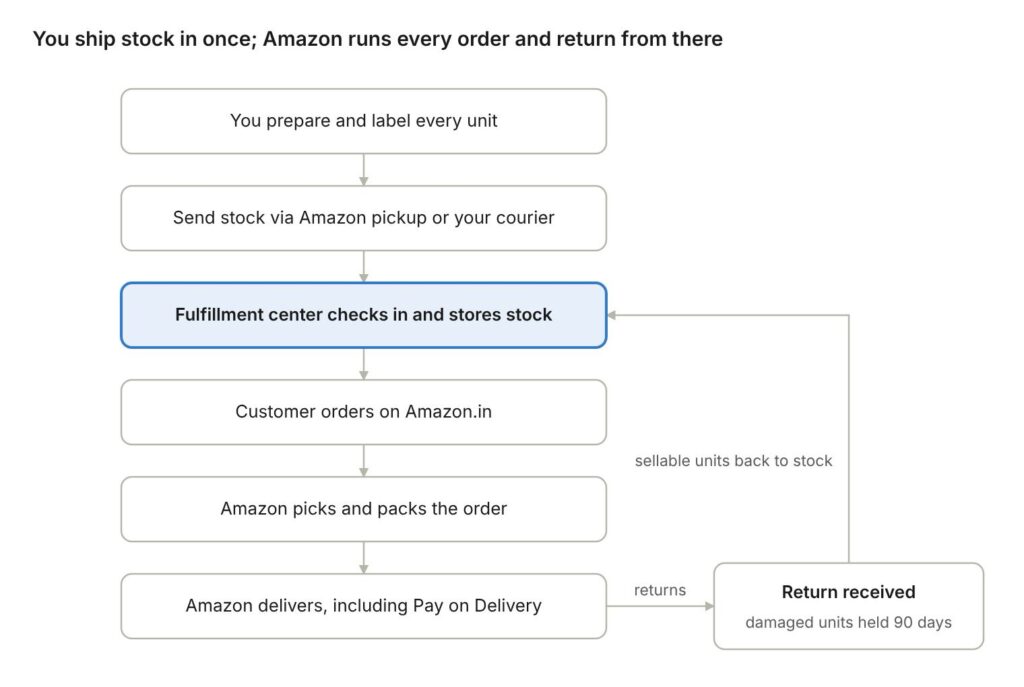
Amazon FBA process diagram for sellers in India · 6 steps and the returns loop
What Amazon handles and what you still handle
FBA takes packing and delivery off Meera’s hands, but it doesn’t run her business for her. This is the part new sellers most often misunderstand.
|
Amazon handles |
You still handle |
|---|---|
|
Storing your products in its fulfillment centers |
Deciding which products to send, and how many |
|
Picking and packing each order |
Your product listings, photos and prices |
|
Delivering orders, including Pay on Delivery |
Advertising and promotions |
|
Customer queries and refunds on FBA orders |
Planning when to restock |
|
Receiving returns |
Packing and labeling stock before you send it |
|
Registering each fulfillment center you use under GST (more on this in the steps below) |
If you are still deciding whether to sell on Amazon yourself or supply Amazon directly, our comparison of Amazon Vendor Central and Seller Central explains the difference.
Benefits of Amazon FBA
For Meera, the benefits go beyond getting her spare room back. How much these benefits matter depends on the products you sell and the category you compete in.
- The Prime badge. Most FBA products are eligible for Prime, apart from large appliances, furniture, and items that need special handling. Prime shoppers get faster delivery, so the badge can make your listing more attractive, especially when competing sellers already have it.
- A better chance at the Featured Offer. When several sellers offer the same product, Amazon shows one of them next to the Add to Cart button. This is called the Featured Offer, or the Buy Box, and most sales go through it. Amazon says FBA improves your chance of winning it, though price, stock levels and your seller rating still matter. More sales can also help you earn the Amazon Best Seller badge.
- Fewer customer service headaches. Amazon answers delivery questions, issues refunds, and collects returns for FBA orders.
- Delivery across India. Amazon says its network delivers to 99% of India’s PIN codes, per its FBA page. How fast a customer gets your product depends on which fulfillment centers hold your stock.
- Room to grow. During a sale, Meera no longer needs extra packers or space. Amazon’s warehouses absorb the extra orders.
What does Amazon FBA cost in India?
There is no single FBA fee. Each time a product sells, Amazon charges a few separate fees, and it also charges every month for the space your stock takes up. Here is what each fee is for, based on Amazon’s fees and pricing page as of October 2026.
|
Fee |
What it pays for |
How much (before GST) |
|---|---|---|
|
Referral fee |
Amazon’s commission on each sale |
A percentage of the selling price, set by category. Zero on items up to ₹1,000 in most categories |
|
Closing fee |
A fixed charge on each order |
Depends on the item price and shipping method. For FBA items up to ₹300, between ₹14 and ₹27 |
|
Weight handling fee |
Delivering the order to the customer |
Depends on the parcel’s weight and how far it travels. Starts at ₹37 |
|
Pick and pack fee |
Picking your product off the shelf and packing it |
₹17 for a standard item up to 1 kg, plus ₹5 for each extra kg up to 5 kg. ₹26 for heavy and bulky items |
|
Storage fee |
The warehouse space your stock uses |
₹50 per cubic foot per month. A cubic foot is roughly a carton 30 cm long, wide and high |
|
Long term storage fee |
Stock that stays in the warehouse for a long time |
An extra charge on stock stored for more than six months [SME to add current rate] |
|
Removal fee |
Getting unsold stock sent back to you |
₹10 per standard item |
|
GST |
Tax on Amazon’s fees |
18% on all the fees above |
One thing to know about weight. Amazon charges on whichever is higher: the actual weight, or the “volumetric” weight, which reflects how much space the parcel takes up (length x width x height in cm, divided by 5,000). A light but bulky product can cost more to ship than its weight suggests.
What changed in 2026. From 16 March 2026, Amazon India stopped charging the referral fee on products priced under ₹1,000 in more than 1,800 categories, according to its press release. In Amazon’s own example, total FBA fees on earphones priced at ₹798 fell from ₹248 to ₹109 per unit. Other fees still apply, and closing fees rose slightly from 7 September 2026.
What this means for Meera’s two products
Meera sells two very different products, and their size, weight and selling price lead to different fulfillment costs.
- Her steel bottle (₹699, about 400 g). Bottles fall in a category with no referral fee up to ₹1,000, so she pays the closing, weight handling, and pick and pack fees, plus GST. The bottle is light and sells every day, so each unit spends only a short time in storage.
- Her cast iron kadai (₹1,800, about 3 kg). For cookware above ₹1,000, the referral fee is 12.5%, about ₹225 per kadai. Pick and pack costs ₹27 because of the extra weight, and the weight-handling fee is higher too. The kadai sells a few times a week, and its large box also adds storage charges while it waits.
[SME: add closing fee, weight handling and GST lines to show a total per unit for each product.]
Amazon’s revenue calculator lets you enter your own product and see the fees for each delivery option side by side. It is worth doing for every product before you send stock to Amazon.
FBA or another option: the four ways to deliver an order
FBA is one of four ways to get orders to customers on Amazon.in, and many sellers use more than one.
- Easy Ship: you store and pack the product, and Amazon collects it from you and delivers it.
- Self Ship: you store, pack and deliver the product yourself or through your own courier.
- Seller Flex: you store and pack the product in your own warehouse to Amazon’s standards, and Amazon collects and delivers it. This option is available by invitation from Amazon only.
In other countries, Easy Ship and Self Ship would usually be called FBM, short for fulfilled by merchant. Here is how the four compare, based on Amazon’s fulfillment channel comparison.
|
FBA |
Easy Ship |
Self Ship |
Seller Flex |
|
|---|---|---|---|---|
|
Who stores the stock |
Amazon |
You |
You |
You |
|
Who packs the order |
Amazon |
You |
You |
You |
|
Who delivers |
Amazon |
Amazon |
You |
Amazon |
|
Prime badge |
Yes |
By invitation only |
Only for nearby customers, through Local Shops on Amazon |
Yes |
|
Pay on Delivery |
Yes |
Yes |
No |
[SME to confirm] |
|
Storage and pick and pack fees |
Yes |
No |
No |
No |
|
Who can join |
Any seller |
Any seller |
Any seller |
By invitation |
|
Often suits |
Products that sell quickly |
Large catalogs with tight margins |
Sellers with their own delivery setup |
Larger brands with their own warehouse |
The main trade-off is how much fulfillment work you want Amazon to handle and what it will cost. FBA costs more per order because Amazon does more of the work, but it brings the Prime badge and a better chance at the Featured Offer. Easy Ship costs less per order, but the storage and packing stay with you.
Is Amazon FBA right for your products?
There is no single right answer for a whole business. The answer usually depends on the product, so it helps to ask a few questions about each one.
- How quickly does it sell? Storage is charged every month. A product that sells within days costs little to store, while one that sits for months keeps adding to the bill.
- How big and heavy is it? Pick and pack and delivery fees rise with weight and size, so small, light products tend to fit FBA more easily.
- Do shoppers in this category expect Prime? If the sellers you compete with already show the Prime badge, not having it may cost you sales. Even if they do not, consider whether faster delivery could influence shoppers’ decisions in your category.
- Is there still enough contribution left after all costs? Contribution is what remains from the selling price after product, fulfillment, advertising and expected return costs. Fees alone do not show whether a product is profitable, so work out the contribution on FBA and on Easy Ship for the same product.
When Meera ran through these questions, each product had a different answer. Her bottles sell daily, are light, and compete with Prime listings, so she moved them to FBA. Her kadai is heavy and sells more slowly, so she kept it on Easy Ship for now and plans to revisit it once sales pick up.
From our work with brands [Paxcom account team to supply, B-04]: when we reviewed [number] products for [a top five FMCG brand in India] over [period], [x] moved to FBA and [y] stayed on Easy Ship, and FBA products converted at [x]% against [y]% on Easy Ship. If you would like a similar product-by-product review of your catalog, see how we work through Marketplace Seller Solutions.
If anonymized data is not cleared before publishing, delete the paragraph above and keep only the Marketplace Seller Solutions link in a single sentence.
How to start using Amazon FBA in India
Once Meera decided which products to move, getting started took six steps. The first three are one-time setup. The last three become part of the routine each time she sends stock.
1. Set up your Amazon Seller Central India account
Seller Central is the dashboard where you manage everything you sell on Amazon.in. If you are new, you will add your business details, GST number, and bank account, and list at least one product. Our guide on how to become an Amazon seller walks you through registration. Meera already had an account, so she could move straight to step 2.
2. Sign up for FBA
In Seller Central, open the FBA section and choose to join FBA [SME to confirm current menu label]. You will also choose the fulfillment centers you want to use. It usually makes sense to pick centers close to most of your customers, rather than close to your own warehouse.
3. Add the fulfillment centers to your GST registration
Because your stock will sit in Amazon’s warehouses, the tax department treats each fulfillment center as one of your business locations. You or your CA will need to add each one to your GST registration as an Additional Place of Business before sending stock. If a fulfillment center is in a state where you are not registered yet, you will generally need to register in that state as well [CA to confirm wording].
4. Switch your products to FBA and prepare the stock
In Seller Central, change the delivery setting on each product from yourself to Amazon [SME to confirm current menu path]. Then get the stock ready. Each unit needs a barcode Amazon can scan, either an eligible manufacturer barcode or an Amazon barcode label where required, and fragile items need extra protective packaging. Meera measured and weighed each packed bottle at this stage, since Amazon’s fees are based on these figures.
5. Create a shipment and send your stock
In Seller Central, create a shipment listing the products and quantities you are sending, print the box labels, and book a delivery slot. You can send the boxes through Amazon’s pickup service (ATS), which collects them from your premises, or through your own courier. Your products become available once Amazon has checked in and processed the shipment.
6. Keep an eye on your stock
Check your stock levels and storage charges regularly, ideally every week. Restock fast sellers before they run out, and plan ahead of big sale events so your stock reaches Amazon before demand rises. If a product has been sitting for a while, consider a price change or bringing it back before it reaches six months and starts attracting long-term storage fees.
Screenshots: one annotated Seller Central screenshot for each of steps 2, 4 and 5, with numbered callouts. Redact seller IDs, GSTIN, and revenue.
Common Amazon FBA mistakes and how to avoid them
Most FBA problems come from a handful of avoidable decisions rather than from the fees themselves.
|
Mistake |
What to do instead |
|---|---|
|
Sending every product to FBA |
Start with the products that sell fastest. Slow sellers keep adding to your storage bill until they sell. |
|
Restocking too late for festive sales |
Send stock for the October to December sale season well in advance, so it is received and live before demand rises. |
|
Shipping before the GST update is done |
Add each fulfillment center to your GST registration before your first shipment. |
|
Guessing the size and weight |
Measure and weigh each product in its packaging. Fees are based on these figures, so incorrect measurements can lead to inaccurate fee estimates and unexpected charges. |
|
Assuming FBA is free for products under ₹1,000 |
Only the referral fee is waived. Closing, delivery, pick and pack and storage fees still apply. |
SOP rule: rows must come from Paxcom account team notes. Account team to confirm or replace each row before publishing.
Amazon FBA FAQs
What is the full form of FBA on Amazon?
FBA stands for Fulfillment by Amazon. It is a service in which Amazon stores your products in its warehouses, then packs and delivers your orders and handles returns for you.
Is Amazon FBA storage free or unlimited?
No. Amazon charges a monthly fee based on how much space your stock takes up in its warehouse. Stock that stays for more than six months also attracts an extra long-term storage fee.
Do I need a separate GST registration for Amazon FBA?
You do not need a new GST number for a fulfillment center in a state where you are already registered, but you do need to add it to your registration as an Additional Place of Business. A fulfillment center in another state will generally need a GST registration in that state.
Does Amazon FBA guarantee the Buy Box?
No. FBA can improve your chances of winning the Buy Box, also called the Featured Offer, but your price, stock levels, and seller rating also play a part.
Is Amazon FBA cheaper than Easy Ship?
Per order, FBA usually costs more because it includes storage and pick-and-pack fees that Easy Ship does not. For products that sell quickly, the Prime badge and better Buy Box chances can make up for the extra cost, so it is worth comparing product by product.
Is FBA free for products under ₹1,000 after the 2026 fee cut?
No. Only the referral fee is waived, and only in eligible categories. The closing, delivery, pick and pack and storage fees still apply, along with 18% GST on those fees.
Making FBA work for your business
For Meera, FBA did not have to be an all-or-nothing decision. Moving her best-selling bottles freed up her space and her evenings, while keeping the kadai on Easy Ship kept her storage costs in check.
The same approach can work for most sellers. Start with the products that sell fastest and are easiest to ship, watch the fees and storage charges for a few months, and review your choices whenever Amazon updates its fees.
Related reading:
- How to become an Amazon seller in India
- Amazon Vendor Central vs Seller Central
- How to win the Amazon Best Seller badge
- Paxcom case studies
Planning to sell to customers in the US from India? That works through a separate program, covered in our guide to Amazon Global Selling for the USA.
Not sure which of your products belong in FBA? Book a consultation with the Paxcom marketplace team