TL;DR
Amazon Rufus is a conversational shopping assistant that recommends products based on user intent and needs, not keyword matching. It works with Amazon’s backend AI system, Cosmos, which interprets product data using semantic understanding. Sellers must shift from keyword-heavy SEO to context-rich product data, structured backend attributes, and image clarity to remain visible in AI-driven Amazon discovery.
Table of Contents
What Is Amazon Rufus?
Amazon Rufus is an AI-powered conversational shopping assistant that helps customers discover products by asking natural language questions instead of typing exact keywords.
Unlike traditional Amazon search, Rufus focuses on:
- Use cases
- Problems
- Intent
- Context
Example:
Instead of searching “running shoes men,” a shopper may ask:
“What shoes help reduce knee pain during long runs?”
Rufus responds with recommendations, not rankings.
Also Read: How Amazon Uses Artificial Intelligence to Boost E-Commerce
How Amazon Rufus Works With Cosmos
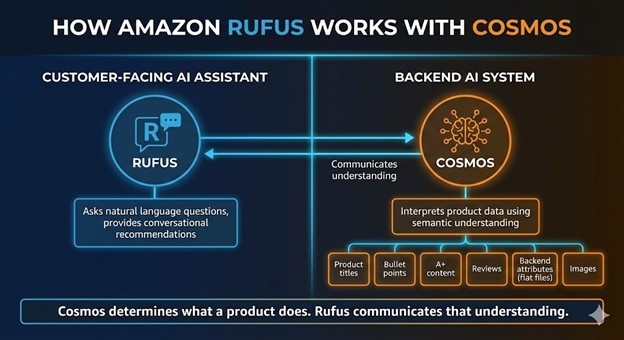
Amazon Rufus does not work alone.
Amazon Rufus + Cosmos Explained Simply
- Rufus = Customer-facing AI assistant
- Cosmos = Amazon’s backend AI system that understands products
Cosmos analyzes:
- Product titles
- Bullet points
- A+ content
- Reviews
- Images
- Backend attributes (flat files)
Cosmos determines what a product does.
Rufus communicates that understanding to shoppers.
If Cosmos cannot clearly understand a product’s purpose, Rufus does not recommend it.
Why Keyword Rankings Are Becoming Less Important
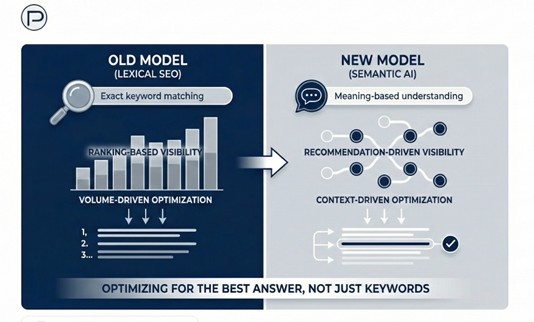
Amazon’s AI-driven discovery represents a shift from lexical matching to semantic understanding.
Old Model (Lexical SEO)
- Exact keyword matching
- Ranking-based visibility
- Volume-driven optimization
New Model (Semantic AI)
- Meaning-based understanding
- Recommendation-driven visibility
- Context-driven optimization
In simple terms:
Sellers are no longer optimizing for keywords.
They are optimizing to be the best answer.
How AI Changes Amazon Product Copywriting
Key Principle:
AI systems need explicit connections between features, benefits, and use cases.
Example
❌ Feature-only copy:
“Breathable mesh upper”
✅ AI-readable copy:
“Breathable mesh upper prevents overheating during long-distance marathon training.”
Why this works:
- Defines the feature
- Explains the benefit
- Specifies the use case
AI systems like Cosmos do not reward vague descriptors.
They reward clear intent mapping.
The Query Fan-Out Framework (How Rufus Thinks)
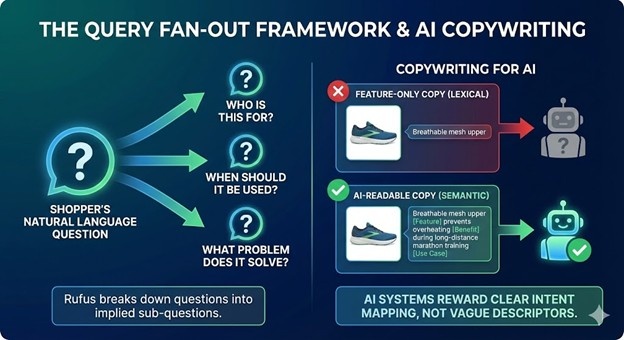
When a shopper asks a question, Rufus breaks it into implied sub-questions.
Your product content should answer:
1. Who Is This For?
Example:
“Designed for flat-footed runners and overpronators.”
2. When Should It Be Used?
Example:
“Best for humid outdoor runs and summer training.”
3. What Problem Does It Solve?
Example:
“Reduces knee strain and shin splints on hard surfaces.”
Rufus can infer—but inference reduces confidence.
Explicit answers improve visibility.
Why Backend Attributes (Flat Files) Matter More Than Ever
Flat files are the primary communication layer with Cosmos.
Structured backend attributes help AI systems:
- Classify products accurately
- Match products to intent-driven queries
- Reduce ambiguity
If a backend field is empty, Cosmos assumes:
“This feature does not exist.”
This directly impacts whether Rufus recommends a product.
Old SEO vs. AI-Driven Amazon Discovery
Aspect | Traditional SEO | Rufus + Cosmos AI |
Discovery Model | Keyword search | Conversational answers |
Optimization Focus | Titles & bullets | Structured data + context |
Shopper Behavior | Exact queries | Problem-based questions |
Visibility Outcome | Rankings | Recommendations |
How Amazon AI Interprets Product Images
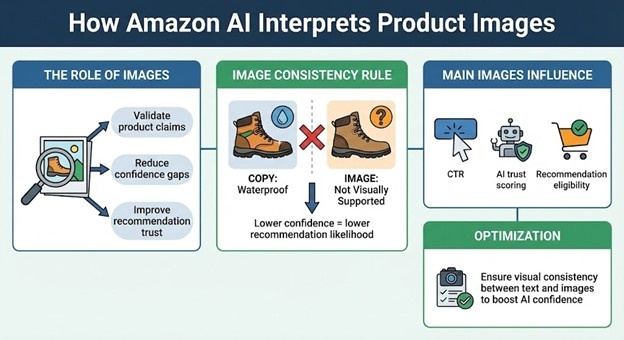
Amazon’s AI systems analyze images alongside text.
Images are used to:
- Validate product claims
- Reduce confidence gaps
- Improve recommendation trust
Also Read: AI in CPG (Consumer Packaged Goods): Invisible Digital Shelf
Image Consistency Rule
If your copy says “waterproof” but your image does not visually support it, AI confidence drops.
Lower confidence = lower recommendation likelihood.
Main images now influence:
- Click-through rate (CTR)
- AI trust scoring
- Recommendation eligibility
Also Read: Shape of Indian eCommerce
The Shift From Search Economy to Answer Economy
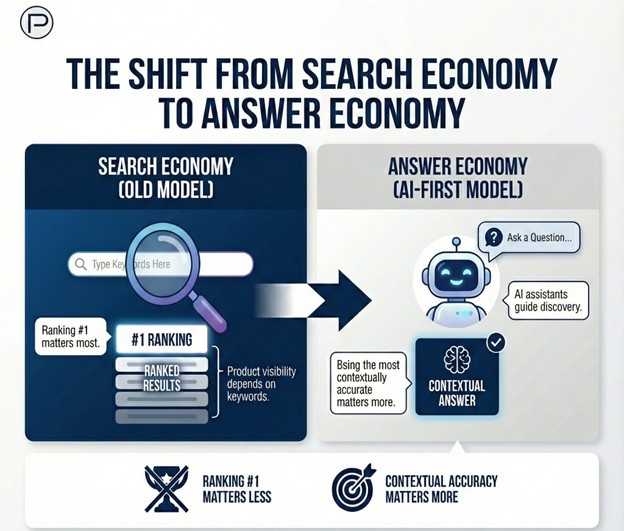
Amazon is actively testing AI-first shopping experiences where:
- The search bar is minimized or removed
- AI assistants guide discovery
- Product visibility depends on answer quality
In this environment:
- Ranking #1 matters less
- Being the most contextually accurate product matters more
What Amazon Sellers Should Do Now (Action Checklist)
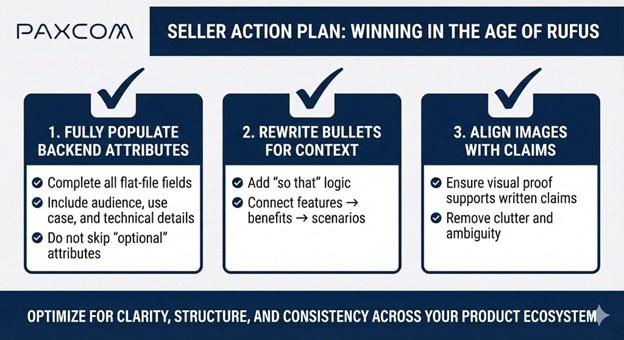
1. Fully Populate Backend Attributes
- Complete all flat-file fields
- Include audience, use case, and technical details
- Do not skip “optional” attributes
2. Rewrite Bullets for Context
- Add “so that” logic
- Connect features → benefits → scenarios
3. Align Images With Claims
- Ensure visual proof supports written claims
Remove clutter and ambiguity
Final Takeaway
Amazon Rufus represents a shift from search-based discovery to answer-based recommendations. Sellers who structure their product data for clarity, context, and intent alignment are more likely to be surfaced by AI systems like Rufus and Cosmos.
How Paxcom Helps Brands Win Visibility in the Age of Rufus AI
Amazon Rufus and Cosmos don’t reward tactics.
They reward clarity, structure, and consistency across your entire product ecosystem.
This is where most sellers struggle—not because they don’t try, but because the work spans content, data, images, and intent mapping across marketplaces.
That’s exactly the gap Paxcom works in.
Explore Paxcom’s GEO Framework
If you want to understand how your brand shows up (or doesn’t) in AI-driven discovery today, start here:
👉 Generative Engine Optimization (GEO)
https://paxcom.ai/geo-generative-engine-optimization/