TL;DR:
Google is still where users browse and compare; AI search is where decisions are increasingly shaped. While AI-driven traffic remains smaller in absolute volume today, its influence is growing faster than any other discovery layer. ChatGPT crossed 800M+ weekly active users, AI-generated answers now appear in 15–30% of commercial queries (by category), and referral traffic from AI tools shows consistent month-on-month growth with higher conversion intent.
The shift is structural: a single AI response can now replace multiple search results, comparison pages, and PDP visits. Visibility is moving upstream—before the click, and often without one. This is why AEO and GEO matter for eCommerce brands. AI systems reinforce the sources, products, and signals they already trust. Brands that invest early in generative engine optimization, answer engine optimization, digital shelf accuracy, and AI discovery readiness build compounding visibility as conversational commerce and AI shopping agents scale toward 2026.
The Shift in How eCommerce Gets Discovered in the AI Era
The Rules of eCommerce Discovery Are Quietly Changing. For years, eCommerce visibility followed a familiar pattern:
rank for keywords, win ad placements, optimize PDPs, and drive clicks.
That model still matters — but it is no longer the full picture.
Today, product discovery is increasingly shaped by AI-driven product discovery across search engines, marketplaces, voice assistants, and conversational interfaces. Consumers are no longer just typing queries into search bars; they are asking questions, seeking recommendations, and expecting instant, contextual answers.
Instead of scrolling through ten blue links, shoppers now encounter AI-generated responses that summarize options, highlight brands, and suggest products, often before a single click happens.
This shift is fundamentally changing how visibility works in eCommerce.
Also Read: AI Trends in eCommerce: 9 Non-Negotiables for Modern Brands
From Search Results to AI Answers
Modern discovery journeys often look like this:
- “What’s the best protein supplement for daily use?”
- “Which skincare brand is good for sensitive skin?”
- “What can be delivered in 15 minutes near me?”
These queries trigger answer engines and generative AI systems, not just traditional search rankings. The brands that surface in these responses are not chosen randomly, they are selected based on structured data, relevance signals, brand authority, and content clarity.
This is where Generative Engine Optimization (GEO) and Answer Engine Optimization (AEO) come into play.
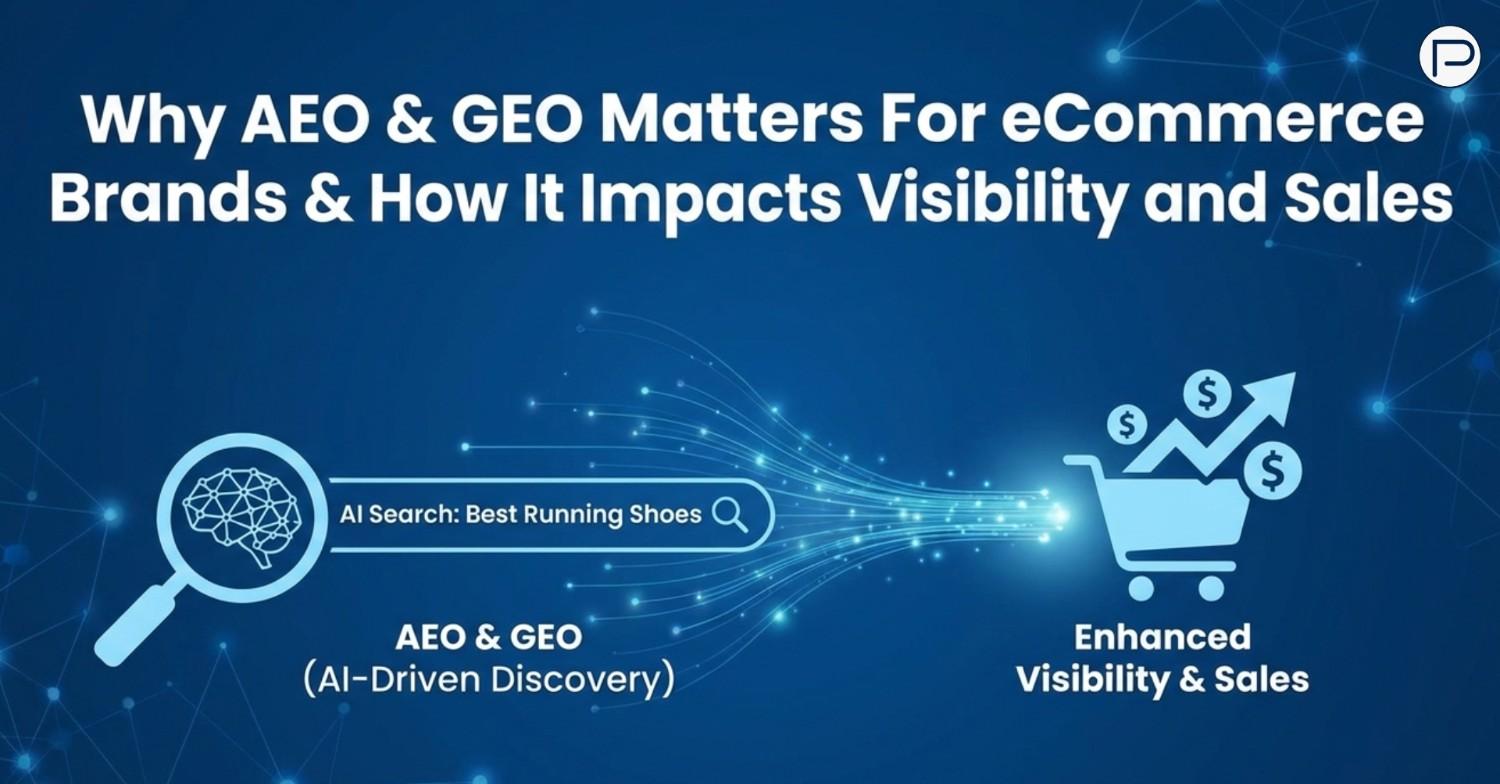
Why AEO &GEO Matters for eCommerce Brands
As AI search and conversational commerce accelerate, visibility is no longer only about ranking, it is about being referenced, cited, and recommended by AI systems.
For eCommerce brands, this means:
- Visibility may occur without a click
- Consideration can happen inside AI responses
- Purchase intent is shaped before users reach a PDP
Brands that are not optimized for this new discovery layer risk becoming invisible, even if their products are listed, priced competitively, or well-reviewed.
In the sections ahead, we’ll break down what GEO and AEO are, how they differ from traditional SEO, and how they directly impact eCommerce visibility and sales in 2025 and beyond.
How Discovery Works in the Age of AI; Understanding GEO & AEO
To understand how GEO (Generative Engine Optimization) and AEO (Answer Engine Optimization) really impact eCommerce visibility and sales, we must first grasp how search and discovery itself has evolved.
AI isn’t optional anymore, it’s table stakes
AI is no longer a fringe experiment in online retail in 2025, it has become a core driver of how brands discover customers and how shoppers discover products. According to eComposer, roughly 77 % of eCommerce professionals reported using AI daily in their operations, while around 80 % of retail executives expected their organisations to adopt AI automation by the end of 2025. These tools are transforming everything from personalisation to inventory planning to search relevance at scale.
As per Dotdesh, more than 89 % of retailers are already using or actively testing AI technologies in eCommerce, a clear signal that AI is essential for future competitiveness, not merely an optional upgrade.
From keywords to intent, the shift in discovery
Traditional SEO has long been the foundation of product discoverability in digital retail, driven by keyword matches and ranking algorithms. But this approach is losing ground to AI-led discovery signals, especially as AI search, conversational agents, and generative interfaces take centre stage.
In 2025, notable trends emerged:
AI-powered shopping assistants and chatbots can now not only answer product queries but guide users through personalised recommendations and even complete purchases. Leading tech players such as OpenAI, Google, and others are developing AI shopping agents that can autonomously browse, select, and even check out on behalf of users, fundamentally reshaping how consumers shop online.
Financial Times
This change influences not just traffic patterns, but fundamentally the quality of traffic. Businesses that appear optimised for AI-driven responses, not just traditional search, enjoy higher relevance and engagement simply by aligning with intent, not just keywords.
Where AEO fits into this transformation
Answer Engine Optimization (AEO) refers to the practice of structuring and enriching your product and content data so that AI models and answer engines select your content as the best response to user prompts. Unlike traditional search engines that return long lists of links, AI/answer engines deliver concise, intent-matched recommendations — often directly in the interface users are interacting with (e.g., ChatGPT, AI assistants embedded in marketplace apps, browser plugins).
Also Read: AI in CPG (Consumer Packaged Goods): Invisible Digital Shelf
This means:
- Users may never see a traditional results page
- Products might be cited within AI responses
- Structured data (product attributes, FAQs, use cases) becomes a competitive differentiator
Brands that ignore AEO risk becoming invisible even if they rank well in classic search listings.
GEO: expanding optimisation beyond words
Generative Engine Optimization goes beyond keywords and structured content. It involves tuning your product data, digital signals, and semantic patterns to align with generative models’ understanding of relevance.
This includes:
- Consistent, accurate product attributes
- Clear narrative around use cases and benefits
- Rich, structured FAQs and schema
Signals that generative models use to score relevance
In practice, this means that two brands with the same product might rank differently in an AI-generated recommendation because one has more coherent, intention-aligned data.
The shift from keyword matches to signal alignment is where GEO diverges from traditional SEO, and why brands must rethink discoverability in the AI era.
How GEO & AEO Directly Impact eCommerce Visibility
As AI-led discovery grows, the ways shoppers find products are being reshaped — and that drill-down has direct consequences on visibility, traffic patterns, and sales outcomes. GEO (Generative Engine Optimization) and AEO (Answer Engine Optimization) aren’t abstract concepts anymore, they are part of the economic mechanics of online retail.
AI-Driven Discovery Is Already Redirecting Visibility. By 2025, AI had moved well beyond novelty and into mainstream digital discovery. In fact: AI-powered search results now appear in roughly 91 % of product-related queries, a trend that fundamentally shifts visibility metrics from “traditional keywords only” to AI-answer indexing.
In AI search contexts like ChatGPT and generative platforms, consumers aren’t sifting through blue links, they are being shown summarised answers, product recommendations, and conversational suggestions.
These shifts aren’t theoretical. They mean search engines and generative agents are competing for attention with clickable web results. For brands, this introduces both opportunity and risk:
- Opportunity: Products that are structured, contextually rich, and aligned with intent stand a better chance of being cited as answers, not just ranked.
- Risk: Even top-ranking SEO listings can be bypassed if generative systems summarise alternatives that don’t link to your PDP at all.
A report recently revealed that search analyses show that AI Overview features (Google/Bard/LLM summaries) now appear for a significant share of commercial queries, triggering in around 16 % of searches, where 80 % of the cited sources did not rank organically in traditional search results.
This statistic highlights a core reality: being #1 in organic search no longer guarantees visibility in AI-powered discovery. AI agents may gather multiple sources, summarise them, and only then choose what to present, and traditional ranking alone won’t get you into that answer.
That’s where GEO & AEO become visibility mechanisms, not just rankings.
The Revenue Link: Visibility → Consideration → Sales
When visibility itself changes shape, so does the conversion funnel.
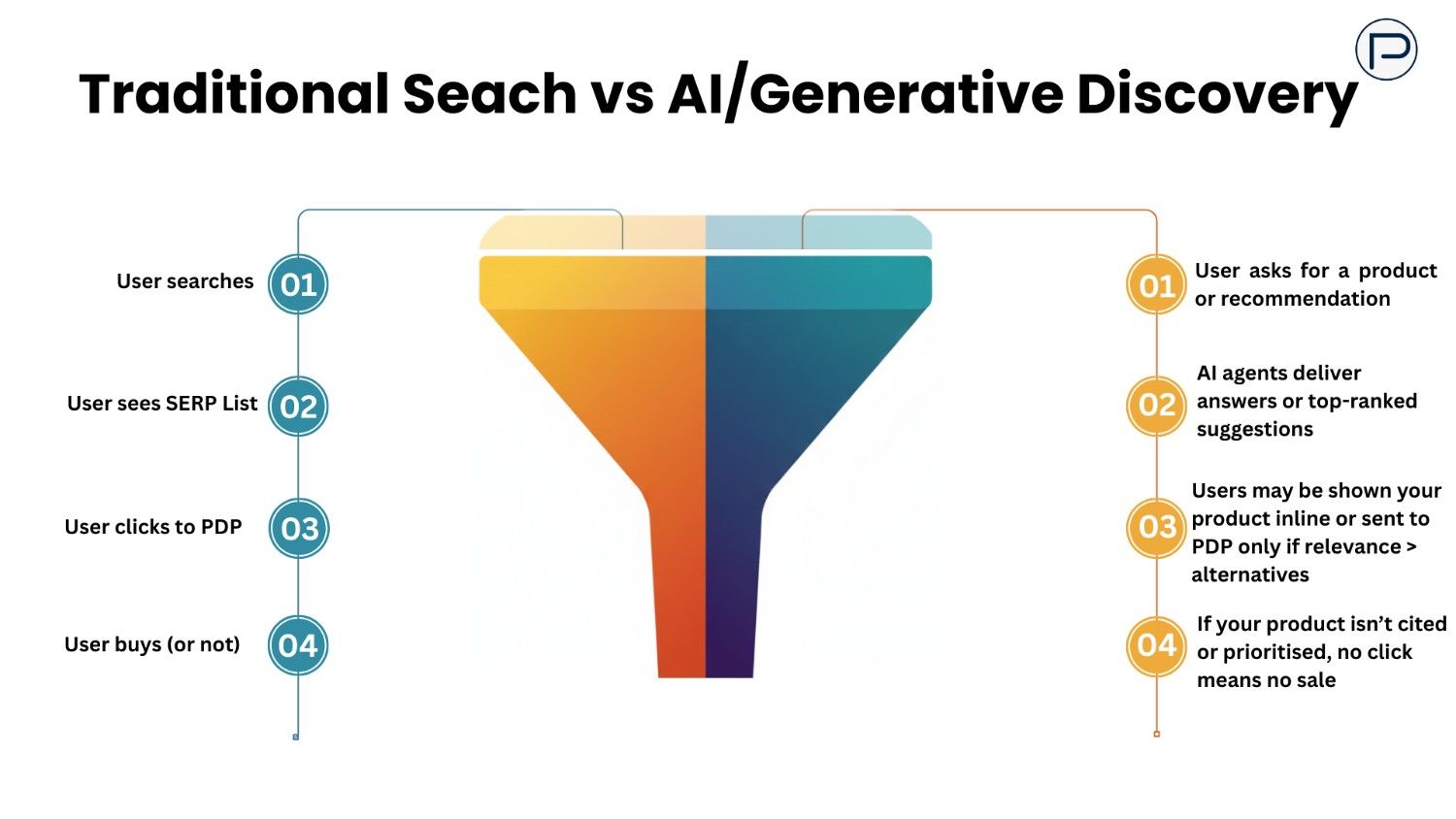
Studies suggest that brands cited directly in AI recommendations may see conversion improvements, simply because the friction between intent and action is reduced. AI-generated suggestions bypass traditional barriers like click stacking, multi-page redirects, or ambiguous category listings.
This means that higher visibility via AEO/GEO can deliver not just traffic, but higher-intent traffic.
What the Early Returns Show for 2026
Industry trends into 2026 reinforce this direction:
- AI in eCommerce is forecasted to grow rapidly, with the overall AI market expected to reach billions more as technology adoption deepens. For example, the AI market in eCommerce was valued at $9.01 billion in 2025, and retailers are widely increasing AI spend and adoption.
- 97 % of retailers plan to increase AI investment, signaling that visibility optimisation, including for AI systems, will remain a core strategic priority.
These trends outline a clear strategic shift: brands that don’t align with AI visibility through GEO & AEO, risk losing incremental revenue to competitors who do.
AI Discovery Isn’t Just Search — It’s the New Path to Purchase
Finally, it’s important to recognise that visibility in the AI era isn’t limited to search pages:
Conversational commerce and assistant recommendations can occur on chat interfaces, voice platforms, and app-embedded experiences — making AI discovery a multi-touchpoint reality.
promptwire.co
With consumers increasingly relying on conversational prompts or direct recommendations, a product that never appears in those pathways may be skipped entirely, even if it ranks well traditionally.
Which brings us logically to the next section — how to operationalise GEO & AEO for your product catalog in ways that directly improve visibility and sales.
How GEO & AEO Influence Sales Outcomes (Beyond Clicks)
In the AI-led discovery era, sales are no longer won at the click stage — they’re won at the answer stage. GEO and AEO compress this journey by ensuring your product is recommended, cited, or prioritised before a shopper ever lands on a PDP.
From Traffic Volume to Traffic Quality
AI-driven discovery changes who reaches your product:
- AI answers filter options upfront, exposing users only to high-relevance products
- Fewer impressions, but higher purchase intent
- Reduced dependency on discount-led persuasion
In practical terms, brands optimised for AI-driven product discovery often see:
- Higher conversion efficiency
- Lower bounce rates
- Faster path to purchase
This is because AI recommendations are context-aware, factoring in use case, availability, price sensitivity, and historical relevance rather than surface-level keywords.
The Compounding Effect Into 2026
As AI shopping agents and conversational commerce mature:
- Fewer brands will be shortlisted per query
- Recommendation slots will become more competitive
- Visibility will increasingly favour data-ready, intent-aligned catalogs
By 2026, this creates a clear divide:
- Brands optimised for GEO & AEO win repeat AI exposure
- Others rely more heavily on paid media to compensate for organic invisibility
Key Takeaway for eCommerce Leaders
GEO and AEO don’t just improve discoverability, they reduce friction between intent and conversion.
They determine whether your product enters the buying conversation at all.
Turning GEO & AEO Into a Measurable Advantage
Understanding GEO and AEO is only the first step. The real advantage for eCommerce brands comes from operationalising AI-led visibility in a way that is measurable, repeatable, and scalable.
As we move into 2026, visibility is no longer about where you rank, it’s about whether AI systems trust, reference, and recommend your products at the moment of intent.
From AI Visibility to Business Outcomes
GEO and AEO influence three critical commercial levers:
- Higher-Intent Discovery
AI-driven discovery surfaces products after interpreting user intent. This means brands that appear in AI responses are often entering the funnel closer to conversion, not at the awareness stage. - Reduced Dependency on Paid Discovery
When products are consistently cited or recommended by AI systems, brands reduce over-reliance on paid search and sponsored placements to remain visible. - Compounding Visibility Effects
Unlike traditional campaigns that reset with budgets, AI-driven visibility compounds over time. Clean data, structured content, and consistent signals reinforce future recommendations.
This is why forward-looking brands are treating AI discoverability as a long-term asset, not a one-time optimisation.
Why Data Accuracy Becomes Non-Negotiable
AI systems don’t “interpret” messy data generously.They prioritise:
- Accurate product titles and attributes
- Consistent pricing and availability signals
- Clear use-case descriptions and FAQs
- Reliable digital shelf presence across platforms
Even small inconsistencies, outdated images, mismatched attributes, missing keywords — can weaken a product’s eligibility for AI-driven recommendations.In practical terms, GEO success depends heavily on digital shelf health.
Where Digital Shelf Analytics Fits In
This is where brands move from theory to execution.
To compete effectively in AI-led discovery, teams need:
- Continuous monitoring of product visibility across platforms
- Clear insight into where listings break or degrade
- Signals that explain why certain products surface and others don’t
Digital shelf analytics acts as the feedback loop for GEO and AEO efforts, helping brands understand what AI systems are “seeing” and responding to.
Instead of guessing how visibility shifts impact performance, brands can measure, refine, and optimise with confidence.
The Strategic Shift for 2026
As AI adoption accelerates, one thing is clear:
Brands that treat GEO and AEO as isolated SEO tactics will struggle. Brands that integrate them into content, analytics, and campaign execution will win.
The future of eCommerce visibility isn’t louder messaging, it’s clearer signals. And those signals must be built, tracked, and refined continuously.
A Practical GEO & AEO Readiness Checklist for eCommerce Brands
As AI-led discovery reshapes how products are surfaced, brands need to move from awareness to execution. GEO and AEO success doesn’t come from one-off optimisations — it comes from systematic readiness across content, data, and visibility signals.
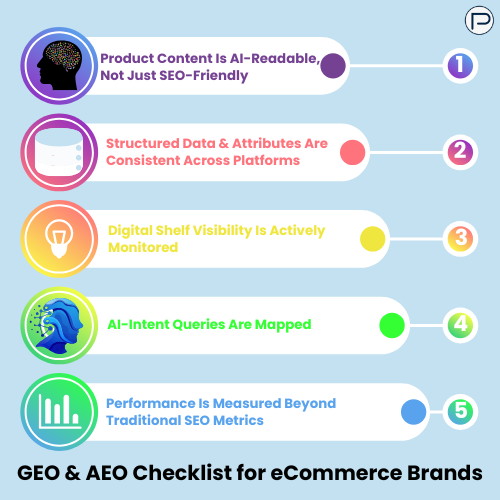
Here’s a practical checklist eCommerce teams can use to assess where they stand today and what needs fixing before 2026.
1. Product Content Is AI-Readable, Not Just SEO-Friendly
- Product titles clearly describe what the product is, who it’s for, and where it fits
- Descriptions go beyond features to include use cases and problem-solution language
- FAQs are written in natural, conversational formats aligned with how users ask questions in AI tools (critical for Answer Engine Optimization)
Why it matters: AI systems prioritise clarity and intent over keyword stuffing.
2. Structured Data & Attributes Are Consistent Across Platforms
- Core attributes (price, size, variants, availability) are accurate and synchronised
- Product data is structured in a way that AI systems can interpret, summarise, and cite
- No conflicting information across marketplaces, brand sites, or quick commerce platforms
Why it matters: Inconsistencies reduce trust signals and lower the chance of being surfaced in AI-generated answers.
3. Digital Shelf Visibility Is Actively Monitored
- Brands know where and how their products appear across marketplaces
- Visibility gaps (missing keywords, broken images, incorrect categorisation) are identified early
- Competitive benchmarking is done regularly, not reactively
Why it matters: GEO isn’t just about being present, it’s about being preferred.
4. AI-Intent Queries Are Mapped
- Teams understand the types of questions AI users ask (e.g., “best”, “compare”, “recommended for”)
- Content is aligned to informational, comparative, and transactional AI prompts
- Product narratives support recommendation-style discovery, not just search listings
Why it matters: AI discovery compresses the funnel, brands must appear earlier in the decision moment.
5. Performance Is Measured Beyond Traditional SEO Metrics
- Visibility is tracked beyond rankings and impressions
- Signals like share of shelf, content accuracy, and discoverability are monitored
- Teams connect visibility data to conversion and revenue impact
Why it matters: GEO success isn’t measured in clicks alone, it’s measured in qualified presence.
How Paxcom Helps Brands Operationalise GEO & AEO
This is where theory turns into execution.
Paxcom helps brands prepare for AI-led discovery by combining data intelligence, digital shelf analytics, and GEO-focused optimisation into a single, actionable framework.
With Kinator, brands can:
- Track digital shelf visibility across marketplaces and quick commerce platforms
- Identify content gaps that impact AI and answer-engine discovery
- Monitor competitor visibility and category-level shifts
- Ensure product data consistency, a foundational signal for GEO
Paired with Paxcom’s GEO services, brands can:
- Align product content for AI-driven product discovery
- Optimise FAQs and structured data for answer engines
- Prepare product catalogs for future AI search and shopping agents
The result?
Better visibility, higher relevance, and stronger conversion outcomes — not just today, but as AI discovery becomes the default.
Closing Thought
GEO and AEO aren’t future concepts, they’re already shaping how consumers discover, compare, and buy products. Brands that start preparing now will own visibility tomorrow. Those that don’t may never even enter the conversation.
Reach out to us at info@paxcom.net for more!