Show up in AI answers, not
just search results
We optimize your product pages, marketplace listings, and content so ChatGPT, Gemini, Perplexity, and Copilot can confidently recommend your brand.

Why AI ‑led
discovery now
Consumers increasingly ask AI systems for product advice. Traditional SEO alone won’t earn you a place in those answers.
We align your content, structure, and signals so your brand is confidently cited by AI
The Old Playbook is Losing Ground
Invisibility

Data Gaps

Authority

Semantic
Invisibility
Your product data is rich, but it's not structured for AI. You're losing conversations because search engines can't parse your true value
Structured
Data Gaps
Without proper schema markup and AI-friendly metadata, your brand is invisible to the generative models that power new discovery platforms
Missed
Authority
Every AI-recommended product is an earned mention. By not speaking the language of generative search, you're missing a new, high-value source of traffic
Introducing AI-led Product Discovery

AI-led discovery is our proprietary framework engineered to align your brand with the future of digital discovery. We make your products conversational, discoverable, & authoritative in an AI-first world.
Conversational Content
We transform your listings with natural, semantic language that directly answers customer questions, making your brand a conversational expert.
Structured Metadata
We implement robust JSON-LD, schema, and API-visible tags to give AI models a clear, concise blueprint of your product.
Authority Building
Our strategy goes beyond your site, building a digital footprint that positions your brand as a trusted authority in generative search results.
Conversational Content
We transform your listings with natural, semantic language that directly answers customer questions, making your brand a conversational expert.
Structured Metadata
We implement robust JSON-LD, schema, and API-visible tags to give AI models a clear, concise blueprint of your product.
Authority Building
Our strategy goes beyond your site, building a digital footprint that positions your brand as a trusted authority in generative search results.
How Search is Evolving?
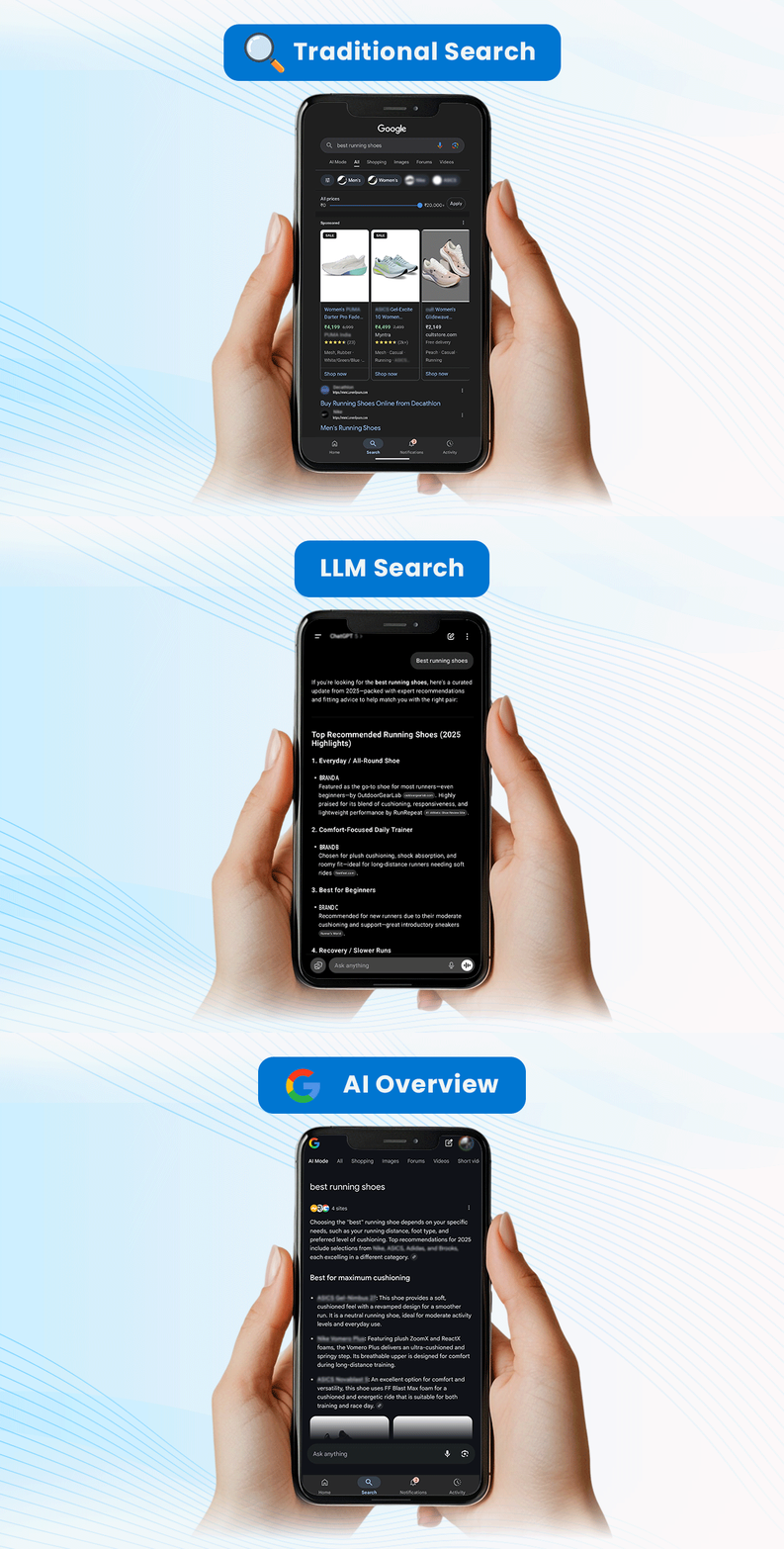
Paxcom’s AI Share of
Search Tracker

This is Designed for AI Discover Era
Tracks if you’re being cited in GPT answers (even in sign-out mode)
Identifies who’s winning visibility on your priority prompts
Gives you a semantic visibility score-so you can monitor, benchmark, and improve

Our Coordinated Process
Structured Metadata
We analyze your current digital presence and identify content gaps by simulating AI-driven customer queries.
Optimization Blueprint
We craft a detailed framework for your product listings, focusing on semantic content and structured metadata.
Implementation & Scaling
We deploy optimized content with seamless integration & technical precision; submitting listings for citations, enabling LLM crawlability, & structuring site architecture for better discovery.
Tracking & Growth
We monitor AI-driven traffic and continuously refine your strategy to ensure sustained visibility and brand authority.
Let's map your GEO plan
Join forward-thinking brands who are already winning in the Al-first world.
FAQ's
Generative Engine Optimization (GEO) is a process used to format website content so that Large Language Models (LLMs) and AI search engines can easily read and cite it. While traditional SEO optimizes for ranking links on a search results page, GEO optimizes for inclusion in the direct answers generated by AI tools like ChatGPT, Claude, and Google’s AI Overviews. It focuses on structure, citation, and factual clarity rather than keywords.
An LLM-based search uses a large language model to answer questions in plain language. Instead of matching keywords, the model interprets the meaning of the query and provides a direct response. These systems often summarise information, compare products, or create shortlists instead of showing a traditional results page.
Amazon uses machine-learning models to analyse a shopper’s browsing, purchase history, and product behaviour. Based on these patterns, the system predicts which items a user may want to see next. These recommendations appear in areas like “Recommended for you,” “Frequently bought together,” and “Customers also viewed.”
AI product recommendations are suggestions created by algorithms that study user behaviour, product details, and browsing patterns. The goal is to show items that match a shopper’s needs, preferences, or past activity. This is commonly used on eCommerce platforms to help users find relevant products faster.
Yes, Amazon allows AI-generated content in several areas. Sellers can use AI tools to write product descriptions, titles, or bullet points. For books published through Kindle Direct Publishing, Amazon requires authors to state if any part of the content was generated by AI. For most seller-facing content, Amazon allows AI use as long as the information is accurate and follows marketplace guidelines.
Yes. If the model finds clearer information or more complete data for another product, it may prioritise that instead of only looking at ratings.
No. SEO focuses on search engines. GEO focuses on generative AI systems that answer questions directly instead of showing results.
No. Any business that wants to appear in AI-generated answers can use GEO practices.