TL;DR
Amazon Brand Stores have evolved into strategic brand ecosystems that connect retail media traffic, AI-driven discovery, and conversion-focused digital shelf design. They provide controlled brand environments inside Amazon’s marketplace, enabling structured shopper journeys, measurable engagement, and stronger purchase outcomes.
For brands competing in high-visibility categories, Brand Stores are no longer branding assets, they are performance infrastructure.
Amazon Brand Stores in 2026: From Storefronts to AI-Driven Brand Ecosystems
Imagine a shopper searching for a category leader but encountering only fragmented product listings, inconsistent messaging, and price-led decisions. The brand is visible, but not persuasive.
This is the exact gap Amazon Brand Stores are designed to solve.
Within Amazon, Brand Stores have evolved from simple product collections into owned retail media environments that shape discovery, guide decision-making, and strengthen brand authority inside an algorithm-driven marketplace.
In 2026, Brand Stores are no longer optional branding assets, they are strategic infrastructure for conversion-led growth.
What is an Amazon Brand Store?
An Amazon Brand Store represents a personalized and adaptable online storefront within the Amazon ecosystem. It acts as a central hub where sellers and vendors can present their brands and products to customers visually, captivatingly, and engagingly. The Brand Store offers a unique shopping experience, enabling businesses to narrate their brand’s story, exhibit various products, and foster connections with new and existing customers.
Structure and Layout of an Amazon Brand Store
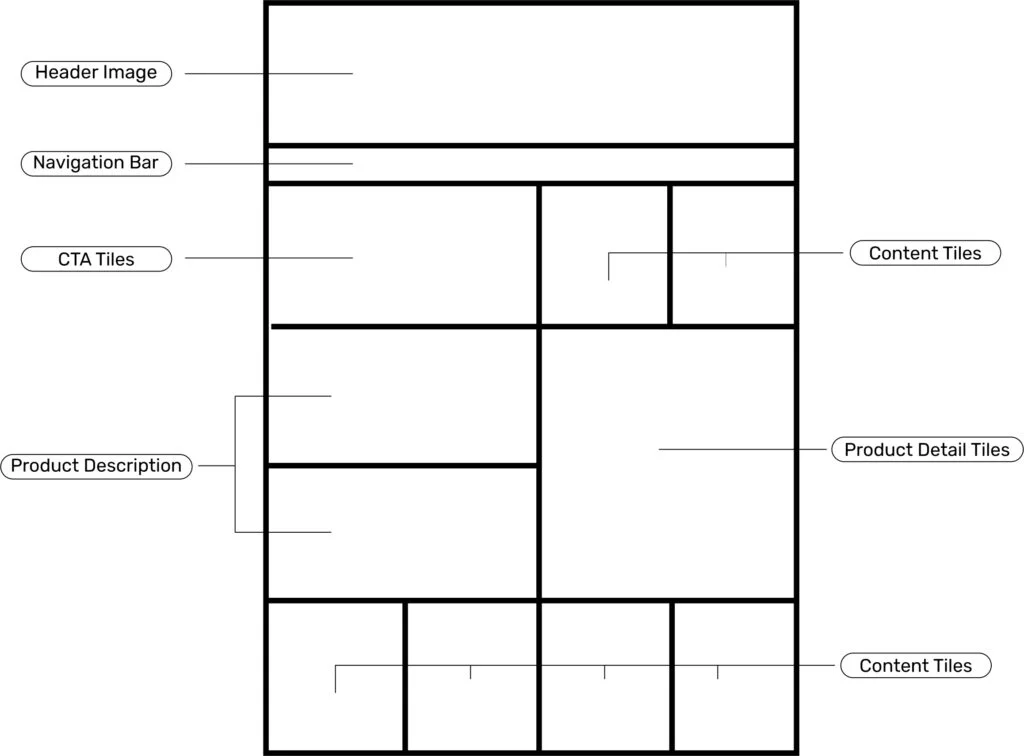
A meticulously designed Amazon Brand Store typically consists of several pivotal components, each geared toward enhancing the shopping experience:
- Header: Positioned at the top of your Amazon Brand Store, the title should immediately seize the visitor’s attention and convey your brand’s essence. While text inclusion is permissible, the primary focus should be high-quality visuals aligned with your brand’s identity. The recommended dimensions for the header image are 3000×600 pixels.
- Text or Text-Based Tiles: These tiles are tailored for succinct, informative product descriptions. Employ concise sentences to spotlight product features and benefits, striking a balance that offers informative insights without overwhelming shoppers.
- Images or Image-Based Tiles: High-resolution images are pivotal for image-based tiles, as they serve as primary showcases for your products and their functionality. Whenever possible, include images that depict your products in practical usage, elucidating their purpose clearly.
- Product with Text Tiles: Combining images and text, these tiles present your products with brief, descriptive titles. Aim for a harmonious composition, keeping titles concise at around 6 to 8 words. Striking this balance ensures that the product remains the focal point while providing essential information.
How to Set Up an Amazon Brand Store?
Setting up an Amazon Brand Store is straightforward, but a strategic approach ensures it supports discovery, conversion, and long-term performance.
- Ensure Eligibility and Brand Ownership
Before building, register your brand in the Amazon Brand Registry and ensure your trademark is approved. You must have either a Seller Central or Vendor Central account linked to your brand. This establishes your rights to control brand content within the marketplace. - Access the Store Builder
Sign in to your Amazon Advertising Console and navigate to Brand Store Builder. This self-service environment lets you design and preview your storefront without development resources. - Choose a Store Template
Select a template that aligns with your portfolio structure and shopper intent. Templates help you organise categories, hero assets, product grids, lifestyle tiles, and educational sections. If your assortment is large or diverse, consider multi-page architecture. - Design with Structure and Discovery in Mind
Use drag-and-drop tiles to:
- Create product collections grouped by category, use-case, or shopper intent
- Add lifestyle imagery that contextualises products
- Include storytelling tiles that communicate brand values, sustainability commitments, or usage guidance
Keep mobile usability and visual hierarchy at the forefront, most shopping journeys start on smaller screens.
- Connect Navigational Pathways
Link internal pages logically and set up deep links from your homepage to category and campaign pages. This ensures shoppers can navigate fluidly across the store, reducing bounce and improving conversion. - Preview, Review, and Submit for Publishing
Once design, navigation, and content are complete, preview the store across devices. Correct any layout issues or content inconsistencies, then submit for Amazon review. Approval times vary by marketplace region. - Connect Traffic and Measure Early Signals
After launch, integrate Sponsored Brands or other campaign traffic into your Brand Store. Tag and track early engagement via the Store Insights dashboard to understand where visitors engage and where further optimisation is needed.
The Strategic Role of Amazon Brand Stores
Amazon operates primarily as a search-led marketplace. Brand Stores introduce something fundamentally different: controlled brand-led navigation inside a performance ecosystem.
They enable brands to:
- Own their narrative within Amazon’s discovery framework
- Create structured product journeys beyond search results
- Build brand affinity alongside conversion
- Anchor retail media traffic into a curated experience
For brands operating in high-competition categories, this shifts the game from visibility competition to experience optimisation.
AI-Led Storefront Experiences
Amazon’s commerce environment is increasingly guided by AI-driven discovery and intent interpretation. Brand Stores now function as structured environments that support this evolution.
Modern Brand Stores enable:
- Context-aware product discovery pathways
- Intent-driven category navigation
- AI-supported merchandising logic
- Semantic browsing beyond keyword dependency
This means brands are no longer designing static pages, they are designing decision pathways aligned with shopper intent.
For organisations investing in digital shelf analytics (a focus area in your 2025–2026 content strategy), this creates a measurable bridge between assortment visibility and purchase behaviour.
Full-Funnel Measurement: From Traffic to Conversion Quality
One of the most strategic advantages of Brand Stores is their role as a measurement layer within retail media ecosystems.
They provide visibility into:
- Traffic source contribution (ads, organic, external)
- Engagement depth across store sections
- Path-to-purchase behaviour
- Store-level vs SKU-level performance alignment
This transforms Brand Stores into a diagnostic environment where brands can evaluate not just how much traffic they receive, but how effectively that traffic converts.
For decision-makers, this shifts performance evaluation from campaign metrics to experience-led conversion outcomes.
Simplifying Discovery Through Product Collections
As marketplace catalogs expand, the biggest barrier to conversion is no longer availability, it is navigation. Product collections within an Amazon Brand Store address this challenge by transforming browsing into a guided discovery experience.
Rather than presenting products as an unstructured grid, collections organize assortments around natural shopping logic, category relevance, use cases, seasonal intent, or product innovations. This structured merchandising reduces cognitive load and helps shoppers reach decision confidence faster.
Each collection pairs a curated group of products with contextual storytelling. Lifestyle-led visuals present items in real-world scenarios, while concise titles and descriptions communicate value without overwhelming the shopper. The result is a storefront that behaves less like a catalogue and more like a navigable brand environment.
From an operational perspective, collections introduce efficiency alongside experience. Merchandising remains current through automated visibility controls that remove unavailable items, ensuring that discovery pathways remain fully shoppable. Focused groupings also improve engagement quality by directing shoppers toward relevant product ecosystems rather than isolated listings.
In a retail landscape increasingly influenced by AI-driven relevance models, structured product groupings play an additional strategic role. Clearly defined relationships between products improve interpretability for platform algorithms, strengthening both discoverability and contextual relevance across search and advertising environments.
For brands, this makes product collections more than a design element. They function as a conversion architecture, guiding exploration, reinforcing brand positioning, and aligning merchandising with shopper intent at scale.
Optimising Your Brand Store for Measurable Impact
A Brand Store within Amazon is a performance asset that improves both engagement and revenue quality when actively optimized. Shoppers who visit a Brand Store purchase 53.9% more frequently, show a 52.1% higher add-to-cart rate, generate a 42.4% higher average selling price, and deliver a 71.3% higher average order value compared to non-visitors (Amazon).
Post-launch optimisation starts with structural alignment, ensuring product detail pages link to the Brand Store via the brand byline, monitoring Store Insights for page-level behaviour, and directing advertising traffic to relevant store sections for a cohesive discovery journey. Sponsored Brand campaigns that route shoppers to Brand Store pages also demonstrate stronger conversion performance than those linking only to product pages.
Brand Stores should be treated as dynamic environments rather than fixed assets. Stores refreshed regularly to reflect seasonality, new launches, and campaign priorities attract 11% more repeat visitors and drive 13% higher attributed sales per visitor (Amazon). Continuous updates signal relevance, improve discoverability, and sustain conversion momentum
Retail Media and Brand Store Synergy
Retail media drives traffic. Brand Stores capture value.
In 2026, high-performing brands treat Brand Stores as the destination layer of advertising strategy.
They support:
- Sponsored Brand campaign destinations
- Launch-focused product ecosystems
- Seasonal merchandising environments
- Category education journeys
This integration ensures paid visibility does not end at the click — it transitions into a guided brand experience.
For organisations running structured marketplace strategies across platforms (like your Flipkart + Amazon comparative perspective), this reinforces a critical principle:
Visibility generates entry. Experience generates conversion.
Brand Control in Algorithmic Marketplaces
Marketplace ecosystems prioritise relevance, price competitiveness, and engagement signals. Brand Stores provide a stabilising layer within this dynamic environment.
They allow brands to:
- Standardise brand storytelling across markets
- Reduce dependency on fluctuating search rankings
- Control category positioning
- Create consistent shopper journeys
For brands expanding across geographies, especially relevant to your Southeast Asian eCommerce lens, hthis ensures brand identity remains consistent even when marketplace dynamics vary.
Conversion Design Framework Inside Amazon Brand Stores
This section summarises the structural elements that directly influence conversion performance.
Core Conversion Drivers
- Intent-layered navigation architecture
- Demand-moment aligned hero storytelling
- Category-segmented product journeys
- Social proof embedded within discovery paths
- Data-informed assortment prioritisation
These elements transform Brand Stores from presentation layers into decision environments.
Why Amazon Brand Stores Matter More in 2026 ?
Marketplace commerce is shifting from keyword competition to intent interpretation. Brand Stores sit at the intersection of three major shifts:
- AI-driven product discovery
- Retail media expansion
- Digital shelf performance accountability
They are evolving into adaptive environments capable of supporting personalised discovery, structured merchandising, and measurable brand influence.
For organisations investing in advanced analytics, the Brand Store becomes a controlled testing ground for demand shaping.
Case Study: Premium Coffee Systems observed 21% increase in the views, Building a Value-Led Brand Destination
A leading premium coffee systems player used its Brand Store within Amazon to transform product discovery into a values-driven shopping experience. The objective was twofold: increase visibility across the full portfolio and communicate sustainability commitments alongside product innovation.
The storefront was structured as a guided ecosystem rather than a catalogue. Dedicated sections educated shoppers on product usage, machine–capsule compatibility, and recycling practices, strengthening trust while reducing decision friction. High-quality lifestyle imagery, video-led storytelling, and shoppable formats positioned products in real-world contexts, improving purchase confidence.
From a growth standpoint, the Brand Store functioned as a central retail media destination. Traffic from Sponsored Brands and other ad formats was routed to the storefront, creating a consistent post-click environment aligned with campaign messaging. The store was refreshed regularly around seasonal demand and product launches, maintaining relevance and sustaining engagement.
Strategic takeaway:
In high-consideration categories, Brand Stores perform best when they combine portfolio visibility, value communication, and structured discovery within a unified environment.
Conclusion
Building a Brand Store within Amazon is no longer just a branding exercise, it is a strategic growth lever. In India’s rapidly evolving e-commerce landscape, a well-structured storefront strengthens discovery, reinforces brand identity, and converts high-intent traffic into measurable revenue impact.
As retail media expands and AI-driven discovery reshapes shopper journeys, Brand Stores must evolve from static catalogues into dynamic, performance-led ecosystems. Features like product collections, shoppable imagery, and seasonal versioning enable brands to stay relevant, contextual, and conversion-ready.
For brands looking to compete at scale, the opportunity lies not just in launching a Brand Store, but in continuously optimising it as part of a broader digital shelf and advertising strategy.If you’re exploring how to build or optimise your Amazon Brand Store for sustained growth, our team at Paxcom can help you design a storefront aligned with performance, visibility, and long-term brand equity. Contact us or reach out to us at info@paxcom.net for more information.