
For most eCommerce teams, the challenge isn’t the absence of data, it’s the inability to act on it effectively.
Most brands already have access to dashboards, reports, marketplace metrics, ad performance numbers, pricing updates, and review trends. The real problem starts after that. Teams can see what is happening, but they still struggle to decide what to do next.
That is where digital shelf performance often breaks down.
A drop in sales can come from many directions at once. Maybe visibility fell. Maybe a competitor changed price. Maybe a product went out of stock. Maybe the content is weak and traffic is not converting. The signals exist, but they sit in different places, owned by different teams, and interpreted in different ways.
This is what “marketplace chaos” looks like in practice. Not a lack of information, but an overload of disconnected insights that fail to translate into clear decisions.
Kinator, our digital shelf analytics tool is built to solve that gap.
It helps brands move from disconnected marketplace signals to structured, actionable decisions across visibility, availability, pricing, content, promotions, and competition. Instead of showing isolated metrics, it helps teams understand what is changing, why it matters, and where to act first.
Why Digital Shelf Complexity Makes Fast Decisions Hard ?
Marketplace operations today are inherently complex. Brands operate across multiple platforms, manage large product catalogs, and compete in environments where visibility and conversion are influenced by constantly changing variables.
In such a setup, different teams often rely on different tools and datasets. Marketing teams analyze campaign performance, category managers monitor pricing and competition, content teams focus on product listings, and operations teams track inventory and availability.
While each function contributes valuable insights, these insights often remain siloed.
For example, a drop in sales may trigger multiple interpretations. It could be attributed to declining ad performance, changes in pricing, reduced visibility, or even stock availability issues. Without a unified view, teams spend considerable time validating assumptions before taking action. This delay can result in missed opportunities, especially in fast-moving marketplace environments.
The Gap Between Data and Decision-Making
The core issue is not data collection but decision-making. Most analytics platforms are designed to report performance. They answer questions such as:
- What is the current visibility of a product?
- How has pricing changed over time?
- What are the trends in campaign performance?
However, these insights often stop short of answering the most critical question:
What should be done next?
As a result, teams are left interpreting data manually, connecting signals across platforms, and prioritizing actions based on incomplete context. This creates inefficiencies and slows down execution.
What Kinator Is, and What It Is Not?
Kinator is Paxcom’s digital shelf analytics platform. It is designed specifically for brands selling on online marketplaces, and it sits at the intersection of visibility intelligence, content health, competitive monitoring, and sales performance.
It is not a generic BI tool adapted for eCommerce. It is purpose-built for the specific decision problems that category managers, digital shelf managers, and eCommerce heads face every day.
Kinator connects the following performance dimensions into a single, unified view:
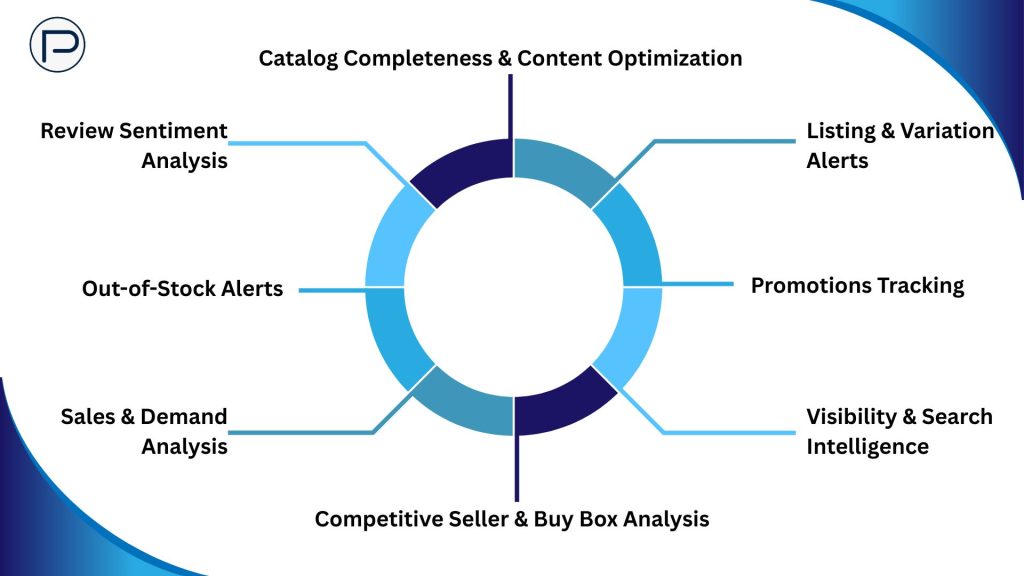
- Visibility & Search Intelligence Kinator tracks how products rank across target keywords and categories over time. This allows teams to spot rank drops early, identify keyword opportunities, and benchmark performance against direct competitors — rather than discovering visibility loss only after it shows up in revenue.
- Listing & Variation Alerts Incorrect or suppressed product variations are a common but often invisible source of sales loss. Kinator surfaces variation-level discrepancies — missing sizes, incorrect parent-child mappings, or suppressed listings — so they can be resolved before they compound.
- Review Sentiment Analysis Star ratings tell you whether customers are satisfied. Kinator’s sentiment analysis tells you why. By identifying recurring themes in review language — around packaging, delivery experience, product performance, or content accuracy — teams can make targeted improvements rather than guessing.
- Out-of-Stock Alerts Stockouts are among the highest-impact, most preventable drivers of visibility loss. Kinator monitors availability at the SKU and variant level and triggers alerts early enough for supply chain teams to act before the marketplace ranking penalty takes hold.
- Competitive Seller & Buy Box Analysis For brands with third-party sellers in the ecosystem, understanding who is winning the Buy Box and at what price is critical. Kinator provides a structured view of seller behaviour, pricing patterns, and Buy Box ownership trends.
- Promotions Tracking Kinator connects promotional activity to performance outcomes, allowing teams to evaluate whether discounts, coupon campaigns, or deal events are generating incremental sales or simply compressing margins on existing demand.
- Sales & Demand Analysis Rather than presenting sales data in isolation, Kinator contextualises it against visibility, content, and competitive activity — making it easier to understand what is actually driving a change in demand.
- Catalog Completeness & Content Optimization Incomplete or low-quality product listings affect both search ranking and conversion rate. Kinator audits listings against marketplace-specific requirements and best practices, surfacing content gaps that have measurable business impact.
How Kinator Simplifies Decision-Making in Practice?
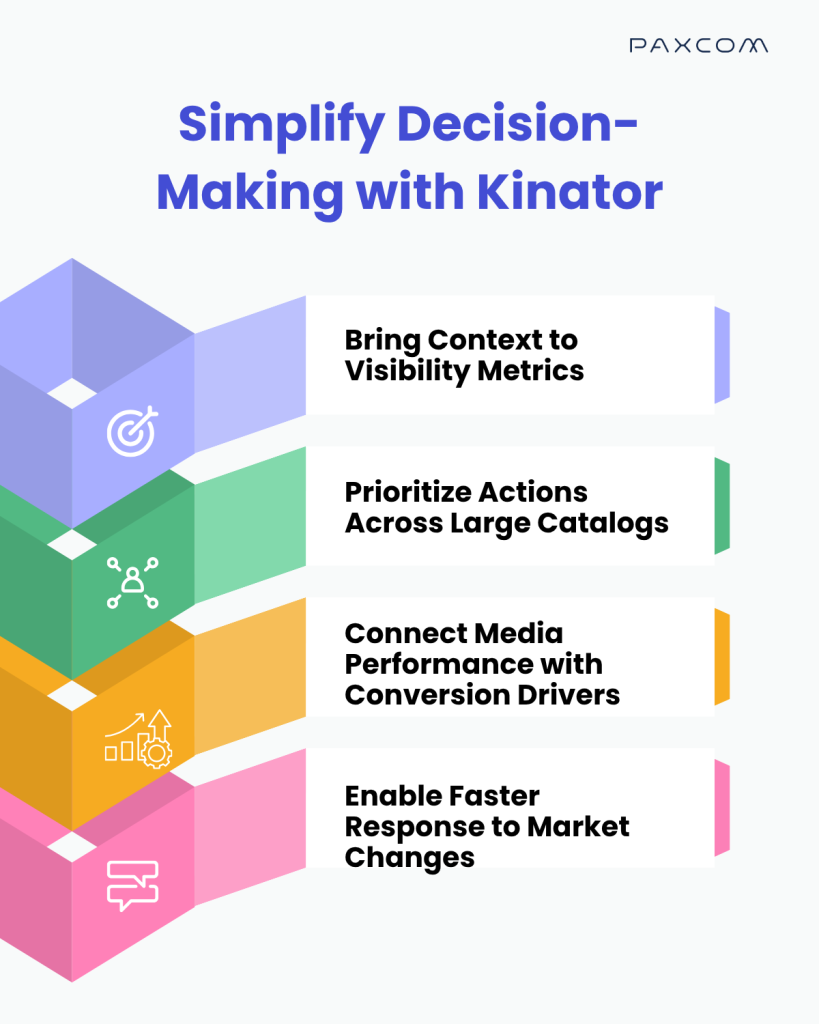
1. Bringing Context to Visibility Metrics
A decline in product visibility is a common challenge in marketplace environments. However, visibility alone does not explain the underlying issue.
In a typical scenario, a product may drop from a top-ranking position to a lower page. Without context, teams may assume that the issue lies in keyword optimization or content quality. However, the actual cause could be increased competition, pricing changes, or shifts in marketplace dynamics.
Kinator addresses this by correlating visibility data with competitor activity, pricing trends, and content attributes. This allows teams to identify the precise driver behind the change, reducing the need for trial-and-error adjustments.
2. Prioritizing Actions Across Large Catalogs
For brands managing extensive product catalogs, identifying where to focus efforts is a significant challenge. Multiple SKUs may exhibit issues simultaneously, making it difficult to determine which ones require immediate attention.
Kinator simplifies this process by highlighting high-impact products and ranking issues based on their potential business impact. Instead of addressing problems in isolation, teams can prioritize actions that contribute most directly to revenue and growth.
3. Connecting Media Performance with Conversion Drivers
It is not uncommon for brands to observe strong advertising performance without a corresponding increase in sales. In such cases, the instinct is often to optimize campaigns further.
However, campaign performance is only one part of the equation. Conversion is influenced by multiple factors, including product content, pricing, reviews, and availability.
Kinator integrates these variables, enabling teams to understand whether the issue lies in traffic generation or in the product experience itself. This ensures that efforts are directed toward the actual bottleneck rather than surface-level metrics.
4. Enabling Faster Response to Market Changes
Marketplace environments are highly dynamic. Competitor pricing strategies, promotional campaigns, and stock availability can change rapidly, influencing product performance.
Without continuous monitoring, these changes may go unnoticed until they begin to impact sales.
Kinator provides timely tracking and alerts, allowing teams to respond promptly to shifts in the competitive landscape. This reduces the lag between insight and action, which is critical for maintaining performance in fast-moving markets.
The Organisational Case: From Silos to Shared Intelligence
One of the less-discussed costs of fragmented analytics is coordination overhead. When marketing, content, category, and operations teams are each working from different data sources, alignment requires repeated reconciliation. Briefings become longer. Decisions take more cycles. Accountability is harder to assign.
Kinator creates a single source of truth that all functions can reference. This does not mean every team sees the same view, but it means that when a category manager says “we have a visibility problem on this SKU,” the media team and content team can immediately see the same evidence and understand their role in resolving it.
This kind of cross-functional alignment is especially valuable in quarterly planning cycles, marketplace audits, and post-campaign reviews, where the ability to trace performance outcomes back to specific actions is critical.
Beyond Analytics: Building a Decision System
The value of Kinator lies not just in its ability to aggregate data, but in its ability to structure that data into meaningful, actionable outputs. In a landscape where speed and accuracy are critical, the ability to move quickly from insight to action can define competitive advantage.
Kinator supports this by enabling:
- Faster identification of issues
- Clear prioritization of actions
- Better alignment across teams
A Day With vs Without Kinator
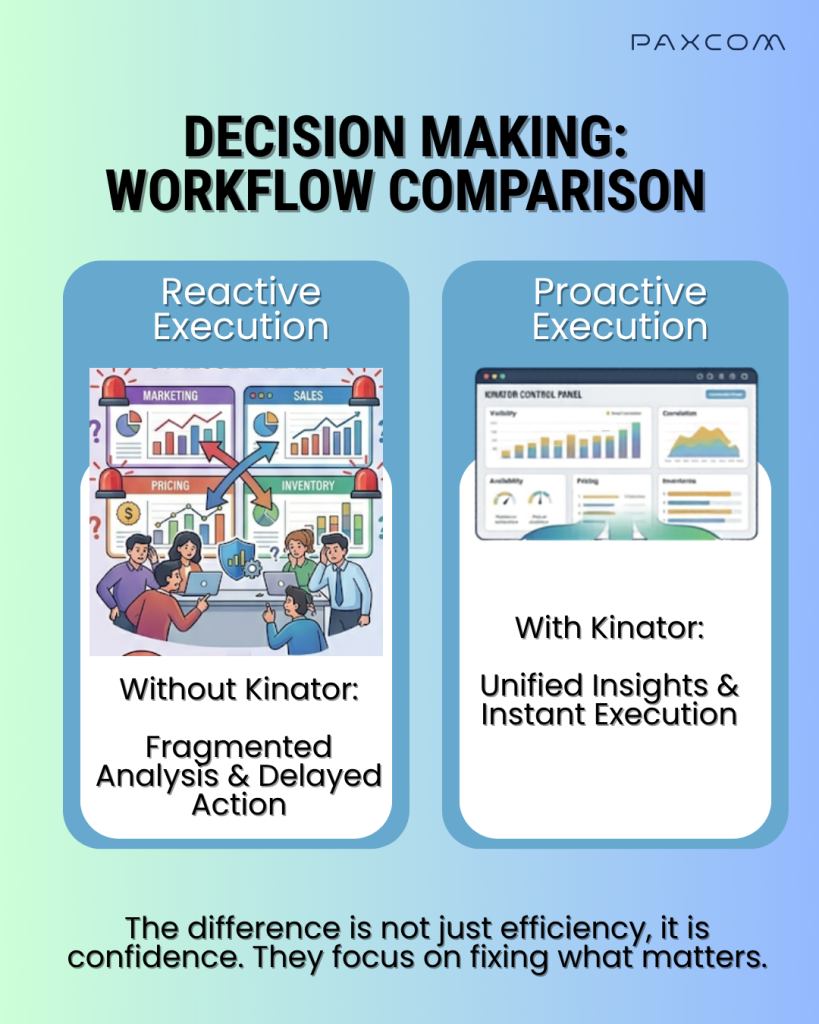
To understand the practical impact of a connected decision system, it helps to compare how a typical day unfolds with and without structured insights.
| Without Kinator | With Kinator |
| The day usually begins with multiple dashboards.Teams review performance metrics across platforms, trying to identify what has changed. A dip in sales triggers a series of checks, visibility, pricing, campaigns, and inventory each requiring separate validation.Different teams interpret the data from their own perspective. Marketing may focus on campaign performance, while category teams look at pricing and competition. Discussions follow, but clarity takes time.By the time the root cause is identified, the window to act has often narrowed. Execution is delayed, and decisions tend to be reactive rather than proactive. | The day starts with clarity. Instead of searching for issues, teams are guided toward them. High-impact changes in visibility, availability, or competition are already identified and structured. Rather than navigating multiple tools, teams operate with a connected view of performance. The relationship between pricing, content, and visibility is clear, reducing the need for manual analysis.Decisions are not based on assumptions but on aligned insights. Actions are prioritized, and execution begins immediately. |
| The difference is not just efficiency, it is confidence. Without Kinator, teams spend time figuring out what is wrong. With Kinator, they focus on fixing what matters. | |
Conclusion: Clarity as a Competitive Advantage
The volume of marketplace data available to brands will continue to grow. The question is not whether teams have access to information, it is whether their systems are built to convert that information into timely, confident decisions.
Kinator is built for that purpose. It does not replace the judgment of eCommerce teams. It gives that judgment the connected, contextual foundation it needs to work effectively at scale.
For brands operating across multiple marketplaces and SKUs, the shift from reactive analytics to proactive decision intelligence is one of the highest-leverage changes available.
Ready to see how Kinator works with your catalog?
Book your Kinator demo: info@paxcom.net