Enterprise commerce didn’t just adopt AI. It operationalized it.
A few years ago, AI in enterprise environments mostly lived at the edge of operations.
It generated reports, summarized data, answered internal questions, and automated repetitive workflows.
Useful? Absolutely.
Operationally critical? Not quite.
That changed faster than most organizations expected. Today, AI sits much closer to execution.
It can analyse customer sentiment before a brand team notices a decline in ratings. It can identify pricing volatility across marketplaces in minutes. It can assist campaign teams with optimization decisions, surface visibility gaps, and increasingly influence operational workflows that directly impact revenue.
In many enterprise environments, AI is no longer functioning as a passive assistant; it is becoming an operational participant, and while most organizations are focused on accelerating AI adoption, a much more important conversation is quietly emerging underneath it:
How secure are these AI-driven systems actually?
Because the moment AI gains access to:
- Enterprise data,
- Operational workflows,
- Customer intelligence,
- Campaign systems,
- Marketplace infrastructure,
The cybersecurity conversation changes completely. This is where Secure AI enters the picture.
Not as another technology buzzword, but as the next operational layer enterprises must govern as AI becomes deeply embedded into commerce execution itself.
AI and Cybersecurity Are No Longer Separate Conversations
For years, cybersecurity operated with relatively clear boundaries.
Organizations focused on protecting:
- Networks,
- Cloud infrastructure,
- Endpoints,
- Applications,
- Enterprise systems.
The objective was straightforward: secure the environment, control access, and reduce external threats.
But AI introduces a different kind of operational complexity.
Unlike traditional software systems, AI systems are dynamic. They process context, generate outputs, interpret information, and increasingly interact with decision-making environments. In enterprise commerce, that means AI now touches areas that directly influence:
- Customer experience,
- Pricing intelligence,
- Product discoverability,
- Marketplace operations,
- Campaign workflows,
- Strategic planning.
This is precisely why AI and cybersecurity are beginning to converge.
On one side, enterprises are using AI to strengthen cybersecurity operations themselves. AI-driven systems can now identify anomalies, accelerate fraud detection, and improve incident response far faster than traditional rule-based environments. But on the other side, and arguably the more important shift for enterprise commerce, organizations must now secure the AI systems themselves.
Because AI has quietly become part of the operational layer, and operational systems become targets.
The Enterprise Risk Landscape Has Quietly Expanded
One of the reasons Secure AI is becoming so important is because most organizations still underestimate how quickly AI exposure expands across enterprise ecosystems.
The risk is not limited to one chatbot or one AI workflow.
The moment AI connects with the data; the attack surface becomes significantly larger.
An AI assistant analysing marketplace performance may have access to sensitive revenue intelligence. A recommendation engine integrated into campaign workflows may interact with advertising data and customer behaviour signals. An operational AI agent assisting commerce teams may connect across multiple APIs, systems, and external platforms simultaneously.
And unlike traditional enterprise software, AI systems introduce new forms of vulnerability.
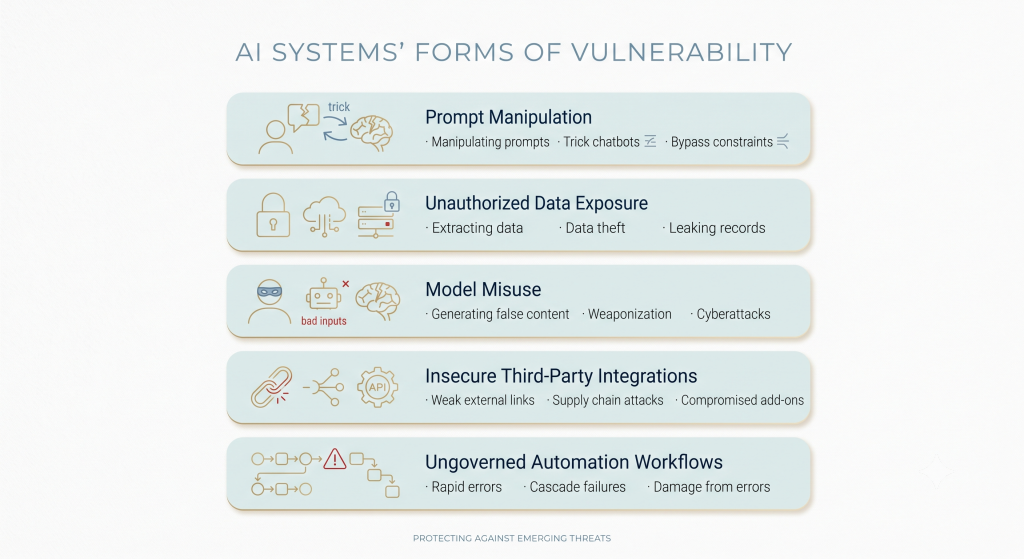
- Prompt manipulation
- Unauthorized data exposure
- Model misuse
- Insecure third-party integrations
- Ungoverned automation workflows
The challenge is no longer simply preventing unauthorized access into systems. It is understanding how AI behaves inside those systems once access already exists.
That is a fundamentally different cybersecurity problem.
Commerce Is Becoming One of the Most Complex AI Environments
Enterprise commerce environments are uniquely exposed because they sit at the intersection of:
- customers,
- marketplaces,
- advertising ecosystems,
- operational data,
- external sellers,
- and real-time decision-making.
Very few enterprise functions operate at this level of continuous external interaction.
A modern commerce organization now manages:
- omnichannel operations,
- retail media,
- digital shelf intelligence,
- customer sentiment,
- marketplace visibility,
- pricing competitiveness,
- fulfilment coordination,
- and increasingly fragmented buying journeys.
AI is naturally becoming embedded across all of these layers because the scale of operational complexity has outgrown manual monitoring alone. But this creates a difficult balancing act for enterprise leaders.
The same AI systems helping organizations move faster can also introduce:
- governance blind spots,
- uncontrolled access,
- unclear accountability,
- and operational risk at scale.
This is especially important as enterprise commerce begins moving toward more autonomous systems.
The industry is already shifting from dashboards → recommendations → intelligent operational participation.
That evolution changes the role of cybersecurity entirely. Because organizations are no longer just protecting infrastructure. They are protecting machine-influenced operational behaviour.
Is Secure AI Really About Governance?
One of the biggest misconceptions surrounding Secure AI is the assumption that it is purely a technical problem. It is NOT.
At its core, Secure AI is a governance challenge. The real issue is not whether enterprises will adopt AI. That decision has already been made across most industries.
The real issue is how much operational authority organizations are willing to give AI systems, and under what controls.
That is why enterprise discussions around secure AI increasingly revolve around:
- Visibility,
- Accountability,
- Access governance,
- Operational boundaries,
- Human oversight.
For example, not every AI system should have unrestricted access to enterprise workflows. Not every recommendation should trigger autonomous execution. Not every external AI integration should be trusted with sensitive marketplace or customer data. This is where governance becomes more important than raw AI capability itself.
The organizations approaching Secure AI maturely are not simply asking:
“What can AI automate?”
They are asking:
“What should AI be allowed to influence?”
That is a much more strategic question.
The Rise of AI Agents Changes Everything Further
If the current AI shift already feels operationally significant, the next phase may become even more transformative.
AI systems are gradually evolving from assistants into agents; the difference matters.
Assistants generate outputs. Agents participate in workflows.
An AI assistant might summarize customer sentiment. An AI agent may eventually trigger operational recommendations, escalate workflow actions, coordinate systems, or continuously optimize processes across environments.
As enterprise commerce systems become more connected, these agentic capabilities will likely expand rapidly.
And this is where Secure AI becomes inseparable from enterprise cybersecurity itself.
Because once AI systems begin participating operationally, organizations need much stronger:
- Approval layers,
- Auditability,
- Role-based permissions,
- Integration governance,
- Behavioural oversight.
The future risk environment will not revolve solely around stolen credentials or network vulnerabilities.
It will increasingly revolve around how autonomous or semi-autonomous AI systems behave inside enterprise ecosystems.
Why Secure AI Will Define Enterprise Trust in 2026?
The next competitive advantage in enterprise commerce will not come from AI adoption alone. Most organizations will adopt AI. The differentiator will be how securely, responsibly, and transparently those AI systems operate at scale.
Customers are becoming more conscious about data privacy. Regulators are increasing scrutiny around AI accountability. Enterprises themselves are becoming more aware of operational dependencies forming around AI-driven systems.
In this environment, Secure AI becomes more than a cybersecurity initiative.
It becomes a trust framework.
The brands that succeed in the next phase of enterprise commerce will likely be the ones that combine:
- Operational intelligence,
- AI-driven efficiency,
- Cybersecurity maturity,
- Governance discipline together.
Because the future of enterprise commerce will not simply be AI-powered.
It will need to be governable, explainable, and secure by design.
Conclusion
Enterprise commerce is entering a fundamentally different operational era.
AI is no longer sitting at the edge of the business. It is moving closer to execution, decision environments, and operational participation.
That shift creates enormous opportunities for:
- Speed,
- Intelligence,
- Scalability,
- Connected commerce execution.
But it also introduces a new category of enterprise risk that traditional cybersecurity frameworks alone were never designed to handle.
Secure AI is emerging because organizations now need to govern not just systems — but the intelligence operating within those systems.
And as AI continues moving deeper into enterprise commerce infrastructure, one reality is becoming increasingly difficult to ignore:
The future of AI and cybersecurity will not be defined by how much AI organizations adopt.
It will be defined by how securely they operationalize it.
How does Paxcom sit at the intersection of secure AI & enterprise commerce?
As enterprise commerce systems become increasingly AI-driven, the challenge is no longer limited to accessing data; it is about governing how intelligence flows across operational environments.
Paxcom sits at the intersection of Secure AI and enterprise commerce by helping brands transform fragmented marketplace signals into connected governed commerce intelligence. From visibility tracking and sentiment analysis to operational insights and marketplace monitoring, Paxcom enables enterprise teams to operate with greater intelligence, accountability, and control in increasingly complex commerce ecosystems.
Every rejected output, manual override, user correction, and workflow exception should improve the system. Secure AI should become sharper and safer through real usage, not just one-time testing. Not every AI task needs the same level of control. A pricing recommendation is higher risk. A campaign budget change needs review. A customer-facing compliance answer needs strict approval.
As AI moves from answers to actions, security must move from model protection to workflow governance. For Paxcom, secure AI means-controlled access, monitored behaviour, automated guardrails, human oversight, and accountable execution. Connect with us to know more at info@paxcom.net or fill the form here