Enterprise AI is moving beyond experimentation. The question is no longer whether businesses should use AI, but where and how it should participate in the work.
According to McKinsey’s 2026 State of AI survey, nearly nine in ten organizations report regular AI use in at least one business function, while 44% say AI is scaling across the enterprise. Among organizations with at least $1 billion in annual revenue, 54% report scaling AI enterprise-wide.
At the same time, enterprises are beginning to explore a more autonomous form of AI. Forty percent of respondents from large organizations say they are scaling AI agents in at least one function, up from 27% in 2025.
This raises an important question: Generative AI or Agentic AI? Which one should enterprises use?
The answer depends less on which technology is newer and more on what the business workflow needs AI to do.
Generative AI and Agentic AI are not competing versions of the same capability. They can play different roles within the same enterprise, and in many cases, work together.
What Is Generative AI?
Generative AI creates new content or outputs based on the information and instructions it receives. It can generate text, images, code, summaries, recommendations and other forms of content.
A typical enterprise interaction might look like:
Human request → AI interprets → AI generates → Human evaluates
Consider a category manager preparing for a festive sales event. They could provide historical sales data, customer feedback and campaign information to a Generative AI system and ask it to identify key trends, summarize performance and suggest campaign ideas.
AI accelerates analysis and creation. The category manager still decides what the business should do.
That makes Generative AI particularly useful when the value lies in creating, interpreting, synthesizing or assisting.
Common enterprise applications include:
- Product content generation
- Customer feedback summarization
- Market and competitor analysis
- Campaign ideation
- Report generation
- Knowledge assistance
- Code generation
- Executive summaries
The important point is that human involvement does not make these workflows less valuable. In many business decisions, human judgment is an intentional part of the process.
What Is Agentic AI?
Agentic AI approaches a business problem differently.
Instead of responding to a single request, an AI agent can work toward a defined objective across multiple steps. Depending on its design, it can gather information, use connected tools, make decisions within defined boundaries, execute actions and evaluate outcomes.
A simplified workflow looks like:
Goal → Understand → Plan → Act → Evaluate → Continue or Escalate
Imagine a brand wants to monitor marketplace visibility.
A Generative AI system could analyze a performance report and explain why visibility may have declined.
An agentic system could potentially:
- Continuously monitor the relevant signals.
- Detect a significant change.
- Pull pricing, availability, content and performance information.
- Investigate possible causes.
- Evaluate the situation against predefined business rules.
- Recommend or initiate the appropriate next step.
- Escalate an exception to a human when necessary.
The difference is not simply that one system is “smarter.”
It is that Agentic AI can participate across a workflow rather than only producing an output at a point in that workflow.
Generative AI vs Agentic AI: What Actually Changes?
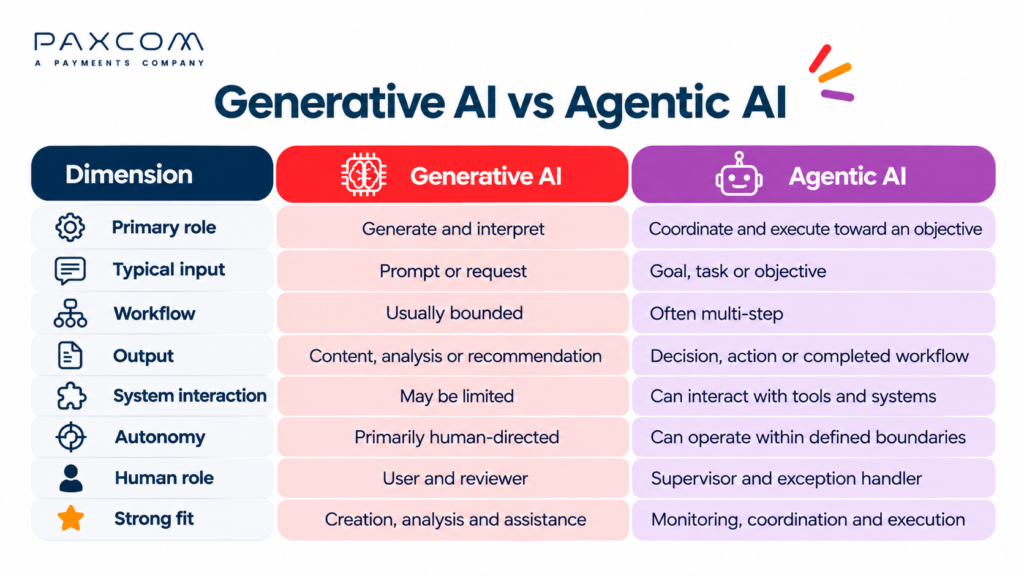
This distinction should not be interpreted as a hierarchy.
A business does not become more mature simply by replacing Generative AI with Agentic AI.
The more useful question is:
What does the workflow actually require AI to do?
Where Generative AI Makes Sense
Generative AI is particularly useful when the desired outcome is information, content or insight.
Consider a consumer brand preparing a new product launch.
The marketing team may need to:
- Analyze previous campaign performance
- Understand customer feedback
- Generate product positioning options
- Draft campaign copy
- Adapt messaging for different audiences
Generative AI can support each of these activities while the marketing team remains responsible for the final decisions.
This model works well when:
- The output is the objective.
The business primarily needs content, analysis, ideas or information. - Human judgment remains central.
The decision has contextual, commercial or creative considerations that benefit from human oversight. - The workflow is relatively bounded.
There may be several prompts or iterations, but the system does not necessarily need to coordinate multiple enterprise systems. - The cost of independent action outweighs the benefit.
Keeping a human involved may be intentional rather than inefficient.
In these situations, introducing greater autonomy does not necessarily create greater value.
Where Agentic AI Makes Sense
Agentic AI becomes more relevant when the business objective extends beyond generating an answer.
The workflow may involve:
- Multiple connected steps
- Repeated decisions
- Continuous monitoring
- Access to enterprise systems
- Defined business rules
- A measurable action or outcome
Consider promotion reconciliation.
A conventional workflow might require a team member to collect promotion files, compare claims against planned promotions, identify discrepancies and prepare exceptions for review.
An agentic workflow could potentially monitor the relevant inputs, identify discrepancies, apply predefined rules, organize the exceptions and route them to the appropriate team.
The value comes from coordinating the workflow, not simply generating a report.
This distinction is especially relevant as enterprises scale AI. McKinsey’s 2026 research shows that large organizations are moving more quickly from experimentation to scaled use of AI agents, with 40% reporting scaled agent use in at least one function, compared with 27% a year earlier. In consumer goods and retail, respondents most commonly report using agents in marketing and sales activities.
When Enterprises Need Both
The choice does not always have to be Generative AI versus Agentic AI.
In many enterprise workflows, the two can form different layers of the same system.
Take a digital shelf monitoring workflow.
Agentic layer:
Monitors marketplace signals and detects a meaningful visibility change.
↓
Agentic layer:
Collects price, availability, content and performance data.
↓
Generative AI layer:
Interprets the signals and explains the likely causes.
↓
Generative AI layer:
Creates a recommendation or summarizes the issue for the business team.
↓
Agentic layer:
Routes the recommendation into the appropriate workflow or executes a permitted action.
↓
Human:
Reviews exceptions or high-impact decisions.
Here, Generative AI provides interpretation and generation, while the agent provides orchestration and execution.
This is why a binary comparison can sometimes be misleading. The strongest enterprise architecture may use both capabilities at different stages of the same workflow.
A Practical Framework for Choosing Between Them
Instead of starting with technology, enterprises can start with five questions.
1. What is the desired outcome?
If the business needs content, analysis or an explanation, Generative AI may be appropriate.
If the desired outcome is a completed process or action, Agentic AI may be more relevant.
2. How many steps are involved?
A single interaction may not require an agent.
A workflow involving research, validation, decision-making and execution may benefit from an agentic approach.
3. Does AI need access to enterprise systems?
If AI only needs to generate an output, extensive system access may not be necessary.
If it needs to retrieve information, update systems or trigger actions, integrations become much more important.
4. How much autonomy is appropriate?
Not every decision should be automated.
Enterprises need to define which actions AI can take independently, which require approval and which should always remain human-led.
5. What happens when the system is wrong?
The consequences of an incorrect product description are different from those of an incorrect pricing change, customer communication or commercial decision.
The higher the impact, the more carefully autonomy, approval thresholds, monitoring and escalation need to be designed.
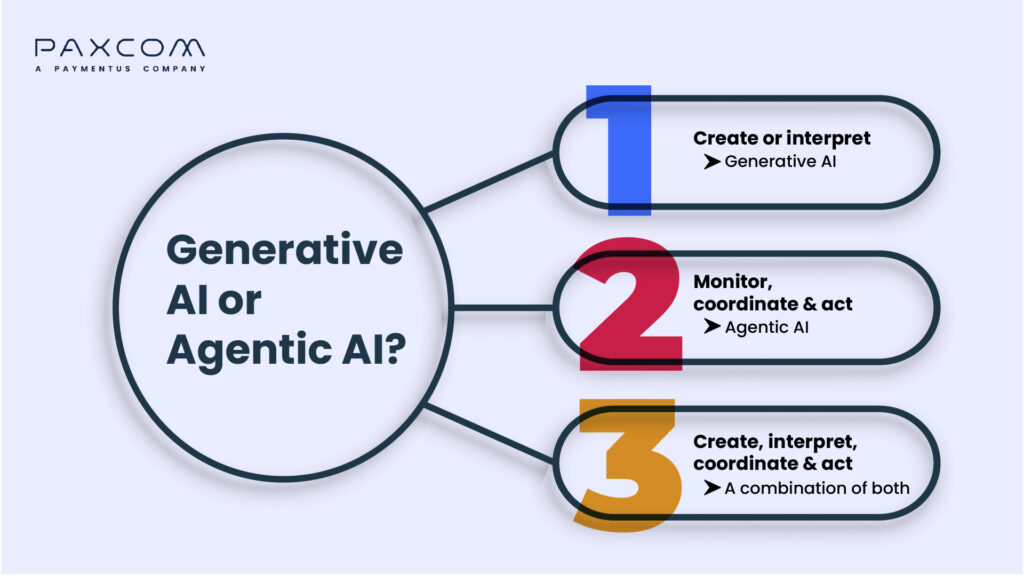
The resulting decision can be simple:
Create or interpret → Generative AI
Monitor, coordinate and act → Agentic AI
Create, interpret, coordinate and act → A combination of both
Autonomy Is a Design Decision
Deloitte’s 2026 State of AI in the Enterprise research found that 74% of respondents expect their organizations to use AI agents at least moderately within two years. Yet only 21% report having a mature governance model for Agentic AI.
One of the biggest mistakes enterprises can make is treating maximum autonomy as the ultimate goal.
It isn’t.
A workflow for generating campaign ideas may benefit from keeping the marketer firmly in control.
A workflow that monitors thousands of marketplace SKUs may benefit from continuous AI-led monitoring.
A high-value commercial decision may still require human approval even if AI performs most of the analysis beforehand.
The right question is therefore not:
How autonomous can we make AI?
It is:
Where can autonomy create value, and where should human judgment remain directly involved?
This distinction becomes increasingly important as AI agents move into enterprise environments.
IBM’s 2026 study of 2,000 technology executives found a similar readiness gap: only 11% said they were fully prepared for the expected scale of AI agent deployment, while 77% said AI adoption was already moving faster than their current governance capabilities.
The implication is not that enterprises should avoid autonomous AI.
It is that capability and control need to evolve together.
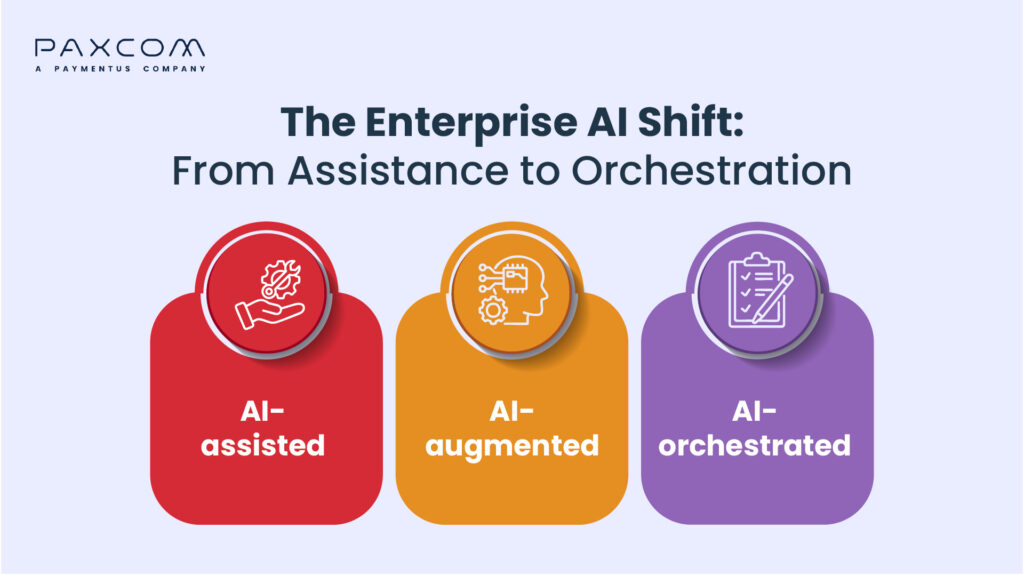
The Enterprise AI Shift: From Assistance to Orchestration
This creates a broader way to think about enterprise AI maturity.
AI-assisted
A person performs the workflow and AI helps with individual tasks.
AI-augmented
AI takes over selected parts of the workflow while the person remains the primary operator.
AI-orchestrated
AI coordinates multiple steps, systems or tools while people supervise the workflow and handle exceptions.
Autonomous
AI executes defined workflows independently within established boundaries.
These aren’t mandatory stages that every enterprise needs to move through.
Different workflows can sit at different levels of autonomy within the same organization.
That is why AI strategy should begin with workflow design, not technology selection.
Paxcom’s Perspective: Start With the Workflow
For enterprises operating in commerce, AI decisions increasingly affect everything from product content and discovery to marketplace intelligence, promotions and customer interactions.
The opportunity is not to introduce AI wherever possible. It is to identify where AI can create measurable value and determine the appropriate level of intelligence, orchestration and autonomy for that workflow.
Paxcom approaches enterprise AI from this workflow-first perspective.
Generative AI can help teams create and interpret.
Agentic AI can help systems coordinate and act.
And the combination can create workflows where intelligence moves from understanding information to making decisions and executing the next step.
The technology should follow the business requirement, not the other way around.
Conclusion
So, which should enterprises use: Generative AI or Agentic AI?
There is no universal answer.
Use Generative AI when the workflow benefits from generation, interpretation, synthesis or human-led assistance.
Use Agentic AI when the workflow requires continuous reasoning, coordination, decision-making or action across multiple steps.
Use both when the workflow needs intelligence and execution.
The more important enterprise decision is not choosing an AI label. It is deciding where AI should assist, where it should orchestrate, where it can act independently, and where humans should remain in control.
That is the foundation for building AI systems that are not only more capable, but better aligned with how the business actually operates. Contact us at info@paxcom.net for more information.
FAQs
Is Agentic AI better than Generative AI?
Neither is universally better. Generative AI and Agentic AI address different workflow requirements. The appropriate choice depends on the desired outcome, complexity, system access, level of autonomy and risk involved.
Can Generative AI and Agentic AI work together?
Yes. Generative AI can provide interpretation, content and recommendations within an agentic workflow, while Agentic AI can coordinate tools, decisions and actions around those capabilities.
What is the main difference between Generative AI and Agentic AI?
Generative AI primarily creates or interprets outputs in response to instructions. Agentic AI is designed to pursue an objective across multiple steps and can potentially make decisions and take actions within defined boundaries.
When should an enterprise use Agentic AI?
Agentic AI can be considered for workflows involving multiple steps, repeated decisions, continuous monitoring, connected systems and clearly defined business rules. High-impact workflows may still require human approval at key stages.
Does using Agentic AI mean removing humans from the workflow?
No. Agentic AI can operate with human oversight, approval thresholds and exception handling. The appropriate level of human involvement depends on the workflow and the consequences of an incorrect action.