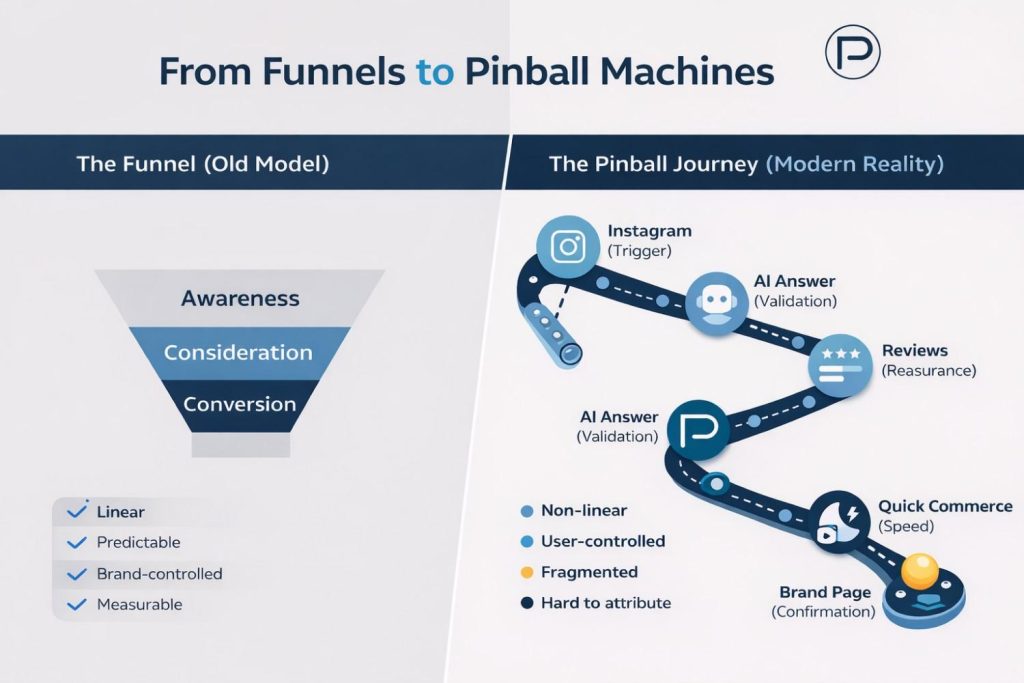
Why Modern Discovery Looks More Like a Pinball Machine Than a Funnel
For decades, marketers designed customer journeys as a straight line.
Awareness → Consideration → Conversion.
It was neat. Predictable. Easy to map in decks.
It is also increasingly detached from how decisions are actually made today.
Modern discovery doesn’t move forward step by step.
It bounces.
A typical journey today looks less like a funnel and more like a pinball machine—fast, chaotic, and shaped by whatever the consumer hits next.
Consider this:
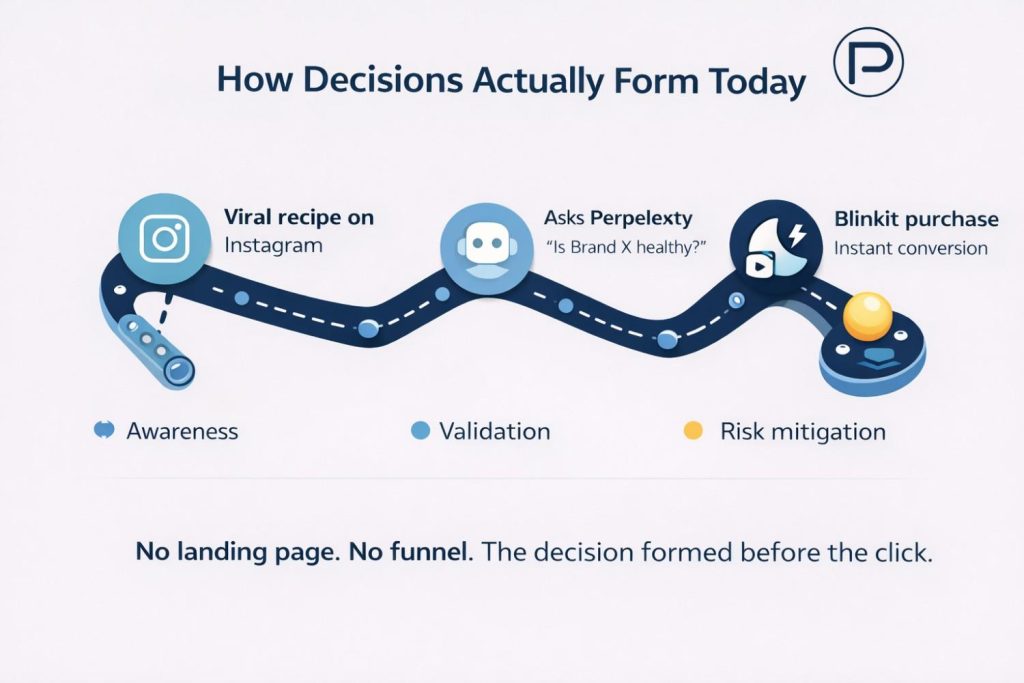
- A user sees a viral recipe on Instagram (awareness)
- Asks Perplexity: “Is Brand X healthy?” (validation)
- Scans Amazon reviews to reduce risk (reassurance)
- Buys it on Blinkit because they want it in 10 minutes (conversion)
No landing page.
No neatly staged funnel.
No single “moment of truth.”
The decision is formed across multiple surfaces, often before a brand even realizes it was in the running.
TL;DR — Executive Summary
Customer journeys no longer follow linear funnel logic.
Discovery and decision-making now occur across a distributed set of surfaces including AI-generated answers, social validation, marketplace reviews, and quick commerce availability.
In this environment, decisions form upstream of measurable intent, often before users interact with brand-owned properties. As a result, last-click optimisation and landing-page-centric strategies systematically overestimate their influence on conversion.
The most critical influence points are answer nodes—decision environments where customers actively reduce uncertainty and build confidence. These nodes operate outside traditional attribution frameworks and require content that is structured, consistent, and context-aware across platforms.
Effective growth strategies must shift from funnel control to ecosystem readiness: ensuring that product information, reassurance signals, and availability cues remain aligned wherever customer questions arise.
The competitive advantage now lies in clarity, consistency, and operational responsiveness across the discovery ecosystem—not in incremental optimisation of the final conversion step.
Why the Funnel Worked—For Decades
The funnel wasn’t wrong.
It was accurate for its time.
For years:
- Discovery, evaluation, and purchase happened in the same environments
- Channels were limited
- Attention was concentrated
- Influence occurred close to checkout
A shopper could search, compare, read reviews, and buy within a few predictable steps.
Attribution was clean. Optimisation focused on what happened right before conversion.
That world no longer exists.
The Problem With Linear Funnels in a Non-Linear World
Most brands still optimize as if they control the journey.
They obsess over:
- Landing pages
- Campaign paths
- Conversion rate optimisation at the “last step”
But the reality is uncomfortable:
The decision is often made three steps earlier—inside a chatbot response, a comment thread, or a marketplace review.
By the time the user lands on your page, they’re not deciding.
They’re confirming.
The Pinball Journey Explained
In modern discovery:
- Awareness is the launch
- Confidence builds through repeated micro-validations
- Decisions form before intent becomes measurable
This is why the idea of “touchpoints” breaks down.
Touchpoints imply order.
Reality is shaped by intersections, interruptions, and returns.
Most influence now happens outside brand-owned environments.
What Are Answer Nodes?
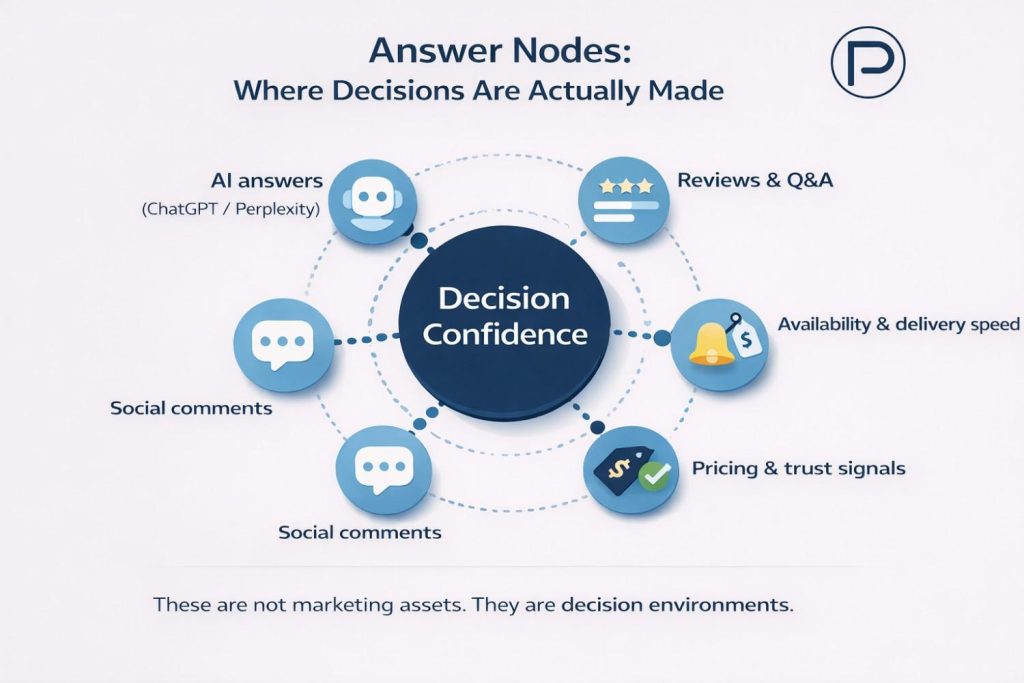
Answer nodes are surfaces where customers actively reduce uncertainty and form confidence.
They include:
- AI-generated responses (ChatGPT, Perplexity, Gemini)
- Marketplace reviews and Q&A
- Social comment sections
- Availability and pricing signals in quick commerce apps
These are not marketing assets.
They are decision environments.
By the time a customer reaches a brand page, the decision is often already shaped.
Why Optimising the Last Click No Longer Works
Traditional optimisation focuses on the final interaction before conversion.
In non-linear journeys:
- The last click confirms decisions
- It rarely creates them
- CRO cannot fix upstream doubt
Brands end up optimising what they can measure, not what actually influences outcomes.
The real losses happen before the click ever occurs.
Where Brands Lose Consideration (Without Seeing It)
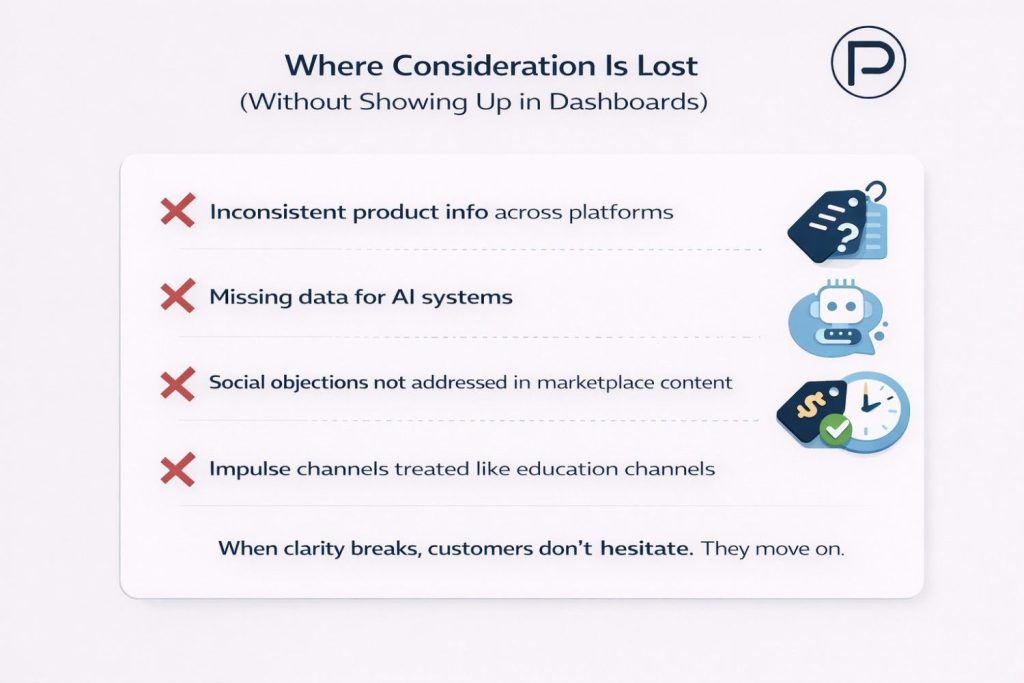
Many brands lose consideration silently due to:
- Inconsistent product information across platforms
- Missing or unstructured data for AI systems
- Unaddressed objections in reviews and social discussions
- Treating impulse environments like education environments
These issues don’t always appear in dashboards.
But they directly impact conversion.
When clarity breaks, customers don’t hesitate.
They move on.
Designing for Ricochet Points Instead of Journeys
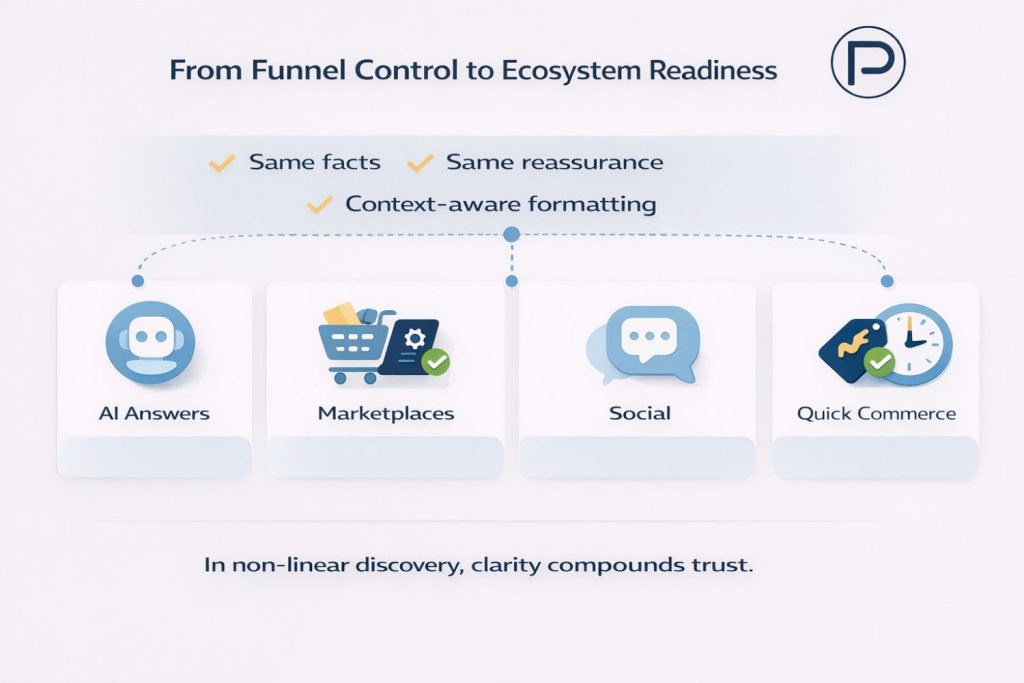
Winning brands are changing how they think.
They no longer try to control the journey.
They optimise for ricochet points—moments where questions arise.
This requires:
- Consistent answers across AI, marketplaces, social, and commerce
- Context-aware content (not copy-paste messaging)
- Cohesion instead of channel-by-channel optimisation
In non-linear discovery, clarity compounds trust.
What Non-Linear Discovery Demands From Teams
This shift is operational, not cosmetic.
It requires:
- Continuous response systems instead of campaign bursts
- Ownership of answers, not just assets
- Faster content feedback loops
- Cross-channel accountability
Digital shelf intelligence becomes a decision system, not a reporting layer—because customers experience visibility, availability, accuracy, and sentiment together.
The New Objective: Be Useful Wherever the Question Is Asked
The goal is no longer to push customers forward.
It is to be useful wherever they pause.
Visibility is now cumulative.
Trust is built through repeated clarity.
Confidence forms long before conversion.
Brands that win show up early, answer clearly, and reinforce reassurance across surfaces.
What This Means Going Forward
Funnels won’t disappear—but they will no longer define strategy.
Discovery will continue to happen upstream, invisibly, and across environments brands do not fully control.
Growth will be driven by:
- Consistency
- Readiness
- Answer clarity
The brands that adapt won’t look louder or more aggressive.
They will simply look easier to understand.