Introduction: Commerce Is Moving Faster Than Teams Can React
A competitor drops prices during peak shopping hours. Another brand suddenly goes out of stock on a high-demand marketplace. Search rankings shift overnight. Customer sentiment around a product begins declining before sales numbers clearly reflect the impact.
For modern commerce teams, these are not occasional problems. They are part of everyday marketplace operations.
Today’s ecommerce environment is no longer static. Brands are not only managing product listings and sales reports. They are managing marketplaces, quick commerce platforms, retail media campaigns, content quality, pricing changes, stock availability, customer reviews, seller activity, and search visibility at the same time.
This has made commerce more dynamic, more competitive, and more difficult to manage manually.
For years, dashboards helped teams understand what was happening across their digital commerce channels. They made data easier to see and track. But as commerce becomes faster and more algorithm-driven, dashboards alone are no longer enough.
The challenge for brands today is not only knowing what changed. The bigger challenge is understanding why it changed, what impact it may have, and what action should be taken next.
This is where autonomous commerce becomes important.
Autonomous commerce is not about replacing commerce teams with AI. It is about helping teams reduce manual effort, respond faster to marketplace changes, and make better decisions with connected intelligence.
In simple terms, commerce is moving from dashboards to decisions, and from decisions to intelligent execution.
What Is Autonomous Commerce?
Autonomous commerce refers to commerce systems that can monitor, analyze, recommend, and execute decisions with minimal manual intervention.
Traditional commerce systems primarily function as reporting layers. They collect information, generate dashboards, and depend on teams to interpret the data and decide what to do next.
Autonomous commerce systems operate differently. Instead of simply reporting market changes, they continuously evaluate signals such as:
- pricing shifts,
- stock availability,
- visibility movement,
- campaign performance,
- customer sentiment,
- and competitive activity.
These systems then help brands determine what action should follow.
In some cases, the workflow remains recommendation-based. In others, predefined actions can be triggered automatically through integrated systems and automation workflows.
The larger shift, “Commerce is evolving from Dashboards → Decisions → Intelligent Execution”
This evolution is becoming increasingly important because marketplaces now move faster than manual operations can efficiently handle.
Autonomous Commerce vs Agentic Commerce
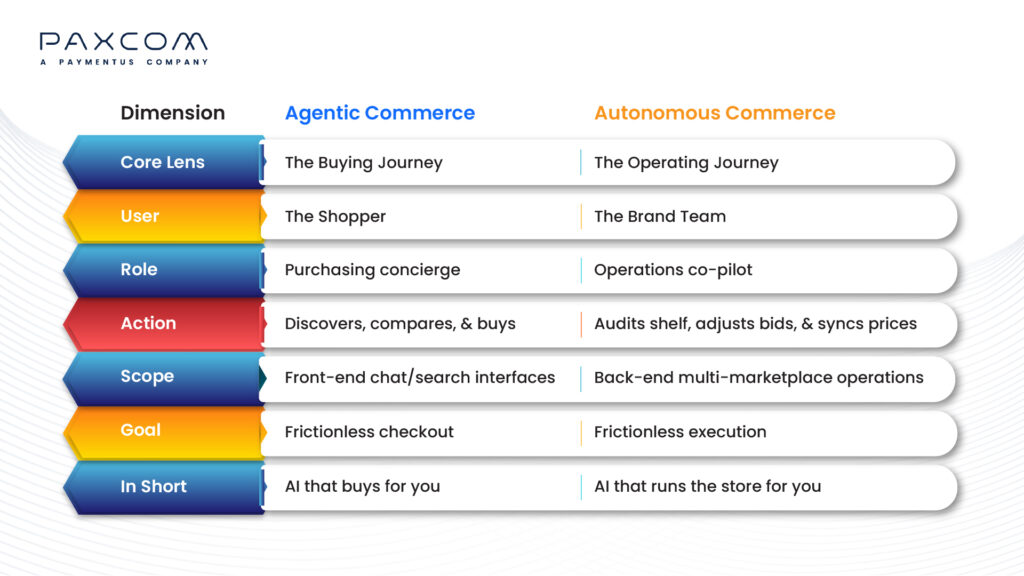
Autonomous commerce is often discussed alongside agentic commerce, but both terms are not exactly the same.
Agentic commerce usually refers to AI agents acting on behalf of shoppers or businesses. These agents may search for products, compare options, recommend purchases, negotiate, or complete transactions.
Autonomous commerce, in the context of brand operations, focuses more on how AI-enabled systems support commerce teams. These systems help brands monitor market changes, understand performance signals, prioritize decisions, and support faster execution across ecommerce operations.
In simple terms, agentic commerce is more about AI participating in the buying journey, while autonomous commerce is more about AI participating in the operating journey.
This distinction is important because most brands today are already facing operational complexity. They are not only trying to sell better. They are trying to manage pricing, availability, campaigns, content, search visibility, customer reviews, and competitor movement across multiple platforms.
Autonomous commerce helps brands manage this complexity with more speed, context, and control.
Why Autonomous Commerce Is Emerging Now
Autonomous commerce is not emerging only because AI has become popular. It is emerging because the operational complexity of commerce has increased significantly.
Modern commerce teams are expected to manage multiple marketplaces, quick commerce platforms, retail media campaigns, content consistency, pricing competitiveness, customer sentiment, inventory movement, and search visibility at the same time.
At the same time, consumer behavior has become more fragmented. A shopper may discover a product on social media, compare prices on a marketplace, check reviews on another platform, ask an AI tool for recommendations, and finally complete the purchase through quick commerce or a brand website.
This creates an environment where brands need faster awareness and better decision-making across channels.
The rise of quick commerce, AI-powered discovery, retail media networks, marketplace advertising, and omnichannel retail has added more complexity to this system. Manual commerce execution is beginning to show its limits because teams spend too much time monitoring dashboards, validating data, coordinating across functions, and reacting only after performance changes have already happened.
Autonomous commerce helps address this challenge by making commerce operations more continuous and connected.
Instead of waiting for weekly reviews or delayed reports, teams can identify important changes earlier, understand their impact faster, and take action before the opportunity window closes.
What Autonomous Commerce Looks Like in Practice
One of the biggest misconceptions around autonomous commerce is that it is purely futuristic.
In reality, many brands are already using forms of autonomous systems across commerce operations today. The difference is that these systems are increasingly becoming more connected, intelligent, and context-aware.
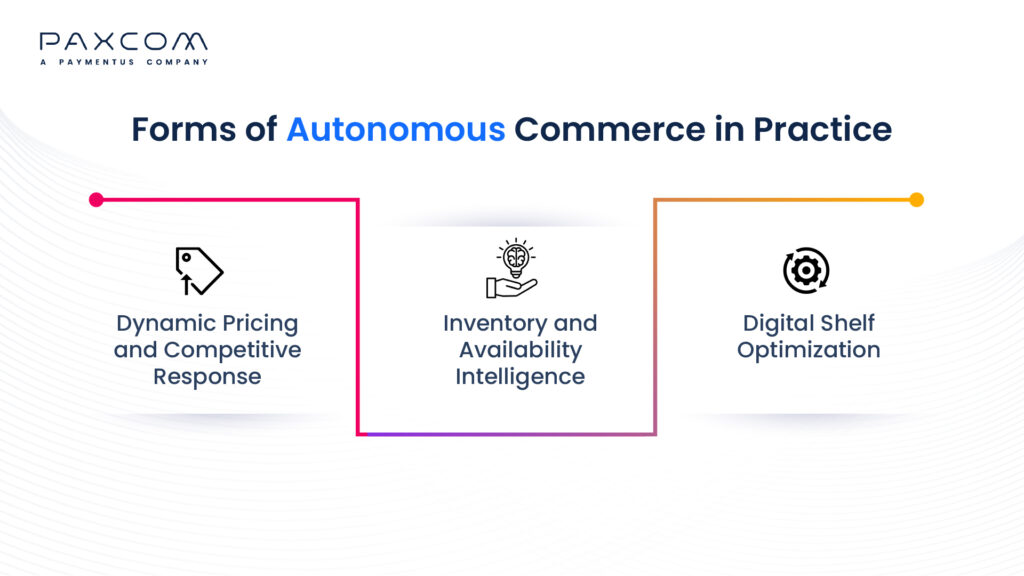
1. Dynamic Pricing & Competitive Response
Pricing has become one of the most dynamic elements of modern commerce.
On marketplaces like Amazon and Flipkart, pricing fluctuations happen constantly due to:
- promotions,
- inventory movement,
- competition,
- and demand changes.
Traditional workflows often require teams to manually monitor pricing shifts before deciding how to respond. Autonomous commerce systems simplify this process by continuously tracking pricing intelligence and identifying high-impact market changes early.
For example, if a competitor suddenly increases prices or goes out of stock, the system can identify the opportunity window immediately, helping brands respond faster with visibility, pricing, or promotional adjustments.
The value is not simply automation.It is speed-to-decision.
2. Inventory & Availability Intelligence
Stock availability directly impacts:
- visibility,
- conversion,
- advertising efficiency,
- and customer trust.
Yet many brands still identify inventory issues only after sales performance begins declining.
Autonomous commerce systems continuously monitor:
- stock movement,
- seller availability,
- and marketplace inventory signals.
This allows brands to identify:
- out-of-stock risks,
- seller inconsistencies,
- and availability gaps
before they significantly impact marketplace performance.
In fast-moving categories, even a short stock gap can influence rankings, conversions, and competitive positioning.
3. Digital Shelf Optimization
Modern digital shelves are influenced by much more than product listings alone.
Search visibility, content consistency, ratings, reviews, availability, and promotional activity all influence discoverability and conversion simultaneously.
Autonomous commerce systems help brands continuously monitor:
- search rankings,
- content health,
- catalog consistency,
- visibility trends,
- and shelf movement across marketplaces.
Instead of waiting for periodic audits, brands gain ongoing visibility into digital shelf performance. This becomes especially important as AI-powered discovery and marketplace algorithms increasingly reward
- complete product information,
- stronger customer sentiment,
- and higher operational consistency.
Campaign Management Services Are Becoming More Intelligence-Led
Campaign management services are also evolving alongside autonomous commerce systems. Traditionally, campaign optimization relied heavily on:
- historical reports,
- manual bid adjustments,
- and delayed performance analysis.
However, modern commerce environments require campaign decisions to align with:
- inventory conditions,
- visibility trends,
- pricing competitiveness,
- and conversion readiness.
As autonomous commerce capabilities mature, campaign management services are becoming more connected to live commerce intelligence rather than isolated advertising metrics alone.
This allows commerce teams to make better-informed optimization decisions while reducing operational inefficiencies.
Customer Sentiment & Experience Monitoring
Customer sentiment often reveals operational problems before performance dashboards do.
A sudden increase in negative reviews may indicate the following:
- product quality issues,
- inaccurate descriptions,
- delivery concerns,
- or catalog inconsistencies.
Autonomous commerce systems increasingly use AI-driven sentiment analysis to identify recurring customer concerns across marketplaces.
Instead of manually reviewing thousands of customer comments, brands gain structured visibility into:
- sentiment trends,
- recurring feedback themes,
- and product perception shifts.
This helps brands improve:
- product experience,
- content quality,
- and conversion performance more proactively.
The Role of an eCommerce Analytics Platform
As commerce ecosystems become more connected, the role of an eCommerce analytics platform is also evolving.
Traditionally, analytics platforms focused primarily on reporting.
- sales performance,
- advertising metrics,
- and marketplace data.
Today, brands require much more than reporting.
Modern commerce operations depend on systems capable of connecting:
- visibility signals,
- inventory intelligence,
- customer sentiment,
- campaign performance,
- pricing movement,
- and competitive insights.
This is where modern ecommerce analytics platforms are beginning to function less like dashboards and more like commerce intelligence systems.
Rather than helping teams simply “see data,” these platforms help brands:
- identify operational gaps,
- prioritize decisions,
- reduce delayed reactions,
- and improve execution speed across marketplaces.
For enterprise commerce brands, this shift is becoming increasingly important because fragmented systems often create fragmented execution.
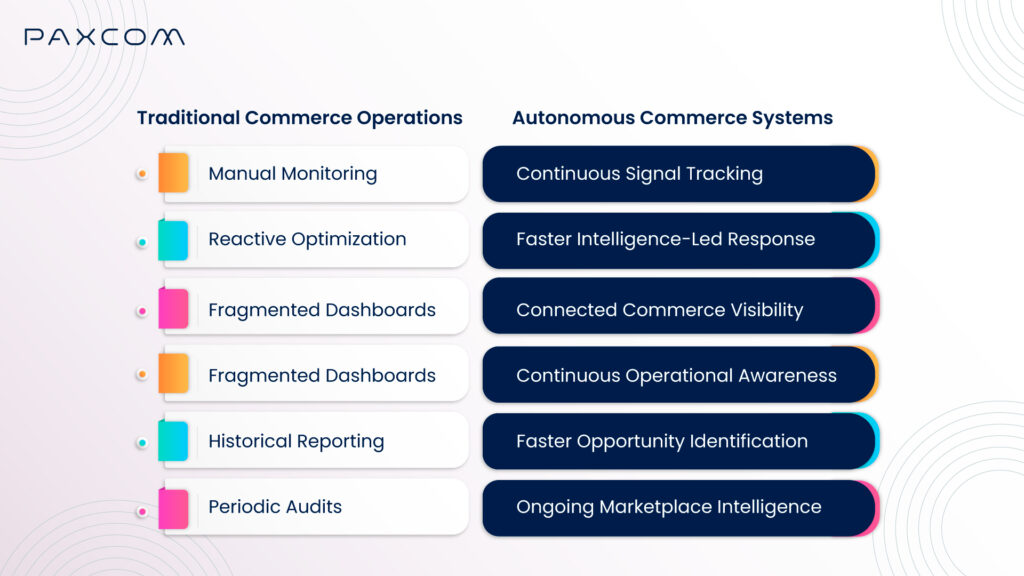
Traditional Commerce vs Autonomous Commerce
The objective of autonomous commerce is not to remove human involvement completely.
Instead, it is to help teams operate faster, smarter, and with better visibility across increasingly complex commerce environments.
Challenges Brands Must Consider
While autonomous commerce offers significant operational advantages, it is important to recognize that successful implementation depends heavily on system quality, data accuracy, and operational alignment.
One of the biggest risks is overautomation. Not every commerce decision should be fully automated. Human oversight remains critical for:
- strategic planning,
- brand positioning,
- creative direction,
- and high-impact business decisions.
Additionally, disconnected data systems can limit the effectiveness of autonomous workflows.
If inventory data, content systems, campaign reporting, and marketplace intelligence remain fragmented, automation alone cannot solve operational inefficiencies.
Brands must also focus on:
- data quality,
- workflow governance,
- and cross-functional alignment
to ensure autonomous systems generate meaningful business outcomes.
The goal should not be replacing commerce teams.
The goal should be augmenting them with faster intelligence and connected execution capabilities.
The Future of Autonomous Commerce
Autonomous commerce is still evolving, but the direction is becoming clear.
Commerce operations are moving from reporting layers to operating layers.
Earlier, brands used dashboards to understand what happened. Then analytics helped them understand why it happened. Now, AI-led systems are helping teams understand what action should happen next.
In the future, more commerce workflows will become intelligence-led. Content updates, campaign recommendations, pricing alerts, inventory actions, sentiment analysis, and marketplace execution will become more connected.
However, the winning brands will not be the ones that automate everything blindly.
They will be the ones that combine human strategy with intelligent systems.
Commerce still needs judgment. It needs brand understanding, customer empathy, pricing discipline, creative thinking, and commercial experience.
Autonomous commerce does not replace these things. It helps teams spend less time chasing information and more time acting on meaningful opportunities.
How Paxcom Helps Brands Move Toward Autonomous Commerce
Paxcom helps brands move from fragmented commerce reporting to connected commerce intelligence.
Through digital shelf analytics, marketplace monitoring, campaign intelligence, quick commerce tracking, sentiment analysis, content health tracking, and AI-led workflows, Paxcom helps commerce teams detect what changed, understand why it matters, and decide what action should follow.
For brands managing multiple marketplaces, quick commerce platforms, retail media campaigns, and content workflows, this creates a faster way to respond to market movement.
A pricing issue does not remain hidden in a spreadsheet. An availability gap does not wait for the next weekly review. A campaign inefficiency is not viewed only through ad metrics. A content issue is not discovered only after conversion drops.
Paxcom’s approach helps brands connect these signals across commerce operations so that teams can act with more speed, context, and control.
The goal is not to automate every decision. The goal is to build an intelligent commerce layer where teams know what changed, what it means, and what needs attention next.
This is where autonomous commerce becomes practical for modern brands.Not as a future concept, but as an operating advantage.
Conclusion
Modern commerce is becoming too dynamic for fragmented dashboards and delayed reactions alone.
Brands now operate in environments where pricing changes instantly, visibility fluctuates continuously, inventory shifts quickly, campaigns depend on multiple signals, and customer sentiment evolves in real time.
In this landscape, autonomous commerce is emerging as a practical operating model for modern commerce brands.
It helps teams move beyond passive reporting and toward continuous intelligence, faster decision-making, and better execution.
The future of commerce will not belong to brands with the most dashboards. It will belong to brands that can reduce the distance between signal and action.
Because the brands that win will not only be the ones that see the market clearly. They will be the ones that respond to it faster. Contact us at info@paxcom.net for more!