It is 9:07 on a Monday morning, and the sales chart has chosen violence.
Revenue is down. Not dramatically enough to trigger panic, but just enough to invite a meeting.
The media team arrives with a healthy ROAS. The content team confirms that every product page is complete. The supply team says inventory looks fine. Pricing remains competitive. Search rankings appear stable, mostly.
Everyone has a dashboard. No one has an answer.
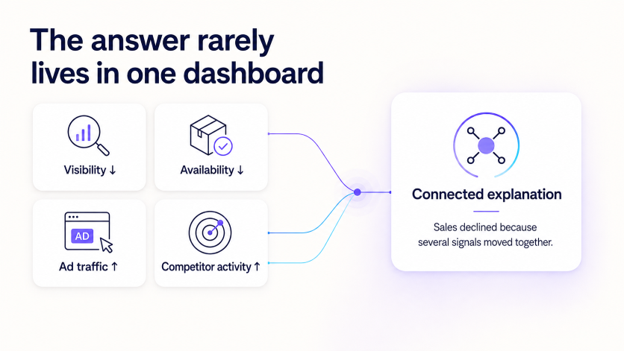
Then somebody notices that the product disappeared from several high-demand locations over the weekend. A competitor had moved above it in search results a few days earlier. Paid traffic continued to arrive, but more shoppers met an unavailable product, or a better-looking alternative.
Nothing had failed spectacularly. Several trivial things had simply happened together.
That is how many eCommerce problems hide: in the space between dashboards.
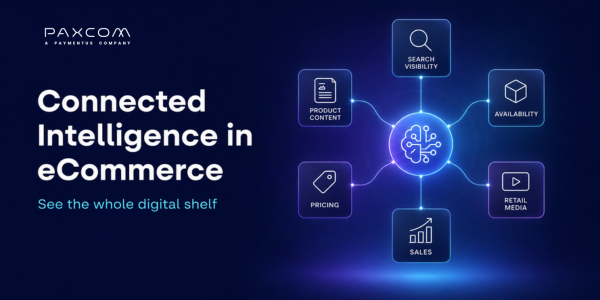
Brands already collect an extraordinary amount of commerce data. The harder task is seeing how one change travels through the rest of the business. Search visibility affects traffic. Availability influences conversion. Pricing changes the value of every ad click. Content shapes whether discovery becomes a purchase. Promotions may lift orders while quietly weakening profitability.
A unified view of the digital shelf connects these movements, giving teams the context to understand what changed, why it matters, and where to respond.
The Digital Shelf Has Outgrown the Dashboard
The digital shelf once referred mainly to how a product appeared on an online marketplace. Today, it spans marketplaces, quick-commerce apps, D2C websites, search results, retail media, dark stores, ratings, reviews, pricing, promotions, content, and local availability.
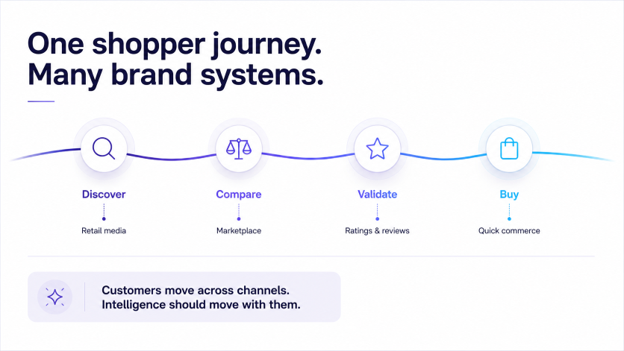
The shopper moves through all of them without respecting the neat boundaries inside an organisation.
They may discover a product through an ad, compare it with a competitor on a marketplace, check reviews, and finally order it from a quick-commerce app because delivery takes ten minutes. To them, this is one buying journey. Inside the brand, however, each moment may belong to a different team, platform, report, or agency.
That separation creates blind spots.
A sales report can show the decline, but not necessarily its cause. Search data may reveal lost visibility without showing that the affected SKU was also unavailable in key cities. A campaign dashboard can celebrate efficient clicks while the product page loses conversions to a competitor with stronger images, better reviews, or a sharper offer.
Read independently, every signal offers a partial explanation. Read together, they reveal the commercial story.
One Problem Rarely Stays in One Column
Suppose a product page passes its content audit. The title is accurate, images are present, specifications are complete, and the brand message is consistent. Yet conversion continues to slip.
The issue may be hiding in comparison rather than compliance. Competitors may have introduced clearer visuals, richer claims, stronger review momentum, or more persuasive offers. The page has not deteriorated; the shelf around it has improved.
Now consider a product that ranks prominently for important search terms but produces disappointing sales. Visibility appears healthy, so the instinct may be to revisit the media plan. Location-level availability tells a different story. If the SKU is missing from dark stores serving areas with high demand, more exposure will only send more shoppers towards a dead end.
Advertising creates another trap. A campaign may maintain its ROAS even as conversion softens. Perhaps a competitor has reduced its price. Perhaps the promoted SKU is intermittently unavailable. Perhaps organic visibility has weakened, leaving paid media to carry more of the journey. Optimising bids alone will not solve any of those problems.
Promotions can be equally deceptive. A campaign may generate an impressive sales spike, then lose some of its value through mismatched claims, deductions, dates, rates, products, or locations. The revenue appears in one system: the leakage surfaces somewhere else, often weeks later.
Connected intelligence brings these relationships into view before teams spend time fixing the most visible symptom.
Stop Asking Only What Happened on a Channel?
“What happened on Amazon?” remains a useful question. It is simply no longer enough.
A stronger question asks what happened to the business across commerce and which signals moved together.
A brand could be gaining marketplace revenue while losing quick-commerce availability in its fastest-growing cities. Retail media may be performing well while organic discoverability steadily declines. Inventory may look sufficient at a national level even though the product is unavailable precisely where demand is strongest. Promotions may increase gross sales without delivering the expected net outcome.
Channel reports cannot always expose these contradictions because each one is doing exactly what it was designed to do: describe its own territory.
Connected intelligence preserves that detail while adding a shared layer across it. Content, search, availability, pricing, promotions, retail media, competition, and sales can then be interpreted as parts of the same commercial system.
The result is not another enormous dashboard for everyone to politely ignore. It is a clearer chain of cause and effect.
From a Metric to a Decision
A conventional alert might say:
Sales declined by 12%.
Useful, but incomplete. The next question arrives immediately: why?
A connected view can add the missing context:
Sales declined by 12% after availability fell in high-demand locations and competitor visibility increased for priority search terms.
Now the conversation changes. Instead of debating which team owns the problem, the brand can investigate replenishment, restore local availability, examine lost search positions, and adjust media activity around the affected SKUs.
This is the practical value of connected intelligence. It shortens the distance between noticing a change and deciding what to do about it.
Where AI Changes the Pace
Commerce teams do not suffer from a shortage of reports. They suffer from the time required to compare them, find meaningful relationships, and separate genuine risks from ordinary movement.
AI can help analyse signals across sources and surface patterns that are difficult to spot manually. It can detect unusual shifts, connect related events, prioritise exceptions, and recommend areas for investigation. Instead of expecting teams to hunt through every SKU, location, channel, keyword, campaign, and competitor, intelligence can direct attention towards the combinations most likely to affect the business.
The journey begins with monitoring, but it should not end there:
Monitor → Connect → Explain → Recommend → Act.
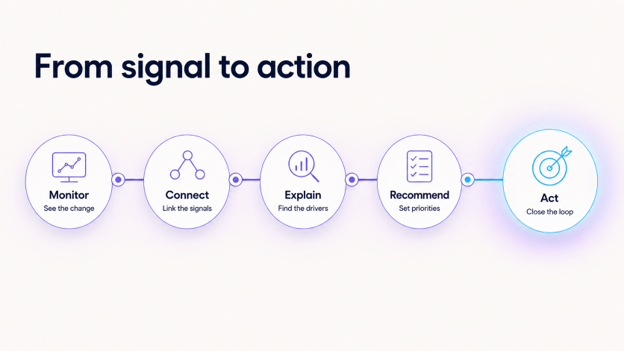
Each step removes some of the friction between data and execution. Monitoring shows the movement. Connection adds surrounding signals. Explanation offers likely drivers. Recommendations help teams prioritise. Action closes the loop.
Human judgement still matters. A useful AI system should give commerce teams sharper context and faster ways to respond, not bury decisions inside an unexplained black box. The strongest approach combines automation with the experience of people who understand the category, customer, channel, and commercial objective.
Building a Commerce System That Can See Across Silos
Paxcom helps global brands connect intelligence and execution across the commerce journey.
Through the Paxcom Commerce Engine and its wider AI ecosystem, brands can bring together signals from marketplaces, quick commerce, dark stores, content, search visibility, pricing, promotions, retail media, competition, and sales. AI Engines can then support the next layer of work: detecting what deserves attention, interpreting why it may be happening, and helping teams move towards action.
This reflects a larger shift in how commerce technology should serve the business. Instead of adding isolated tools to an already crowded stack, brands need an operating layer that can understand activity across functions and turn scattered inputs into coordinated decisions.
The objective is not more data. Most teams passed that milestone years ago.
What they need now is continuity—from signal to insight, and from insight to execution.
Because when sales begin to fall at 9:07 on a Monday morning, the answer should not require six dashboards, four teams, and a very tense spreadsheet.
It should already be connected.
Ready to see the whole commerce picture? Talk to Paxcom about building a connected intelligence layer for your digital shelf.
Frequently Asked Questions
What is connected intelligence in eCommerce?
Connected intelligence in eCommerce brings together data and insights from different commerce channels and business functions to create a more unified view of performance and support better decision-making.
What is digital shelf intelligence?
Digital shelf intelligence involves monitoring and analysing factors that influence online product performance, including content, search visibility, pricing, availability, ratings, reviews, promotions, and retail media.
Why is a unified view of the digital shelf important?
Shoppers move across channels, while commerce data often remains divided among teams and systems. A unified view helps brands identify relationships that individual reports may miss for example, paid traffic weakening because of local stockouts, or conversion declining after competitors improve their content and offers.
How can AI improve digital shelf intelligence?
AI can analyse large volumes of digital shelf data, identify patterns, detect anomalies, connect signals across channels, and surface recommendations that help brands respond more effectively.
Does connected intelligence replace channel-level reporting?
No. Channel-level reporting still provides essential detail. Connected intelligence adds a cross-channel layer so teams can interpret those reports together and understand their combined effect on the business.
How does Paxcom support connected commerce intelligence?
Paxcom brings together commerce intelligence, AI, and execution across digital shelf monitoring, quick commerce, content, pricing, promotions, retail media, and marketplace operations. Its Commerce Engine and wider AI ecosystem help brands move from fragmented signals towards coordinated decisions and action