Quick Commerce has transformed the way consumers shop, but it has also changed how brands need to measure success. Here’s why Dark Store Intelligence is becoming a strategic capability for brands looking to improve availability, visibility, and performance across India’s rapidly expanding quick commerce ecosystem.
Two Orders. One Platform. Two Completely Different Outcomes.
Scenario 1: The Customer’s Experience
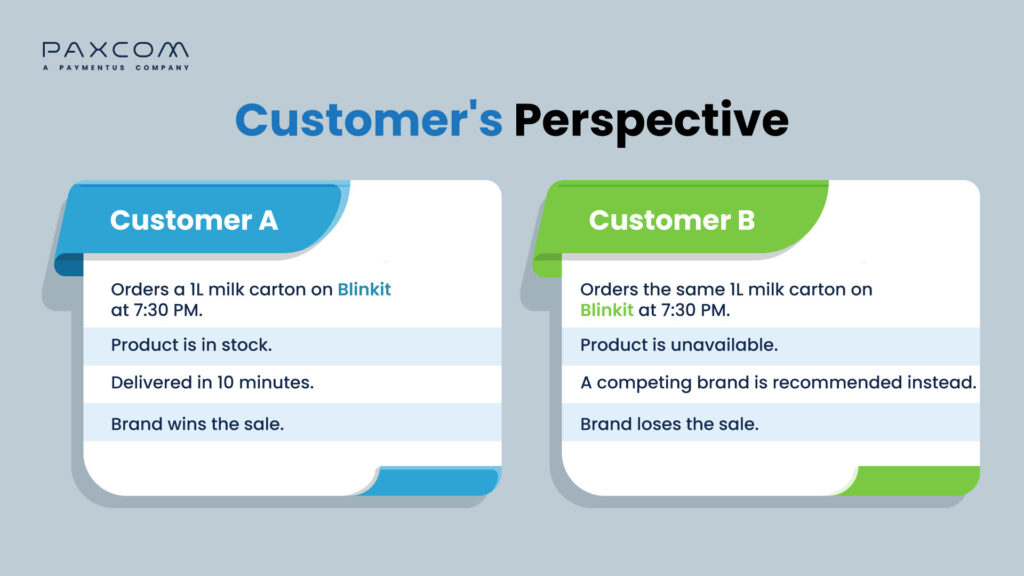
Both customers use the same platform. Both live in the same city. The only difference is the dark store fulfilling the order.
Scenario 2: The Brand’s Perspective
Later that week, the brand reviewed its Quick Commerce dashboard.
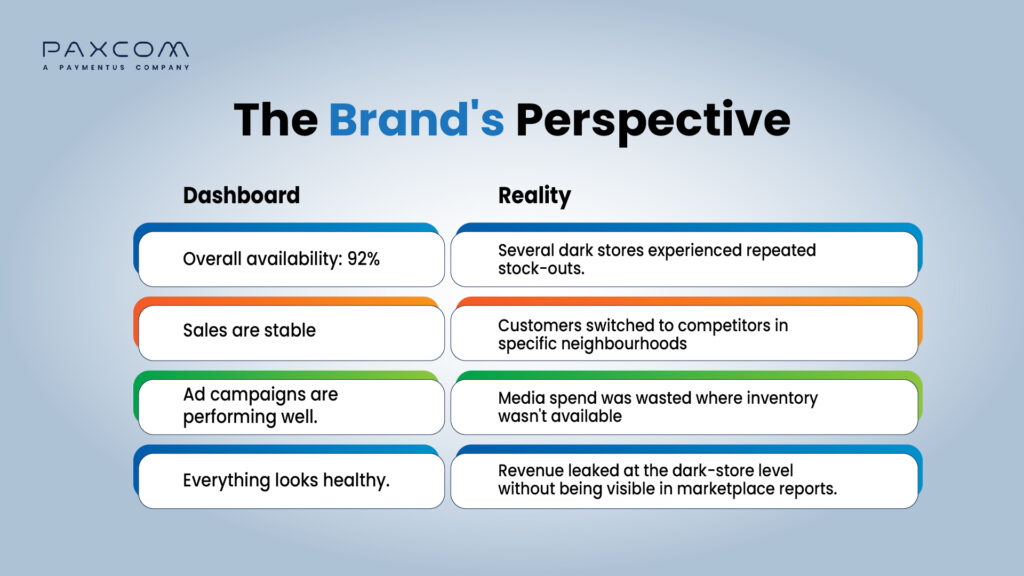
Marketplace analytics revealed the outcome but not the root cause behind it.
This is no longer an isolated operational issue. It reflects how India’s Quick Commerce ecosystem functions today. As dark-store networks expand across the country, brands are no longer competing only on marketplaces. They are competing across thousands of fulfilment centres, each influencing product availability, assortment, visibility, and ultimately, customer purchase decisions.
The Rise of India’s Dark Store Economy
Quick Commerce has evolved far beyond being a faster alternative to traditional eCommerce. It has fundamentally changed the operating model for brands.
A few years ago, brands primarily optimized their performance at the marketplace level. Success was measured through platform-wide metrics such as sales, share of search, advertising ROI, and product availability. These indicators were sufficient because marketplaces operated through centralized fulfilment networks, where inventory and demand could be assessed at a broader level.
Today, India’s leading Quick Commerce platforms operate through extensive networks of dark stores that function as independent fulfilment centres. Blinkit operates 2,243 dark stores, while Swiggy Instamart and Zepto each have more than 1,100. Flipkart Minutes has crossed 1,000 micro-fulfilment centres in under two years, and Amazon Now and BigBasket continue expanding their own rapid-delivery infrastructure. Even category-focused platforms such as Myntra M-Now have invested in dedicated fulfillment networks to support faster deliveries.
Collectively, these platforms now operate well over 7,000 fulfilment points across the country. Every one of them carries its own inventory, serves a unique catchment area, and responds to local demand differently.
For consumers, this infrastructure delivers groceries, electronics, beauty products, fashion, and everyday essentials in minutes.
For brands, it creates an entirely new operational challenge.
Success in Quick Commerce is no longer determined only by being present on Blinkit, Zepto, or Instamart. It depends on how consistently products are available, discoverable, and replenished across thousands of individual dark stores.
This marks one of the biggest structural shifts in digital commerce. Competition has moved from the marketplace to the fulfilment centre.
The Hyperlocal Visibility Gap
Quick Commerce operates differently from traditional eCommerce because every customer order is fulfilled by a nearby dark store.
A customer searching for the same product on the same platform can receive two completely different experiences depending on which fulfilment centre serves their location.
One customer may see your product in stock with multiple pack sizes available.
Another customer, just a few kilometres away, may see the product marked as unavailable.
Neither experience is incorrect.
They simply reflect two different dark stores.
This creates what we call the Hyperlocal Visibility Gap.
It is the difference between how a brand appears to perform at the marketplace level and how it actually performs across individual dark stores.
For many brands, this gap remains invisible until declining availability, missed sales opportunities, or increasing customer substitution begin affecting business performance.
As Quick Commerce expands into more cities and neighbourhoods, this visibility gap becomes increasingly difficult to manage using conventional reporting.
Every Dark Store Is Its Own Market
One of the biggest misconceptions about Quick Commerce is that all dark stores within a platform operate in the same way.
They don’t.
A Blinkit dark store serving a premium residential neighbourhood may see significantly higher demand for organic foods, protein supplements, imported snacks, and premium personal care products.
Another Blinkit dark store a few kilometres away may primarily fulfil orders for household essentials, packaged foods, and value-driven grocery items.
Although both stores belong to the same platform, they function as entirely different commercial environments.
This has important implications for brands. A city-wide availability score may appear healthy while specific neighbourhoods continue experiencing recurring stock-outs.
Advertising campaigns may perform well overall while underperforming in locations where inventory is inconsistent. New product launches may succeed in one cluster of dark stores but struggle in another because assortment decisions differ.
When viewed collectively, these differences become difficult to detect. When viewed at the dark-store level, they become actionable.
That is why Quick Commerce strategy increasingly depends on understanding individual fulfilment locations rather than relying solely on marketplace-wide averages.
What Is Dark Store Intelligence?
As Quick Commerce networks become larger and more fragmented, brands need a more granular way to understand performance.
This is where Dark Store Intelligence comes in.
Dark Store Intelligence is the practice of monitoring, analysing, and optimising product availability, assortment, visibility, and performance at the individual dark store level across Quick Commerce platforms.
Unlike traditional marketplace analytics, Dark Store Intelligence focuses on where business outcomes are actually created.
Instead of asking:
“How is my brand performing on Blinkit?”
Brands can begin asking more operationally relevant questions.
- Which dark stores experience the highest stock-out frequency?
- Which fulfilment centres carry an incomplete assortment?
- Where are competitors consistently outperforming us?
- Which dark stores require faster replenishment?
- Which locations generate the highest sales velocity?
These questions shift decision-making from broad marketplace reporting to hyperlocal execution.
For category managers, revenue teams, and supply chain planners, that difference is significant. It enables decisions that are based on individual fulfilment behaviour rather than platform-wide averages.
Dark Store Tracking vs. Dark Store Intelligence
Many brands have already started investing in dark store tracking.
Tracking is an important first step.
It helps teams monitor product availability, identify stock-outs, and understand whether products are listed across different Quick Commerce platforms.
However, tracking alone answers only part of the problem.
Dark Store Intelligence goes several steps further.
It connects operational signals with business outcomes and enables brands to act on what they discover.
Dark Store Tracking | Dark Store Intelligence |
Identifies stock-outs | Explains why stock-outs occur |
Monitors product availability | Improves availability through actionable insights |
Reports operational data | Connects operational data with business performance |
Focuses on individual events | Identifies recurring patterns across dark stores |
Helps teams observe | Helps teams make better decisions |
As Quick Commerce continues to scale, the difference between tracking and intelligence will become increasingly important.
Brands will not gain a competitive advantage simply by collecting more data.
They will gain it by understanding which dark stores require attention, why performance differs across locations, and what actions improve outcomes consistently.
Dark Store Intelligence provides that missing layer.
The Five Intelligence Layers Behind Every Successful Quick Commerce Strategy
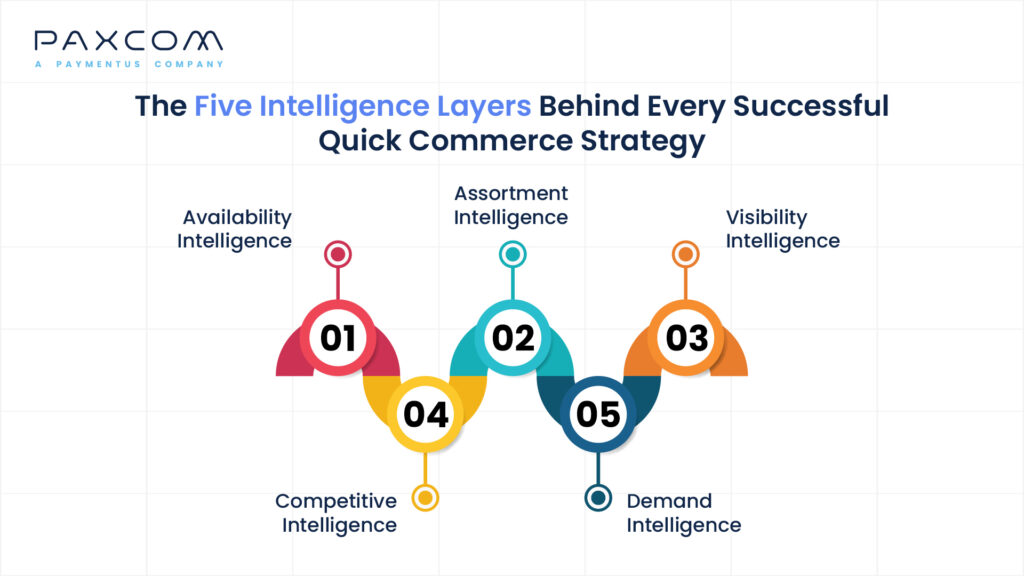
Dark Store Intelligence is often associated with inventory visibility, but its role extends much further. It enables brands to make better commercial decisions by providing visibility into how products perform across individual fulfilment centres. Together, these five intelligence layers help brands move from reactive reporting to proactive execution.
1. Availability Intelligence
Availability remains the most fundamental metric in Quick Commerce. If a product is unavailable at the assigned dark store, the sale is often lost within seconds.
Availability Intelligence goes beyond measuring stock-outs. It identifies recurring fulfilment gaps, highlights stores with inconsistent inventory, and pinpoints locations where demand consistently exceeds supply. This enables supply chain and category teams to prioritise replenishment where it matters most, reducing lost sales and improving service levels.
2. Assortment Intelligence
A common assumption is that every dark store should carry the same assortment. In reality, customer preferences vary significantly across neighbourhoods.
Dark Store Intelligence helps brands understand which SKUs perform best in specific locations and where assortment gaps exist. Instead of distributing products uniformly, brands can optimize assortment based on hyperlocal demand, improving inventory productivity while reducing slow-moving stock.
3. Visibility Intelligence
In Quick Commerce, availability alone does not guarantee sales.
Products need to be visible when customers search, browse categories, or explore curated collections. Changes in search rankings, category placement, or merchandising can directly influence conversion, even when inventory is available.
Visibility Intelligence enables brands to monitor product discoverability across dark stores and identify locations where visibility improvements can drive incremental sales.
4. Competitive Intelligence
Competition in Quick Commerce is increasingly hyperlocal.
A competing brand may dominate one cluster of dark stores while having minimal presence in another. Promotions, assortment, pricing, and availability often differ between fulfilment centres, creating localised competitive dynamics.
Dark Store Intelligence enables brands to benchmark competitor presence across locations, helping commercial teams make informed decisions around promotions, assortment expansion, and market prioritisation.
5. Demand Intelligence
Demand in Quick Commerce changes faster than traditional retail.
Festivals, weekends, weather, local events, and consumer behaviour all influence purchasing patterns at the neighbourhood level.
Demand Intelligence helps brands identify high-velocity stores, emerging demand clusters, and shifting consumption patterns. These insights improve forecasting, inventory planning, and product launches while reducing operational inefficiencies.
Why Does Dark Store Intelligence Change Quick Commerce Strategy?
The role of Dark Store Intelligence extends well beyond operational reporting.
It changes how brands make decisions.
Instead of relying solely on marketplace-level dashboards, commercial teams gain the ability to answer questions that directly influence growth.
- Which dark stores require immediate replenishment?
- Which locations consistently experience stock-outs?
- Where should new SKUs be introduced first?
- Which neighbourhoods justify additional advertising investment?
- Where are competitors gaining share through stronger assortment or availability?
- Which fulfilment centres consistently outperform the city average?
These insights enable brands to move from reactive decision-making to proactive execution.
Marketplace analytics explain performance;Dark Store Intelligence explains performance in context.
That distinction becomes increasingly important as Quick Commerce networks continue expanding.
From Marketplace Strategy to Dark Store Strategy
The next phase of Quick Commerce growth will not be driven solely by expanding to more platforms.
Most leading brands already sell across Blinkit, Zepto, Swiggy Instamart, Flipkart Minutes, Amazon Now, and BigBasket.
The competitive advantage now lies in executing better within those platforms.
That requires a shift in thinking.
Traditional eCommerce | Quick Commerce |
Optimise marketplace performance | Optimise dark store performance |
Measure platform-wide availability | Measure dark store availability |
Regional assortment planning | Hyperlocal assortment planning |
Broad inventory allocation | Dark-store-level replenishment |
Marketplace reporting | Hyperlocal decision-making |
This shift reflects how Quick Commerce has evolved. Brands are no longer competing only for visibility across platforms. They are competing for availability, discoverability, and operational excellence across thousands of individual fulfilment centres.
The Next Competitive Advantage Isn’t More Platforms
As India’s Quick Commerce ecosystem expands, the question is no longer whether a brand should be present on another platform.
The more important question is whether the brand understands how it is performing across the platforms it already operates on.
Adding another marketplace increases reach.Improving execution across existing dark stores increases profitability. Brands that can identify availability gaps, optimize assortment, monitor competition, and respond to local demand faster will consistently outperform those relying on aggregated marketplace reports.
The opportunity is no longer platform expansion.
It is operational precision.
Conclusion
Quick Commerce has fundamentally changed the unit of competition.
A customer does not purchase from a marketplace.
The purchase is fulfilled by a single dark store serving that customer’s location.
That fulfilment centre determines whether the product is available, whether it appears in search, whether the assortment meets local demand, and whether the sale happens at all.
As dark-store networks continue expanding across India, marketplace-level reporting will only provide part of the picture. The future of Quick Commerce will belong to brands that think beyond platforms and manage performance one dark store at a time.
Contact us at info@paxcom.net for more information.
Frequently Asked Questions
What is Dark Store Intelligence?
Dark Store Intelligence is the practice of monitoring and analysing product availability, assortment, visibility, demand, and competitive performance across individual dark stores to improve decision-making in Quick Commerce.
How is Dark Store Intelligence different from dark store tracking?
Dark store tracking focuses on monitoring operational metrics such as product availability and stock-outs. Dark Store Intelligence goes a step further by connecting those metrics with business outcomes, helping brands improve replenishment, assortment, visibility, and overall Quick Commerce strategy.
Why is dark store visibility important?
Dark store visibility helps brands identify where products are unavailable, where assortment gaps exist, and where competitors are outperforming them. This enables faster corrective action and improves sales performance across Quick Commerce platforms.
How can brands improve dark store operations?
Brands can improve dark store operations by monitoring inventory health, optimising assortment based on local demand, strengthening replenishment planning, tracking competitor activity, and using Dark Store Intelligence to identify recurring operational gaps.
What metrics should brands monitor across dark stores?
Key metrics include product availability, stock-out frequency, assortment coverage, search visibility, demand velocity, competitor presence, replenishment efficiency, and promotional performance at the dark-store level.
Why is Dark Store Intelligence becoming essential for Quick Commerce?
As Quick Commerce platforms continue expanding their dark-store networks, marketplace-level reporting no longer provides enough visibility. Dark Store Intelligence enables brands to understand performance at the fulfilment-centre level, leading to better operational decisions and improved business outcomes.